
On this page
When do you need an emission measurement?
- Checking permit conditions. The environmental permit says what is to be measured, the emission limit values and how often they are to be checked.
- Medium combustion plants (1–50 MW) under the Swedish Ordinance on Medium Combustion Plants (SFS 2018:471): periodic measurement at least every three years up to 20 MW and every year above 20 MW.
- Large combustion plants and waste incineration (the Swedish ordinances SFS 2013:252 and 2013:253): continuous measuring systems that must be calibrated and checked with QAL2 and AST.
- The Swedish NOx charge. Boilers, gas turbines and engines that produce at least 25 GWh of useful energy per year need a NOx comparison measurement every year.
- Performance tests after a new build or a rebuild, when the supplier's guarantee values are to be demonstrated.
- Process control: troubleshooting filters and flue gas cleaning equipment, a new fuel mix or the basis for an investment.
What can we measure?
These are the most common parameters, with the standards we measure to. Every method, with its accreditation status row by row, is in the table of all parameters.
| Parameter | Standard |
|---|---|
| Dust | EN 13284-1 |
| NOx | EN 14792 · SS 028425 |
| SO2 | ISO 7935 · EN 14791 |
| SO3 | In-house method (isopropanol) |
| HCl | EN 1911 |
| HBr | EN 1911 (by analogy) |
| HCN | EEM 2015 ch. 5.16 |
| HF | ISO 15713 |
| NH3 | EN ISO 21877 |
| TOC | EN 12619 · SS 028427 |
| NMHC | EN ISO 25140 |
| CO | EN 15058 |
| Metals | EN 14385 |
| Mercury | EN 13211 |
| Dioxins | EN 1948-1 · EN 1948-4 |
| PAH | ISO 11338-1 |
| N2O | EN ISO 21258 |
| CH4 | EN ISO 25140 |
| Particle size | Method chosen case by case |
| Gas flow | ISO 10780 · EN ISO 16911-1 · EN ISO 16911-2 · EEM 2015 ch. 5.29 |
| Moisture | EN 14790 · EN 14790 (calculation) |
| O2 and CO2 | EN 14789 · ISO 12039 |
| H2S | VDI 3486-2 |
| Biogenic CO2 | EN ISO 13833 |
Cannot find what you want to measure? The table of all parameters lists every method, with its accreditation status row by row.
How is an emission measurement done?
Enquiry and measurement programme
You tell us about the plant and what is to be measured. We propose a measurement programme based on the permit (parameters, operating conditions and number of sub-samples) and send a quote.
The measurement site
Sampling ports, a platform and electricity must be in place according to EN 15259. Send us pictures in advance if you can, and we will tell you whether anything needs to be fixed before we arrive.
Measurement on site
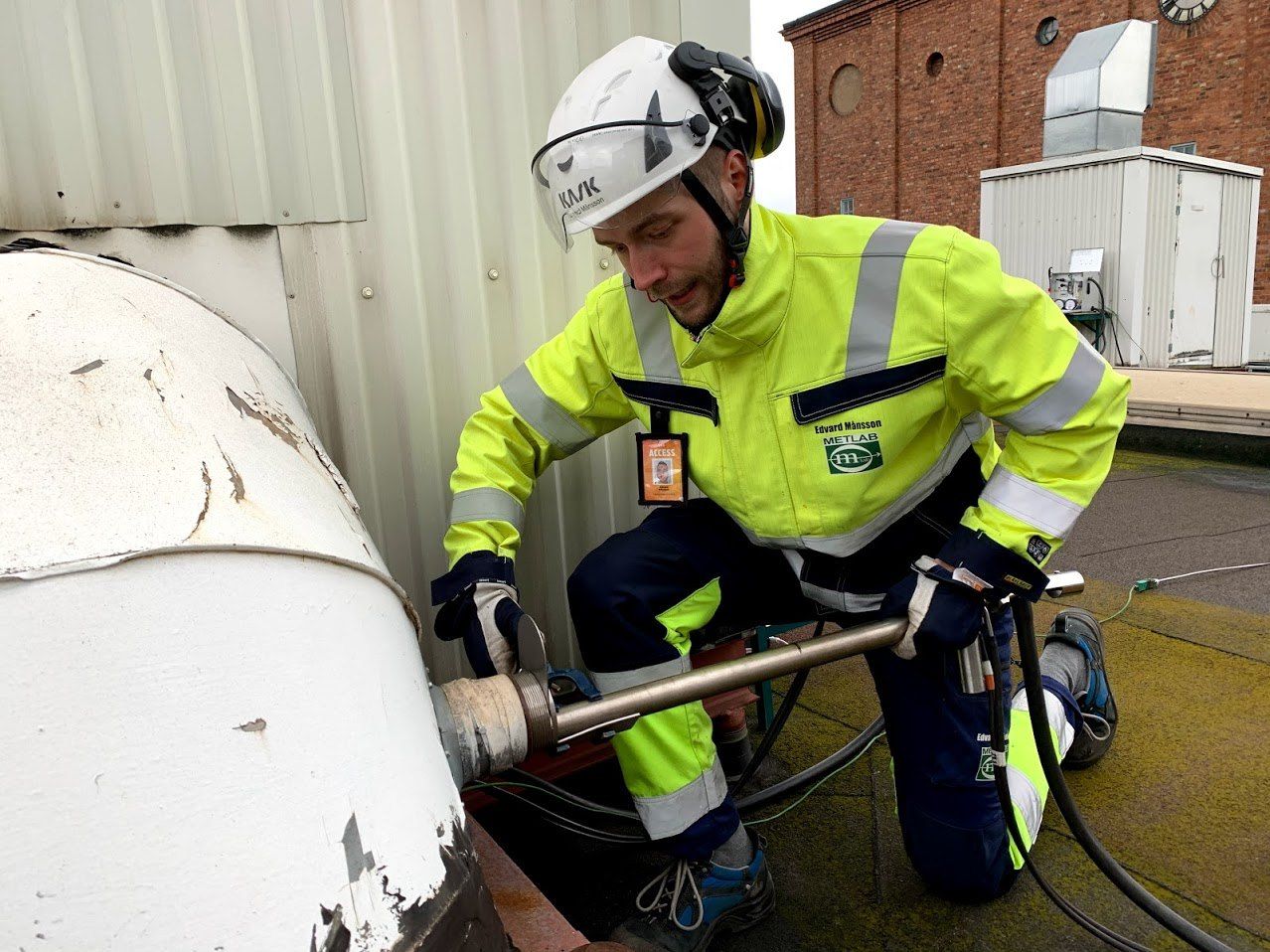
Our measurement engineers measure with standard reference methods, often several parameters at the same time, while the plant runs in the operating conditions that are to be checked.
Analysis
The samples are analysed in our own laboratory or by an accredited laboratory we engage.
Report
The results are converted to the plant's reference conditions, with measurement uncertainty, and delivered as an accredited, digitally signed report, normally within 3–4 weeks.
What does an emission measurement cost?
The price depends on the number of stacks or ducts and operating conditions, how many parameters are measured at the same time, which analyses are needed, the conditions at the measurement site and the travel distance. A dust measurement at one sampling location costs about SEK 15,000–30,000 and a periodic measurement of dust, NOx and CO on one boiler SEK 15,000–35,000, excluding VAT and travel. A larger programme with gases, metals and dioxins costs more, but the price per parameter is lower when a lot is measured on the same visit. Read the price guide or request a quote – we reply within two working days.
How often should you measure?
As often as the permit or the ordinance requires. Medium combustion plants measure at least every three years up to 20 MW and every year above 20 MW. Plants with continuous measuring systems do an AST every year and a QAL2 at least every five years. The comparison measurement for the Swedish NOx charge is done at least once per calendar year. If the permit says nothing about how often, ask the supervisory authority – or us.
We measure across Sweden
METLAB measures emissions at plants across Sweden, from Skåne to Norrbotten. The technicians work from the offices in Enköping, Falun and Skellefteå and measure the same way wherever the plant is: the same methods, the same report.
Stockholm, Gothenburg, Malmö or a mill town far from the nearest city: we come to you. What sets the schedule is when the plant can run at the load the measurement is to represent. Request a quote or contact the nearest office.
Measure yourself
-
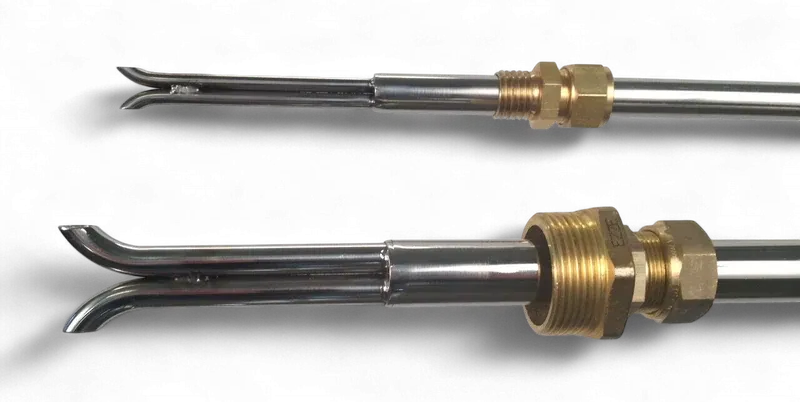 S-type pitot tube
Pitot tube with an accredited calibration certificate
ISO 16911-1. Length 300–4,000 mm, stainless steel or Inconel, connectors of your choice.
-
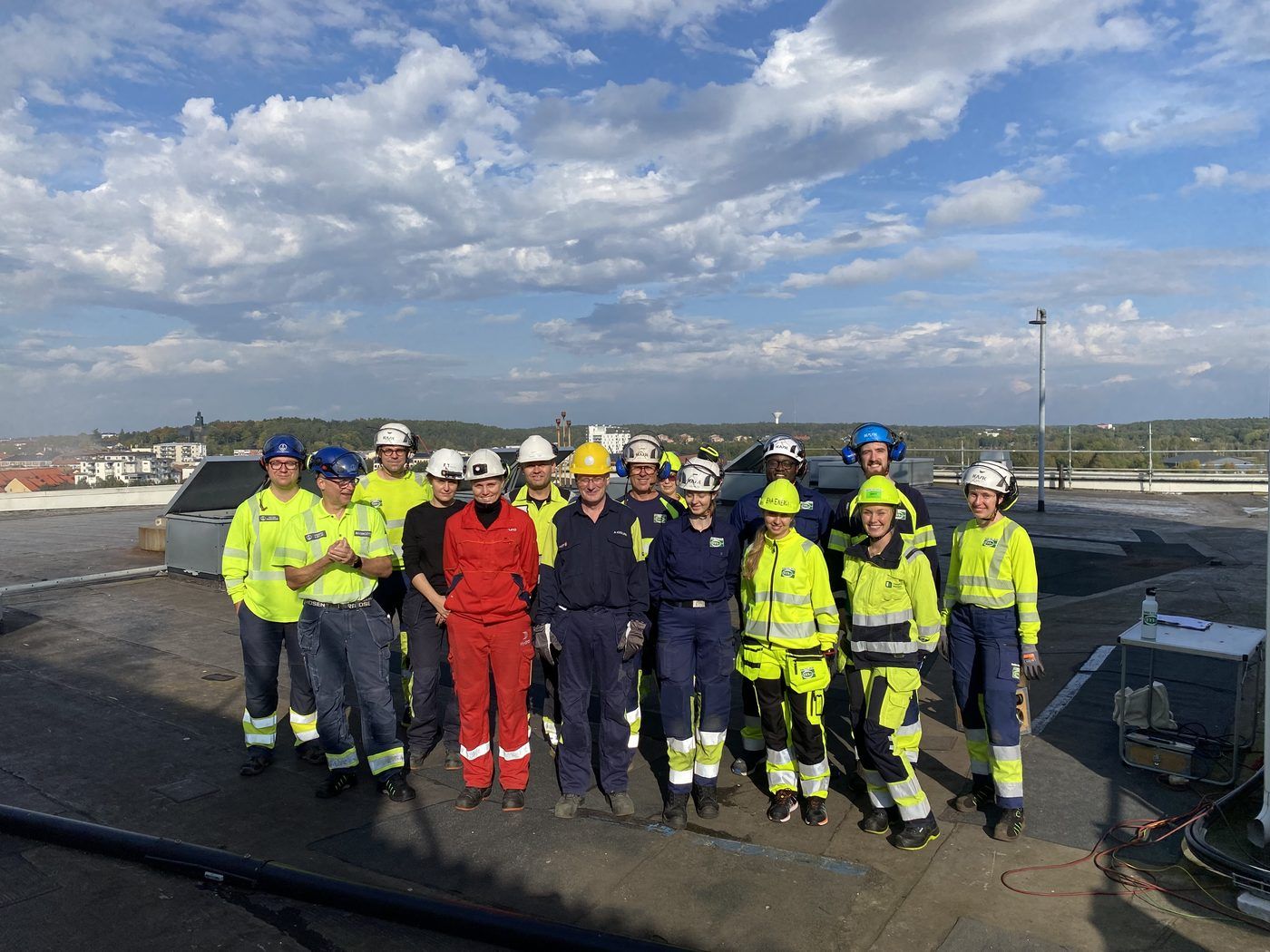 Course · METLAB Academy
Dust sampling and gas flow measurement
Two days of theory and field exercises with our measurement engineers. The next course is planned once enough people have registered their interest.
Frequently asked questions about emission measurement
What is the difference between an emission measurement and continuous measurement?
An emission measurement is made on one occasion with standard reference methods and gives an accredited result for those particular operating conditions. A continuous measuring system (an automated measuring system, AMS) measures all the time, but it has to be calibrated and checked against the standard reference methods – that is what QAL2 and AST do.
Who may carry out emission measurements?
The permit or the ordinance usually requires an accredited laboratory. METLAB is accredited by Swedac according to ISO/IEC 17025. The methods covered are listed in the table of all parameters.
Does the plant have to run at full load?
The measurement is made in the operating conditions that the permit or the purpose specifies, often normal operation or full load. We agree the operating conditions with you in advance so that the result is representative.
How do we prepare the measurement site?
Sampling ports, a platform, electricity and safe access according to EN 15259. Send us pictures in advance if you can, and we will tell you whether anything needs to be fixed before we arrive.
Can you measure several parameters at the same time?
Yes, and it is usually cheaper per parameter. Dust, gases, metals and flow are often measured on the same visit.
How soon do we get the report?
Normally within three to four weeks of the measurement. If you have a deadline, for example for the annual environmental report, tell us when you order.