
On this page
When do you need to measure the moisture content?
- Conversion to dry gas. Concentrations measured in wet gas, for example TOC with a flame ionisation detector and automated measuring systems that measure directly in the flue gas, are converted with the moisture content.
- Gas flow. The moisture content is part of the gas density in pitot tube measurement, and the gas flow is converted to dry gas with it.
- Isokinetic sampling. When sampling dust, metals and dioxins, the moisture content is needed to choose the nozzle and the sample gas flow.
- Checking automated measuring systems. The plant's moisture monitor is checked against EN 14790, suitably at QAL2 and AST. If the NOx emission is calculated in wet gas, the moisture content is also determined at the comparison measurement.
- Flue gas loss and energy balance: the moisture content is needed for the heat capacity of the gas and for moisture and energy balances.
How the sampling train is built
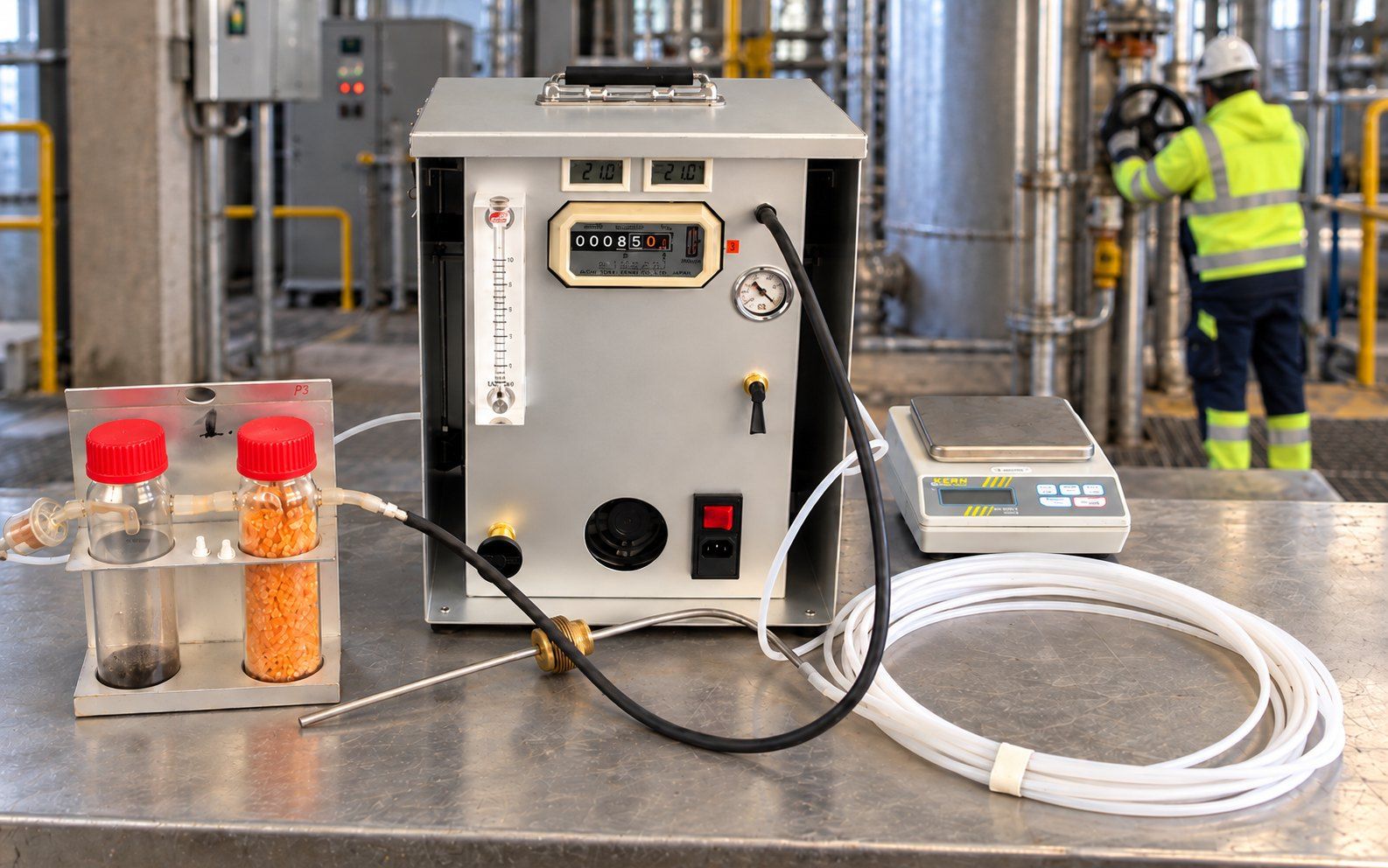
The moisture content is determined gravimetrically. The sample gas is drawn out through a heated probe with a filter to a condensate bottle in a cooling bath, where most of the water vapour condenses. The rest is taken up by silica gel in a drying tower. The dry gas passes through a valve, a pump and a flow meter to a dry gas meter with a thermometer. The bottle and the drying tower are weighed before and after the sample.
- 1. Probe with filter holder, heated
- 2. Condensate bottle in a cooling bath, weighed before and after the sample
- 3. Drying tower with silica gel, weighed before and after the sample
- 4. Valve
- 5. Sampling pump
- 6. Flow meter
- 7. Gas meter
- 8. Thermometer at the gas meter
All the water must end up in the parts that are weighed. That is why the probe and filter are heated, and the tube is laid with a fall to the condensate bottle and is preferably shorter than 10 metres.
How is a moisture measurement done?
Planning and measurement point
If the flue gas is homogeneous in the measurement plane, one measurement point is enough; otherwise several are sampled. The result is the mean of at least two sub-samples under the same operating condition.
Weighing and leak test
The condensate bottle and the desiccant are weighed, and the probe and filter are heated to at least 120 °C and above the acid dew point. Before every sub-sample the probe inlet is blocked: the leak rate may be at most 2 % of the sample gas flow.
Sampling
Sample gas is drawn out at a constant flow for at least 30 minutes, and at least 50 litres must pass the gas meter. At most half of the silica gel may change colour.
Emptying and weighing
The condensate in the tube is emptied into the bottle. With a train of absorption bottles, 30 litres of air are then drawn through the silica gel to vent out carbon dioxide. The bottle is wiped dry on the outside and everything is weighed again.
Calculation and report
The weight of the water is converted to a volume of water vapour and divided by the sum of water vapour and dry sample gas. The moisture content is reported in per cent by volume with measurement uncertainty.
The requirements in EN 14790
The sampling time and sample volume come from our method description, the other requirements from the standard.
| Requirement | Value |
|---|---|
| Leak rate | At most 2 % of the sample gas flow |
| Removal of the water | At most 4 °C after the drying tower, or a colour change in at most half of the silica gel |
| Residual moisture before the gas meter | Below 1.25 vol % |
| Sampling time and sample volume | At least 30 minutes and 50 litres per sub-sample |
| Balance | Resolution 0.1 g or 2 % of the weight of the water |
| Thermometer for saturated gas | Calibrated, uncertainty at most 2.5 K |
| Measurement uncertainty | At most 20 % of the measured value (expanded) |
From wet to dry gas
The moisture content has no limit value of its own, but it decides the result for everything that is measured in wet gas: concentration in dry gas = concentration in wet gas × 100 / (100 − H2O), with the moisture content in vol %. Example: 8.0 mg/Nm3 TOC in flue gas with 20 % moisture becomes 8.0 × 100 / 80 = 10.0 mg/Nm3 dry gas (Nm3: at 0 °C and 101.3 kPa). The gas flow is converted the other way, with (100 − H2O) / 100.
| Moisture content | Factor | One percentage point too high a moisture content gives |
|---|---|---|
| 10 vol % | 100 / 90 = 1.11 | 1.1 % too high a concentration |
| 20 vol % | 100 / 80 = 1.25 | 1.3 % too high a concentration |
| 40 vol % | 100 / 60 = 1.67 | 1.7 % too high a concentration |
Saturated gas after a scrubber or flue gas condensation
After a scrubber or flue gas condenser the flue gas is usually saturated with water vapour and may contain droplets. The gravimetric method then gives values that are too high, and according to EN 14790 a result that reaches or exceeds the saturation value at the temperature and pressure of the flue gas must be rejected.
The moisture content is then determined from the temperature and absolute pressure of the flue gas at a representative point, with the standard's table for saturated gas or the Antoine equation. At normal atmospheric pressure, 40 °C corresponds to about 7 % by volume, 50 °C to 12 % and 60 °C to 20 %. An error of one degree at 60 °C gives almost one percentage point of error in the moisture content. At QAL2 and AST the reference values may be converted with the calculated saturation moisture content, since the moisture content after wet flue gas cleaning is almost constant.
What does a moisture measurement cost?
The moisture content is usually determined with equipment that is already connected for dust, dioxins or wet chemical sampling, and the weighing is done on site, so there is no laboratory analysis. The price depends on the number of stacks or ducts and operating conditions, the number of sub-samples, the conditions at the measurement site and the travel distance. Request a quote – we reply within two working days. Approximate prices for the most common measurements are in the price guide.
How often must the moisture content be measured?
The moisture content has no measurement interval of its own: it is determined when a result is to be converted to dry gas, the gas flow is measured or a sample is taken isokinetically – as often as the permit says. At waste incineration plants, and in large combustion plants with continuous measurement, the water vapour must be measured continuously unless the sample gas is dried before the analysis.
Frequently asked questions about moisture measurement
Is the measurement accredited?
Yes. Both the sampling and the analysis (the weighing, which is done in the field) are within METLAB's Swedac accreditation for moisture content according to EN 14790, the European standard reference method.
How long does the measurement take?
A sub-sample takes at least 30 minutes, and the result is the mean of at least two sub-samples. The weighing is done on site, so no samples need to be sent to a laboratory.
Can the moisture content be determined at the same time as other parameters?
Yes, usually. At dust and dioxin sampling the condensate and desiccant in the sampler are weighed, at wet chemical sampling the whole train of absorption bottles, with a bottle of silica gel last. The gas must not contain droplets.
What is required of the measurement site?
A sampling port where the probe reaches a representative point, a safe working platform and electricity. The flue gas must not be stratified in the measurement plane, but straight runs of duct are not always required.
Can the moisture content be calculated instead of measured?
Yes, in a combustion plant it can be calculated from the fuel analysis and the excess air, but the calculation is not an accredited measurement. If the measured moisture content is clearly higher than the calculated one, the fuel moisture may be wrongly stated – or a tube may be leaking in the boiler.