
On this page
Is your plant covered?
- Production units for electricity and heat: boilers, gas turbines and stationary combustion engines that produce at least 25 GWh of useful energy per calendar year pay the Swedish NOx charge under the Act on Environmental Charges on Nitrogen Oxides (SFS 1990:613). Steam and hot-water boilers in industry count too.
- Each unit on its own. The threshold is assessed per production unit and calendar year. A year below 25 GWh brings neither a charge nor a refund.
- Exemptions: no charge is levied on emissions from kraft and sulphite recovery boilers (section 2 of the Act).
- The charge is SEK 50 per kilogram of NOx, expressed as NO2. The money is returned to the charge payers in proportion to their useful energy (the refund), for 2025 at SEK 8.53 per MWh.
- Your own measured values require a check. The charge may be calculated from your own measured values if the measuring equipment meets NFS 2016:13, which includes the comparison measurement. Otherwise the substitute-value rules apply, and as a last resort the Act's default value of 0.25 g NOx per MJ of fuel input.
What is compared, and what are the requirements?
The comparison covers the whole of the permanently installed measuring equipment, from the point where the sample is taken to the values that the NOx computer reports (sections 2 and 19 of NFS 2016:13). For each parameter at least ten data pairs are formed: your value and the laboratory's for the same period. Each pair must cover at least 60 minutes and follow the hourly or half-hourly averages that your equipment forms. When gas or oil is fired, 20 minutes is enough. This is how large the difference may be:
| What is compared | When it is included | Systematic difference, at most | Standard deviation, at most |
|---|---|---|---|
| NOx or NO | Always. NOx if the equipment measures NO and NO2 separately or has a converter, otherwise NO. | 10 % of the permanently installed equipment's mean – 5.0 ppm if the mean is below 50 ppm | 5.0 % of the mean – 2.5 ppm below 50 ppm |
| NO2 share | When you measure NO and add a share of NO2 | No requirement: the share is determined. A share of 2.0 % or lower counts as 2.0 %. | – |
| O2 or CO2 | When the concentration is used to calculate the flue gas flow | 0.50 vol % | 0.25 vol % |
| Flue gas flow | Always, whether you measure or calculate the flow | 15 % when the laboratory measures the flow – see all cases | 5.0 % |
| Flue gas temperature | When a measured temperature is part of your flue gas flow calculation | The means may differ by at most 10 °C | – |
The requirements are in sections 21–24, 28 and 29 of NFS 2016:13. A difference is systematic when it is statistically significant at 95 % confidence. The result is rounded before it is compared with the requirement: according to the Swedish EPA's guidance, 10.4 % passes the 10 % requirement. There are further exceptions from the 60 minutes for equipment that alternates between several boilers and when the flue gas flow is measured with a tracer method.
How is a comparison measurement done?
Order and planning
You tell us how NOx and flue gas flow are determined on the unit. It is your responsibility to see that every parameter is included in the order. We go through the measurement site, the fuel and the measuring equipment with you and book a date when the unit runs at its most common load.
Calibration and check of the measurement site
Both measuring systems are calibrated with their span gases before the measurement starts, and we can check your span gases against ours. In the measurement plane we check the flow pattern, which decides whether the flue gas flow can be measured there.
Parallel measurement of gas concentrations
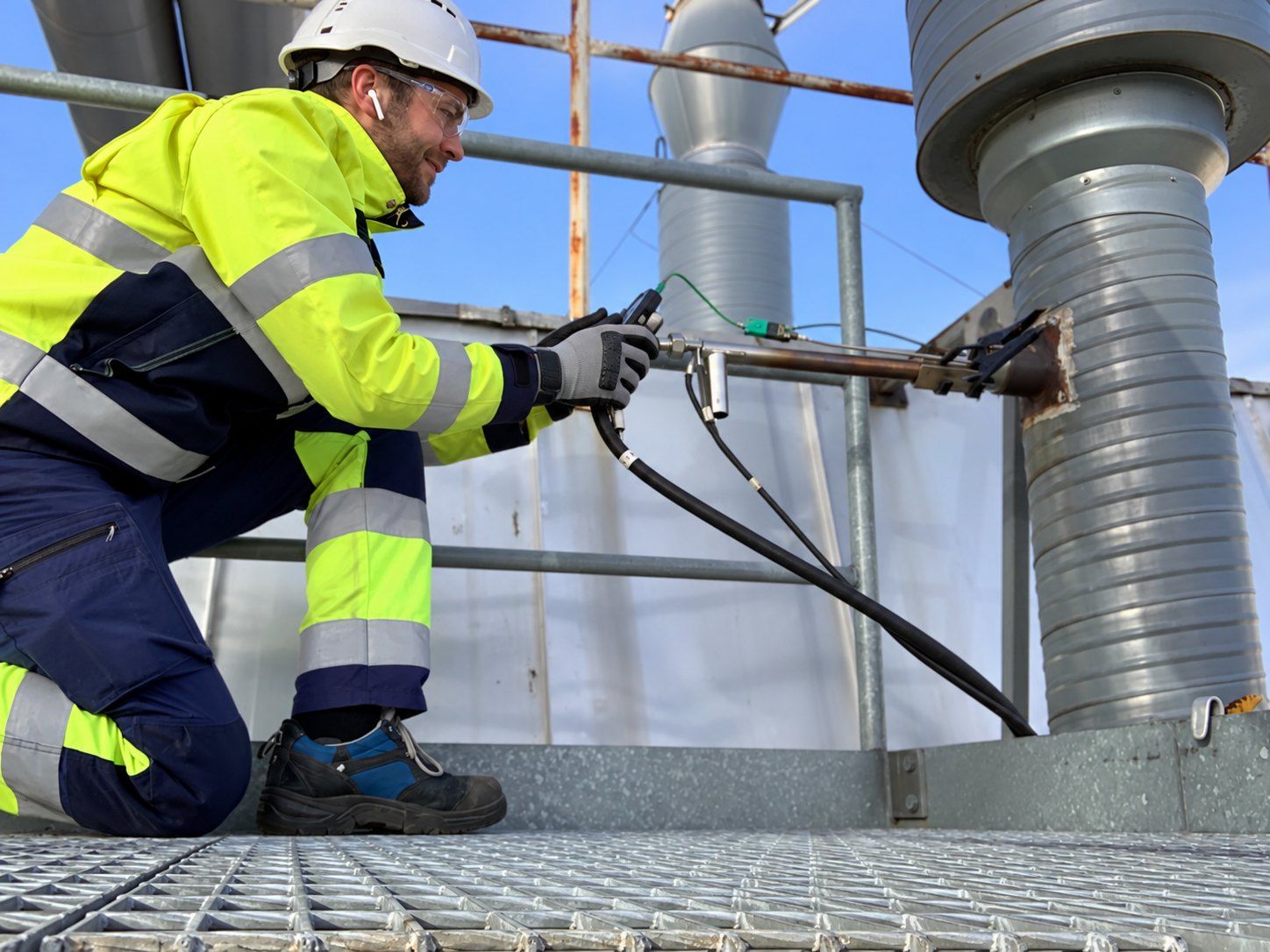
With our own probe close to the point where your sample is taken, we measure NO and NOx at the same time as your equipment, until there are at least ten data pairs. The NO2 share is determined during the same measurement, and O2 or CO2 is compared when the concentration is part of the flow calculation.
Flue gas flow and temperature
The flue gas flow is measured in the first instance, traversing the duct's cross-section with a pitot tube. If the measurement site does not give representative values, the flow is checked by calculation instead. If you use a measured flue gas temperature in your flow calculation, it is compared too.
Evaluation
We compare against the values in your daily report, since they are the basis of the declaration, and in the same state (dry or wet gas). For each parameter the mean and the standard deviation of the differences are calculated, and whether the difference is systematic. Data pairs may not be dropped in order to pass the requirements.
Report
You receive an accredited report with all data pairs, the result against each requirement, the NO2 share, measurement uncertainties and a description of the measurement site and the instruments. The daily reports from your NOx computer are attached. You submit the report to the Swedish Environmental Protection Agency together with the declaration.
What must be ready before the measurement, and when should you book?
As the charge payer, you are responsible for making the measurement possible. There must be sampling ports that can be opened (at least two are needed to measure the flue gas flow), and the workplace must be safe, with a platform, railings, lighting and electricity. Send us a sketch of the measurement site in good time, so that any shortcomings can be put right. Have the daily reports for the measurement period ready too, together with the details of your span gases and current fuel data if you calculate the flue gas flow.
Book in good time, and preferably do not put the measurement at the end of the year. It must be done within the calendar year, and a measurement that fails the requirements must be investigated within ten weeks. Anyone who waits until December has no margin if the boiler is down or if something has to be put right before the declaration on 25 January.
If the equipment fails the requirements
If the equipment fails the requirements for gas concentration, flue gas flow or flue gas temperature, you must investigate the cause within ten weeks of the measurement day, according to section 30 of NFS 2016:13. If you find the cause and correct it without delay, the requirements are considered met. No new comparison measurement is required, but many plants do one to have the correction confirmed. Simply measuring again without investigating the fault is not accepted.
Ask for a preliminary result before we leave the plant, so that the investigation can start at once. According to the Swedish EPA, common causes are air in-leakage in the sample line, wrong reference materials, the performance of the converter, and wrong fuel moisture or formulas in the flow calculation. The result of the comparison may not be used to adjust the equipment: the check must be independent. If the fault can be traced to a certain period, the measurement data must be corrected afterwards, and the investigation and corrective actions should be reported with the declaration.
Without an investigation, or without a comparison measurement during the year, the requirements of the regulations are not met. The emissions for the period must then be calculated with the substitute-value rules instead of the measured values, unless the Swedish EPA grants an exemption. For 2025 the Swedish EPA found that 23 of 284 plants had not followed every requirement. Most often it concerned the ongoing control.
The flue gas flow: measurement or calculation
You may determine your own flue gas flow by measurement or by calculation, as long as the method gives a representative result (section 8 of NFS 2016:13). According to the Swedish EPA's guidance, calculation suits homogeneous fuels, while the flow should be measured when the fuel is mixed or varies over the year. At the comparison measurement the laboratory must measure the flow in the first instance. That requires an even flow in the measurement plane: the angle of the gas flow to the duct's axis below 15°, no local reverse flow, at least 5 Pa of differential pressure across the pitot tube and less than 3:1 between the highest and the lowest gas velocity. Otherwise the flow can be checked by calculation, and the requirements depend on the combination:
| You determine the flow by | The laboratory checks by | Systematic difference, at most | Standard deviation, at most |
|---|---|---|---|
| Measurement | Measurement | 15 % | 5.0 % |
| Measurement | Calculation A | 10 % | 5.0 % |
| Calculation | Measurement | 15 % | 5.0 % |
| Calculation | Calculation A | 5.0 % | 2.5 % |
| Calculation | Calculation B | 3.0 % | 1.5 % |
Per cent of the permanently installed measuring equipment's mean, according to section 28 of NFS 2016:13. Calculation A is made with the laboratory's formulas and the analysis of fuel samples taken during the measurement; for fossil oil, natural gas and LPG the supplier's fuel data may be used. Calculation B is made in addition to A when you calculate the flow yourself, and is a check of the formulas with your input data. For waste, where representative fuel samples are hard to take, the Swedish EPA considers calculation unsuitable as a check method. The fuel's moisture content is the most sensitive figure in a flow calculation: in the Swedish EPA's worked example for a biomass fuel with 55 % moisture, an error of ten percentage points in the moisture content gives an error of 7–13 % in the flow.
Key dates and your own checks during the year
The comparison measurement is one of several checks that NFS 2016:13 requires for your measured values to be valid. This is what the year looks like:
| When | What | Requirement |
|---|---|---|
| Every calendar month with operation | Ongoing control of the gas instruments' zero point and reference point | Adjust at the latest when the deviation exceeds 4.0 % of the reference point's concentration. For NOx, NO and NO2 the limit is not exceeded below 2.0 ppm. If the limit is exceeded, the measured values since the last approved check are not valid (section 7). |
| Every calendar month with operation | The fuel's moisture content is verified, if you calculate the flue gas flow | Other fuel data are updated as needed, at least once per calendar year (section 10). |
| Every calendar year | Comparison measurement | Every third chargeable year for units with under 2,000 operating hours per year (section 18). |
| Every calendar year | The NO2 share and the lower detection limit are determined | The NO2 share is determined at the comparison measurement. If no share has been determined for the year, an addition of 10 % applies (sections 4 and 6). |
| At least every third calendar year | The instrument's linearity is checked | No point may deviate from the ideal line by more than 4 % of the reference point's value (section 6). |
| Within 10 weeks of the measurement | Investigation, if the comparison measurement fails the requirements | Correct without delay once the cause is known (section 30). |
| By 25 January | The NOx declaration for the previous year is submitted in the E-NOx e-service, with the report from the comparison measurement | The same day is the last day to apply for an exemption from the regulations (section 10 of the Act, section 31 of NFS 2016:13). |
| By 1 October | The charge is paid, if it is larger than the refund | A surplus is paid out by 1 December (section 11 of the Act, section 5 of the Swedish ordinance SFS 1991:339). |
The summary shows the main features of NFS 2016:13 and the Act (SFS 1990:613). The wording of the statutes is what applies, and the requirements apply alongside the conditions in your permit.
Changes on the way
In February 2025 the Swedish EPA sent out a proposal for changes to NFS 2016:13 for consultation, with entry into force planned for 1 January 2026. By October 2026 no amending regulations had been issued, so the regulations apply unchanged. The requirements at the comparison itself change little in the proposal: the data pairs are to be consecutive, and the investigation and corrective actions after a failed measurement are to be documented. The biggest difference is in the self-monitoring. The proposal is to check the linearity every calendar year instead of every third year, and to set a limit of 0.40 % by volume for O2 at the ongoing control and the linearity check.
What does a comparison measurement cost?
The price depends on the number of production units, the fuel, the conditions at the measurement site and the travel distance. Ten data pairs take at least ten hours with solid fuels but just over three with gas and oil. If the flue gas flow has to be checked by calculation, a fuel analysis is added. If we measure several boilers on the same visit, or coordinate with a dust measurement or with QAL2 and AST, the price per unit is lower. Request a quote – we reply within two working days. Approximate prices for the most common measurements are in the price guide.
Measure yourself
-
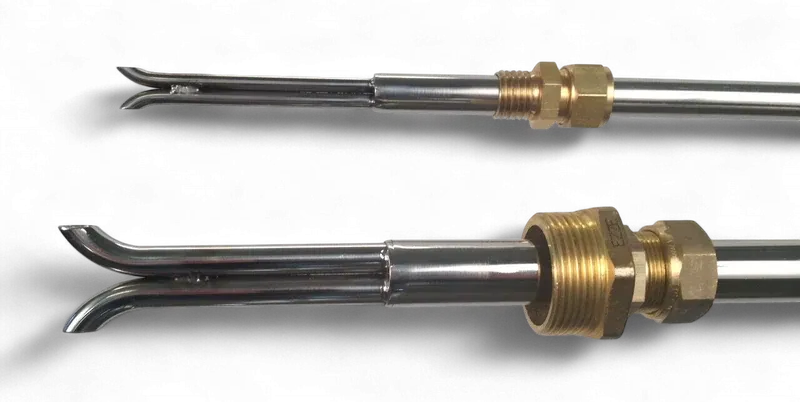 S-type pitot tube
Pitot tube with an accredited calibration certificate
ISO 16911-1. Length 300–4,000 mm, stainless steel or Inconel, connectors of your choice.
-
 Course · METLAB Academy
Dust sampling and gas flow measurement
Two days of theory and field exercises with our measurement engineers. The next course is planned once enough people have registered their interest.
Frequently asked questions about comparison measurements
How often must a comparison measurement be done?
At least once per calendar year. For production units with fewer than 2,000 operating hours per year, at least once every third chargeable year is enough, according to section 18 of NFS 2016:13. The NO2 share must be determined at the same interval, if you use one.
Who may do a comparison measurement?
A laboratory accredited for the task, in Sweden by Swedac. That follows from section 17 of NFS 2016:13. METLAB is accredited for comparison measurements of gas concentrations, flue gas flow and flue gas temperature according to the regulations.
How many data pairs are required, and how long does it take?
At least ten for each parameter, each of at least 60 minutes – so at least ten hours of measurement on top of setting up and calibrating. When gas or oil is fired, including bio-oil and biogas, 20 minutes per pair is enough. If one set of equipment alternates between several boilers with the same fuel, 60 minutes is required for one of them and 20 for the others.
Does the flue gas flow have to be measured?
Yes, at the comparison measurement the flow is always checked, and the laboratory must measure it in the first instance – we traverse the duct with a pitot tube. In your own equipment, on the other hand, the flow may be either measured or calculated.
Can a comparison measurement be coordinated with QAL2 or AST?
Yes, the visit can often be coordinated with QAL2 and AST. But the two sets of rules apply side by side: equipment that passes EN 14181 does not automatically pass NFS 2016:13. If a QAL2 calibration function is to be used for the charge (for NOx or to calibrate the flue gas flow monitor), it cannot be established at the same time as the comparison measurement.
What happens if the measuring equipment breaks down or a check is missed?
The period must be documented, and known faults must be corrected. For at most 37 hours per calendar month the emissions may be estimated from comparable operation. After that they are counted as one and a half times the value measured during comparable operation, for at most 1,440 hours per calendar year, and then with the default value of 0.25 g NOx per MJ of fuel input.
Are two comparison measurements needed if we replace the measuring system during the year?
No. The requirement is at least one comparison measurement per calendar year, even when the measuring system is replaced. If you do only one, the Swedish EPA says it is an advantage to measure after the replacement.
Do you do comparison measurements for parameters other than NOx?
Yes. We check permanently installed instruments for CO, SO2, TOC, N2O, HCl, NH3 and moisture, for example, with our own method, in which the evaluation is done in the same way as in NFS 2016:13.