
On this page
Where do the emissions come from?
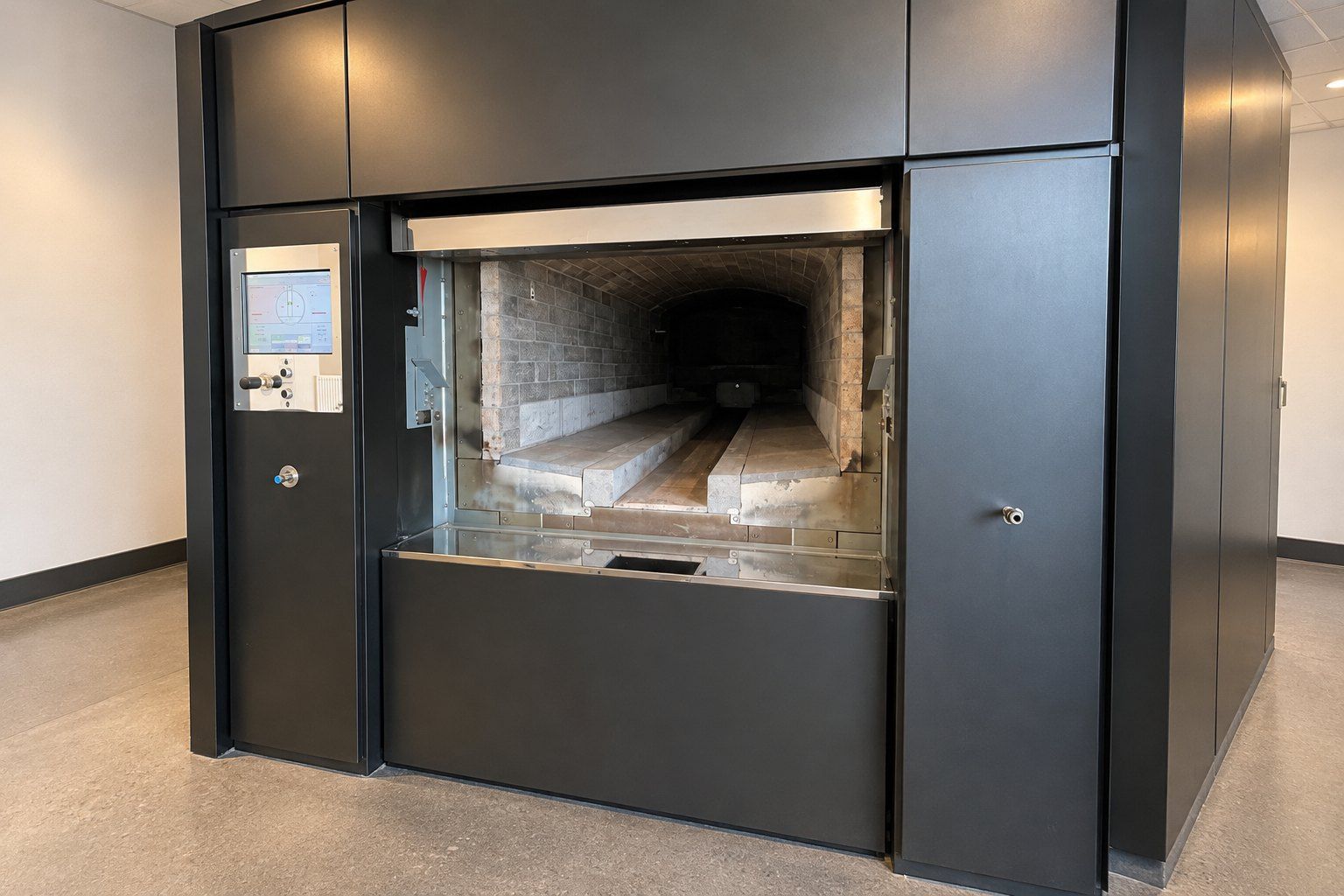
- The cremation furnace: mercury from amalgam fillings is released 10–20 minutes after charging, and when the coffin collapses CO and unburnt hydrocarbons rise quickly. A cremation takes 75–90 minutes.
- The afterburner chamber: is kept at a minimum of 800 °C and burns out CO and hydrocarbons, which also reduces dioxin formation. The auxiliary fuel gives small amounts of NOx and SO2.
- Flue gas cooler and filter: the fabric filter with activated carbon separates dust, mercury and dioxins, over 95 % of the mercury. Differential pressure or opacity raises an alarm at a filter breakthrough. Spent carbon is hazardous waste.
Which rules apply?
| Plant | Regulation | What it means for the measurement |
|---|---|---|
| All crematoria | The Swedish Environmental Permitting Ordinance (SFS 2013:251), chapter 32, section 1: permit category B, activity code 93.20 | Conditions for mercury, dust and CO as an average per cremation and a minimum temperature; the monitoring programme sets the method and the interval |
| All crematoria | Chapter 26, sections 19–20 of the Swedish Environmental Code, SFS 1998:901 and NFS 2016:8 – self-monitoring and the annual environmental report | Continuous recording of CO, O2 and opacity, records, annual environmental report by 31 March, measurement documentation kept for five years |
| Capacity above 500 cremations per year | HELCOM Recommendation 29/1 (2008): dust 10, CO 50 and mercury 0.1 mg/Nm3 | Not binding, but a benchmark for the Swedish Environmental Protection Agency and the courts when the conditions are set |
| The furnace | The Swedish Ordinance on Medium Combustion Plants (SFS 2018:471) exempts crematoria (section 15). The Swedish Ordinance on Waste Incineration (SFS 2013:253) applies to waste, not to cremation | No measurement requirements from the combustion plant ordinances and no BAT conclusions |
The permit can set stricter requirements, and the supervisory authority can order measurements. Older permits state guideline values; the Land and Environment Court of Appeal wants the conditions to state instead how they are checked.
What is measured – and what is typical?
Cremation is batch combustion: flow and concentrations go from zero to the operating value every 75–90 minutes, so conditions and measurements are stated per cremation.
| Parameter | Why in this industry | Typical level or requirement | Method |
|---|---|---|---|
| Mercury (Hg) | Almost all of it comes from amalgam fillings, about 3 g per deceased | Conditions (2010): 100 mg per cremation in 16 permits, 80 µg/Nm3 in 6, as guideline values at inspection. After the carbon filter 1–100 µg/m3 (powder injection) or about 5 µg/m3 (carbon bed) according to OSPAR | EN 13211, often two samples in succession |
| Dust | Ash and soot; a filter breakthrough shows here first | Condition: 10 mg/Nm3 dry gas at 11 % O2, a guideline value as the average over one cremation (MÖD 2009:19) | EN 13284-1 |
| CO | A measure of burnout; rises sharply when the coffin collapses | Condition: 50 mg/Nm3 at 11 % O2 as an average per cremation and 500 mg/Nm3 as a 5-minute value; 100 mg/Nm3 in MÖD 2009:19 | EN 15058 |
| NOx | The auxiliary fuel and the high temperature; no cleaning technique exists | Condition: 900 or 1,200 g per cremation. Measured at the initial inspection and after a rebuild | EN 14792 |
| Dioxins | Chlorine from the body's salt and from plastics; separated in the carbon filter | Condition: 0.1 ng/Nm3 (guideline value). Measured 0.003–0.015 ng/Nm3 after the carbon filter at three crematoria in 2006–2008, 8–10 ng/Nm3 before the filter | EN 1948, 6–8 hour sample |
| TOC | Unburnt hydrocarbons follow the CO concentration | Measured where the permit requires it; the concentration depends on the combustion | EN 12619 |
| O2, temperature and gas flow | Conversion to 11 % O2, temperature conditions and the amount per cremation | Guideline values: furnace above 700 °C, afterburner chamber at least 800 °C. The flow varies from zero to the operating value | EN 14789, thermocouple, EN ISO 16911-1 |
mg/Nm3 = milligrams per cubic metre of dry gas at 0 °C and 101.3 kPa, in the permits usually at 11 % O2 (older ones: 9 % CO2). Conditions and measurement data are examples from the Swedish Environmental Protection Agency's industry guide for crematoria (Branschfakta Krematorieverksamhet, edition 4, 2010) and court rulings; the concentration depends on the furnace, the coffin and the flue gas cleaning.
What the measurement year looks like
Read the permit and the monitoring programme
The conditions state the parameters, the calculation method (per cremation, at 11 % O2) and the sampling location; the monitoring programme states the method and the interval. If there is none, we help you propose one.
The ongoing self-monitoring
The plant's instruments record CO, O2 and opacity or the differential pressure across the filter. Keep records of cremations, sorbent quantity, soot removal and calibrations, and have the filter residue analysed for mercury.
Periodic emission measurement, normally every three years
We measure after the flue gas cleaning over several consecutive cremations: mercury with two samples, dust under representative conditions, CO and O2 throughout. The results are converted to 11 % O2 and to the amount per cremation.
Initial inspection and rebuilds
A new or rebuilt furnace is checked with a mercury balance: concentration and amount after the furnace, in the sorbent and after the flue gas cleaning give the removal efficiency. NOx is measured at the same time. A performance test shows that the supplier's guarantee is met.
Report and annual environmental report by 31 March
You receive an accredited report with concentrations, amounts and conversions you can follow. The results and the follow-up of the conditions are reported in the annual environmental report.
What often goes wrong in the measurement
The oxygen correction. At the end of a cremation the oxygen concentration is close to that of air; a conversion to 11 % O2 then gives a factor of 5 at 19 % O2 and 10 at 20 %. That is why normalised CO values are hard to keep, and some permits count O2 concentrations above 18 % as 18 % after 40 minutes.
The measurement plane. Between the furnace and the cooler there is seldom the straight run of five hydraulic diameters upstream of the measurement plane and one downstream that dust and flow measurement require. Measure after the flue gas cleaning, where the permit says.
The carbon. Activated carbon that loses active surface area in the discharge releases mercury again. Check the carbon quality at every delivery.
What does a measurement cost at a crematorium?
The price depends on how many parameters the permit requires, whether mercury is also to be determined after the furnace and in the sorbent (a mercury balance), how many cremations the measurement is to cover, whether dioxins are included and how accessible the measurement site is. Several furnaces in the same visit lower the cost per furnace. Request a quote – we reply within two working days. Approximate prices for the most common measurements are in the price guide.
Frequently asked questions
How often must a crematorium measure mercury?
As often as the permit and the monitoring programme say. The Swedish Environmental Protection Agency's industry guide assumes periodic inspections with emission measurement normally every three years, more often with old equipment or known shortcomings.
Do the waste incineration rules apply to a crematorium?
No. The Swedish Ordinance on Waste Incineration (SFS 2013:253) applies to the incineration of waste, and crematoria are assessed as an activity of their own with code 93.20. The Swedish Ordinance on Medium Combustion Plants exempts crematoria expressly. The conditions are nevertheless often modelled on waste incineration, with mercury as the exception.
What emission limit value applies to mercury?
There is no national limit value. Permits have stated 100 mg per cremation or 80 µg/Nm3 as guideline values, and HELCOM recommends 0.1 mg/Nm3 at a capacity above 500 cremations per year. The Land and Environment Court of Appeal has preferred requirements on the cleaning equipment and its care to a numerical value (MÖD 2009:19).
Must we submit an annual environmental report?
Yes. A crematorium needs a permit (category B), so the annual environmental report is submitted in the Swedish Environmental Protection Agency's reporting portal SMP by 31 March. It reports how the conditions have been met and summarises the year's measurements.