
On this page
When do you need to measure SO2?
- Permit conditions. The environmental permit sets an emission limit value for SO2 and how often it is to be checked.
- Medium combustion plants (1–50 MW): the Swedish Ordinance on Medium Combustion Plants (SFS 2018:471) requires periodic measurement of SO2 for all fuels except solid biomass from forestry, gas oil and natural gas.
- Large combustion plants (the Swedish Ordinance on Large Combustion Plants, SFS 2013:252): continuous measurement from 100 MW, with exceptions for certain fuels, otherwise at least every six months.
- Waste incineration (the Swedish Ordinance on Waste Incineration, SFS 2013:253): SO2 is measured continuously, and the measuring system is checked every year against EN 14791 (QAL2 and AST).
- Pulp mills: the BAT conclusions specify continuous measurement from recovery boilers (kraft and sulphite), and periodic or continuous measurement from lime kilns.
- Performance tests and troubleshooting: guarantee values for desulphurisation or a scrubber, and tuning of the sorbent dosing.
Instrumental measurement: how the sampling train is built
A sample stream of the flue gas is drawn out through a probe with a coarse filter and carried in a heated sample line to a gas cooler, where the water vapour condenses. The dry sample gas passes a pump, a fine filter and a rotameter on its way to the analyser, which determines SO2 by the absorption of infrared or ultraviolet light. Oxygen is measured in the same sample gas. Zero and span gas are connected at the analyser, and at the probe when the whole system is leak tested.
- 1. Probe with coarse filter
- 2. Heated sample line
- 3. Gas cooler that dries the sample gas
- 4. Condensate drain
- 5. Pump
- 6. Fine filter
- 7. Rotameter
- 8. Analysers for sulphur dioxide and oxygen
- 9. Data acquisition
- 10. Zero and span gas
The accredited measuring range is 1–500 ppm, that is up to 1,430 mg/Nm3. Ammonia in the flue gas can bind SO2 as ammonium sulphate in the gas cooler and give values that are too low, and IR analysers are sensitive to residual moisture and hydrocarbons.
Wet chemical reference method
The sample gas is drawn through a heated probe with a particle filter and then bubbles through two absorption bottles in a cooling bath, filled with hydrogen peroxide solution that oxidises the sulphur dioxide to sulphate. An empty bottle catches splashes and a drying tower dries the gas. After a valve, a pump and a flow meter, a gas meter with a thermometer measures the sample gas volume.
- 1. Probe with filter holder, heated
- 2. Absorption bottles with absorption solution, in a cooling bath
- 3. Knock-out bottle
- 4. Drying tower
- 5. Valve
- 6. Sampling pump
- 7. Flow meter
- 8. Gas meter
- 9. Thermometer at the gas meter
Upstream of the bottles the sample gas comes into contact only with borosilicate or quartz glass, PTFE or titanium. If the flue gas contains droplets, for example after a wet scrubber, the sample is taken isokinetically as in dust measurement, since the droplets can contain dissolved SO2.
How is an SO2 measurement done?
Method and measurement plan
The purpose decides the method. The measurement site must meet EN 15259: in homogeneous flue gas one measurement point is enough, otherwise we measure at several. The plant must run stably in the agreed operating condition.
Instrumental measurement
The system runs on flue gas for about an hour and is then calibrated with zero gas and span gas. SO2 and oxygen are logged continuously. After the measurement, and at least once a day, the calibration is checked again.
Field blank and leak test
For the wet chemical method a field blank is taken before every measurement series, at least once a day: the same handling as a sample, but without starting the pump. The leak rate may be at most 2 % of the sample gas flow.
Wet chemical sampling
The sample gas is drawn through the bottles for at least 30 minutes per sub-sample, normally at 4–10 l/min. The temperature after the bottles must be below 20 °C. Afterwards the tubing and the bottles are rinsed into the sample bottle.
Analysis
An accredited laboratory determines the sulphate content of the sample and the field blank by ion chromatography. The standard also allows titration with thorin as indicator, which is less sensitive.
Calculation and report
The concentration is converted to mg/Nm3, dry gas at 0 °C and 101.3 kPa, and to the plant's reference oxygen content; 1 ppm SO2 corresponds to 2.86 mg/Nm3. The report gives the result with its measurement uncertainty.
The requirements in EN 14791
These requirements decide whether a wet chemical SO2 measurement is valid. The last row applies to the instrumental method.
| Requirement | Value |
|---|---|
| Absorption solution | 0.3 % hydrogen peroxide, 3 % when the concentration is above 1,000 mg/Nm3 |
| Filtration temperature | At least 120 °C and at least 20 °C above the acid dew point |
| Filter | Quartz fibre, ceramic or PTFE – glass fibre reacts with SO3 |
| Absorption | Two bottles in series, at least 95 % in the first |
| Leak rate | At most 2 % of the sample gas flow |
| Field blank | Below 10 % of the emission limit value, and not subtracted from the measured value |
| Measurement uncertainty | Expanded uncertainty at most 20 % of the daily emission limit value |
| Instrumental method | Leak test: at most 2 % deviation with span gas through the whole system. Drift: above 2 % the measured values are corrected, above 5 % the measurement is rejected |
Which method should you choose?
EN 14791 is the European standard reference method. It determines all gaseous sulphur oxides that pass the filter (including SO3), expressed as SO2, whereas an IR or UV analyser measures SO2 alone. In some processes the reference method and an automated measuring system therefore show different values, something to allow for at QAL2.
| Purpose | Method | Why |
|---|---|---|
| QAL2 and AST of an automated measuring system | Wet chemical, EN 14791 | EN 14181 is built on parallel measurements with the standard reference method: at least 15 data pairs (a reference value and the measuring system's value for the same period) at QAL2, at least five at AST |
| Checking against an emission limit value in an ordinance or a BAT conclusion | Wet chemical, EN 14791, or a method shown to be equivalent | The ordinances refer to CEN standards, and EN 14793 sets out how another method is shown to be equivalent |
| Process studies, long measurement periods and checks of permit conditions where the permit does not require the reference method | Instrumental, ISO 7935 | The concentration is shown directly and logged continuously, and no sample needs to be analysed in a laboratory |
Where does SO2 come from, and what lowers the concentration?
SO2 forms when the sulphur in the fuel is oxidised. Wood fuel gives less than 100 mg/Nm3 at 6 % O2 even without flue gas cleaning, according to the Swedish Environmental Protection Agency (Naturvårdsverket). Coal with 0.8 % sulphur gives around 1,100 mg/Nm3 at 6 % O2, and heavy fuel oil with 0.5 % sulphur around 850 mg/Nm3 at 3 % O2, if the flue gas is not cleaned.
The concentration is lowered with lower-sulphur fuel, with sorbent injected into the boiler or the flue gas duct and with a scrubber. In recovery boilers a higher dry solids content in the black liquor gives less SO2 but more NOx. In cement kilns and smelters the sulphur also comes from the raw material.
Which emission limit values apply to SO2?
The emission limit value is in the permit, in the ordinance for the type of plant or in a BAT conclusion, where the upper value of the range applies as the limit value under the Swedish Industrial Emissions Ordinance (SFS 2013:250). The Swedish Sulphur Ordinance (SFS 2014:509) also limits the sulphur emissions from combustion in industrial and energy plants to 0.10 grams of sulphur per megajoule of fuel as a yearly average, and 0.05 if the plant emits more than 400 tonnes of sulphur per year. The values are for dry gas. A new plant is defined in each rule.
| Plant | SO2, mg/Nm3 | Rule |
|---|---|---|
| Medium combustion plant 1–50 MW, boilers | Solid biomass not from forestry 200 (straw 300 in existing plants), peat and other solid fuels 400. At 6 % O2. Liquid fuels other than gas oil 350. At 3 % O2 | SFS 2018:471, annexes 1–3 and 12–14 |
| Large combustion plant, biomass | 200, new plants above 300 MW 150. At 6 % O2 | SFS 2013:252, sections 44 and 50 |
| Large combustion plant below 100 MW firing solid biomass or peat, under the BAT conclusions | Yearly average 15–100, new plants 15–70. At 6 % O2 | BAT 25, (EU) 2021/2326 |
| Waste incineration | 50 as a daily average and 200 as a half-hourly average. Under the BAT conclusions 5–40 as a daily average, new plants 5–30. At 11 % O2 | SFS 2013:253, sections 57 and 62 BAT 27, (EU) 2019/2010 |
| Recovery boiler in a kraft (sulphate) pulp mill | Daily average 10–70, or 10–50 at 75–83 % dry solids in the black liquor. At 6 % O2 | BAT 21, 2014/687/EU |
What does an SO2 measurement cost?
The price depends on the number of stacks or ducts and operating conditions, on the method and on the length of the measurement. Instrumentally, SO2 is measured with the same measuring system as NOx, carbon monoxide and oxygen, so the cost per parameter is low when the gases are measured together. For the wet chemical method, laboratory analysis of every sub-sample and field blank is added. Isokinetic sampling, difficult access and a long journey raise the cost. Request a quote – we reply within two working days. Approximate prices for the most common measurements are in the price guide.
How often must SO2 be measured?
As often as the permit says. The ordinances set the minimum. Medium combustion plants measure at least every three years up to 20 MW and every year above 20 MW; the supervisory authority can grant an exemption if the emission is checked in another way. Large combustion plants measure continuously from 100 MW, with exceptions that include natural gas and oil with a known sulphur content, and otherwise at least every six months. Automated measuring systems are checked against the reference method every year.
Measure SO2 yourself
-
 GM11-101
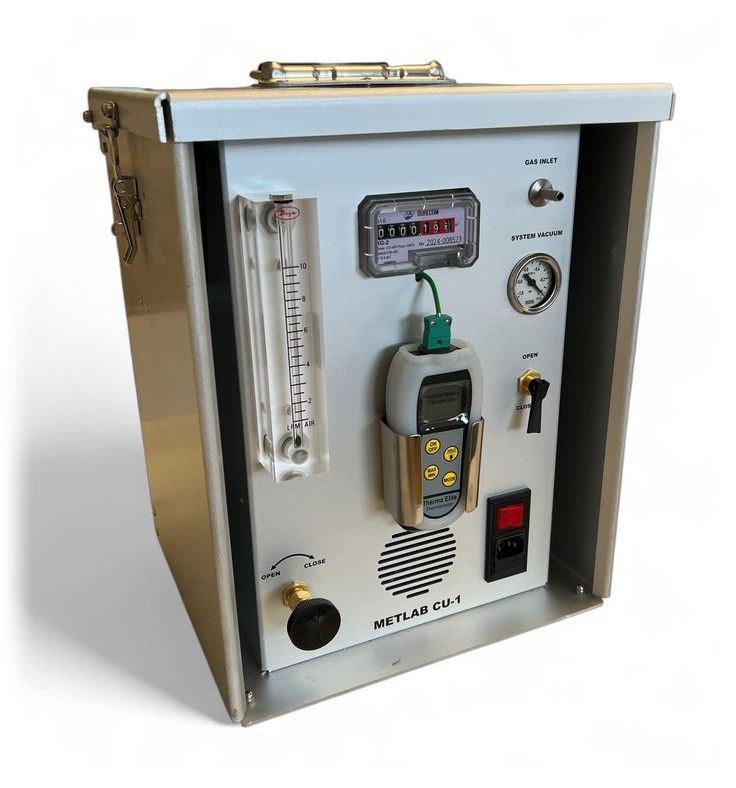
CU-1-10 gas sampler
Control unit with vacuum pump, drying tower, flow meter and gas meter. Up to 10 l/min – the CU-1-20 handles 20.
-
 GM25-101 · GM25-102
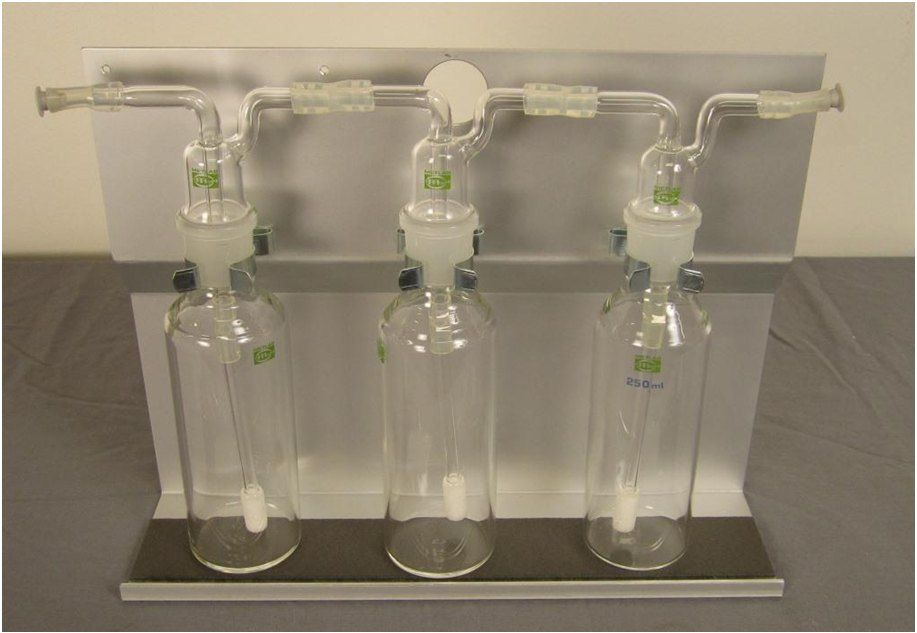
Bottle rack with absorption bottles
Two or three bottles (impingers) in series for the hydrogen peroxide solution, 250 ml borosilicate glass with a glass insert and frit.
Frequently asked questions about SO2 measurement
Is the SO2 measurement accredited?
Yes. Instrumental measurement according to ISO 7935 is within METLAB's Swedac accreditation with sampling and analysis. For EN 14791 the sampling is accredited, and the analysis is done by an accredited laboratory. For that method the detection limit is from 0.001 mg/Nm3 at a normal sampling time, according to our method list.
Can instrumental measurement replace the reference method?
Yes, when the laboratory has shown that the method is equivalent according to EN 14793. That requires a described method with a stated measuring range and type of flue gas, a measurement uncertainty that does not exceed the reference method's, and parallel measurements in the field without a systematic difference.
How long does the measurement take?
A wet chemical sub-sample takes at least 30 minutes, and the BAT conclusions use the average of three consecutive sub-samples. At QAL2 we normally take samples of 30 minutes at waste incineration plants and 60 minutes at large combustion plants.
Can SO2 be measured at the same time as other parameters?
Yes. Instrumentally, SO2 is measured in the same sample gas as NOx, carbon monoxide and oxygen. For the wet chemical method the sample gas from the same probe and filter is split between parallel bottle racks, for example for HCl, HF and ammonia.
What is required of the measurement site?
A sampling port where the probe reaches a representative point in the duct, a safe working platform and electricity, according to EN 15259. After a wet scrubber, where the wet chemical sample is taken isokinetically, a measurement site as for dust measurement is needed.