
On this page
When do you need to measure mercury?
- Permit conditions. The environmental permit sets the emission limit value for mercury and how often it is to be checked.
- Waste incineration and co-incineration: the Swedish Ordinance on Waste Incineration (SFS 2013:253) sets the emission limit value at 0.05 mg/Nm3 and requires at least two measurements a year.
- Automated measuring systems for mercury: the BAT conclusions for waste incineration generally require continuous measurement, and the AMS is calibrated against EN 13211 at QAL2 and AST.
- Large combustion plants: the Swedish Ordinance on Large Combustion Plants (SFS 2013:252) requires measurement of total mercury at least once a year when firing hard coal or lignite, and the BAT conclusions specify measurement for solid biomass fuel and peat as well.
- Process industry: cement kilns, sinter plants, electric arc furnaces and non-ferrous metal smelters have BAT-associated emission levels (BAT-AELs) for mercury.
- Crematoria: mercury is normally part of the initial inspection and of the periodic inspections.
How the sampling train is built
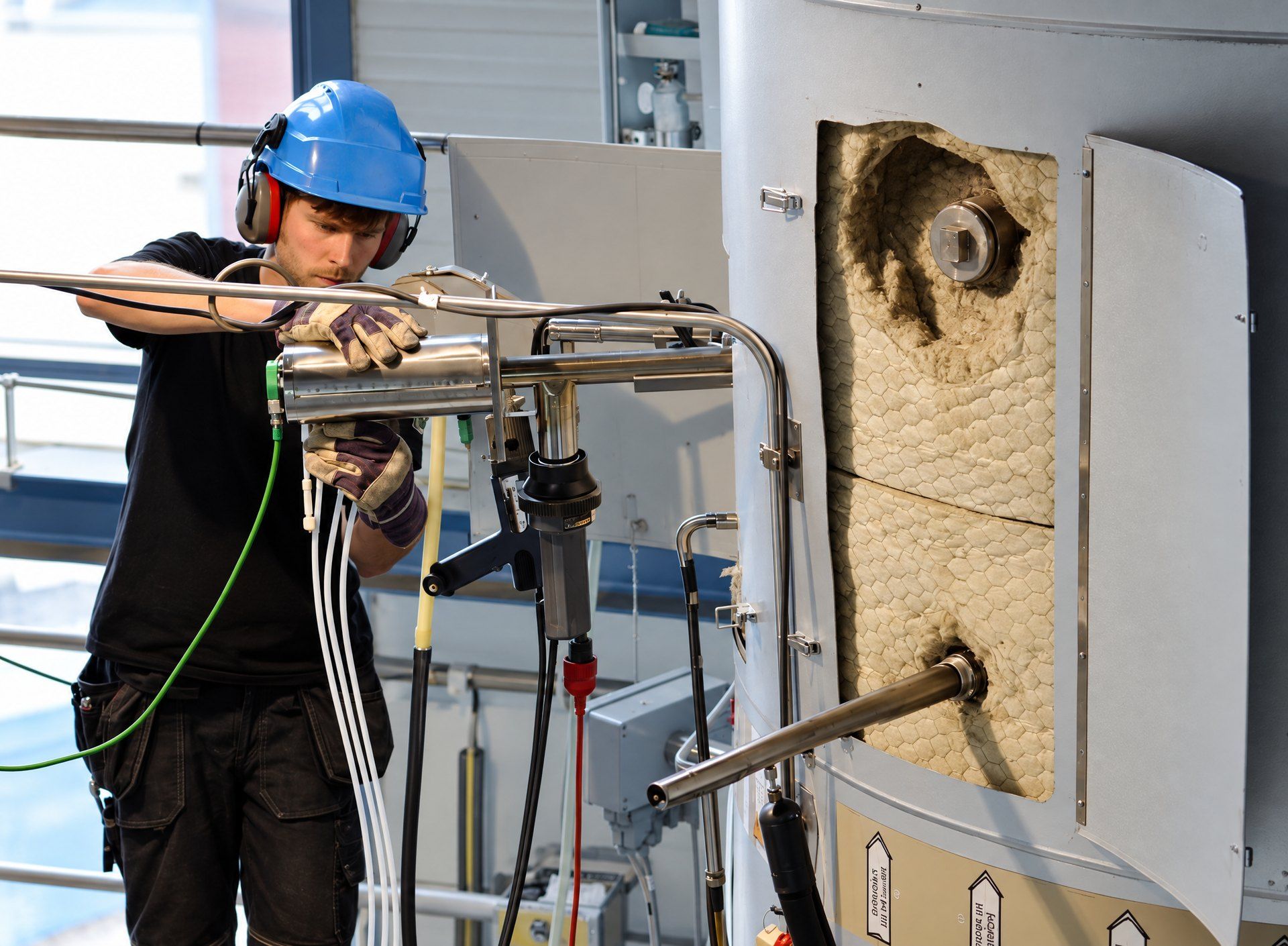
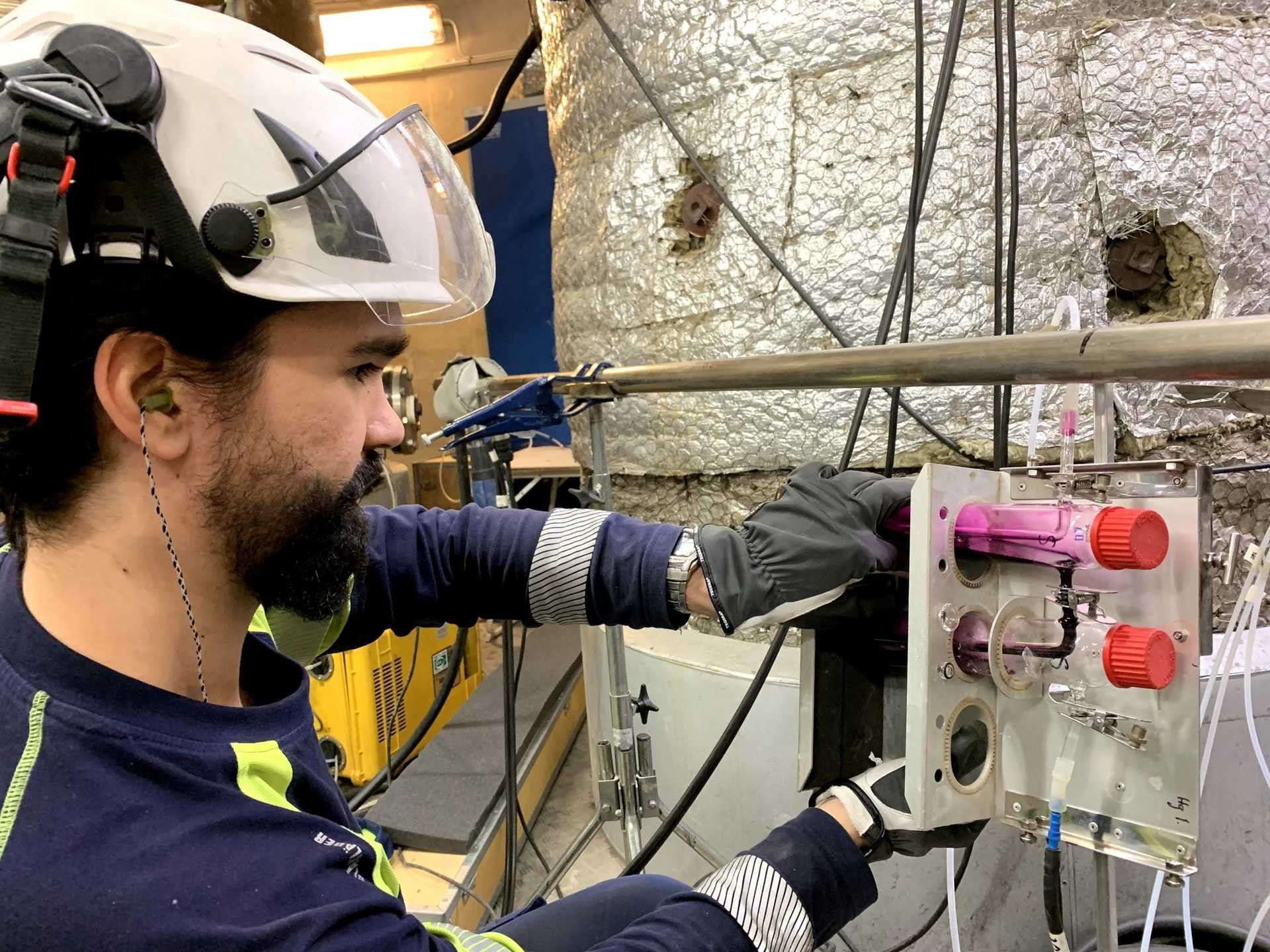
The measuring principle is isokinetic sampling with wet chemical absorption. The sample gas is drawn out through a nozzle facing the gas stream and led through a heated probe tube to a heated filter, where particle-bound mercury is caught. The gaseous mercury is then captured in absorption bottles in a cooling bath with an oxidising solution. We use potassium permanganate in sulphuric acid. An empty bottle catches splashes, a drying tower dries the gas, and after the control valve, pump and flow meter a dry gas meter measures the sample volume. A pitot tube, a thermocouple and pressure gauges are used to keep the sampling isokinetic.
- 1. Nozzle, facing the gas stream
- 2. Probe tube, heated
- 3. Filter holder with plane filter, heated
- 4. Absorption bottles with absorption solution, in a cooling bath
- 5. Empty knock-out bottle that catches splashes
- 6. Drying tower with silica gel
- 7. Control valve
- 8. Gas-tight pump
- 9. Flow meter
- 10. Dry gas meter
- 11. Temperature sensor at the gas meter
- 12. Temperature sensor, flue gas temperature (type K thermocouple)
- 13. Pressure gauge, static pressure in the duct
- 14. Pressure gauge, dynamic pressure (micromanometer)
- 15. Pitot tube (L- or S-type) for gas velocity
- 16. Barometer
The bottles for mercury can only take a low flow, normally 2 l/min in our case, so usually only part of the sample gas, a side stream, is led through them. The probe, filter holder and connections are made of glass, quartz glass, PTFE or titanium.
How is a mercury measurement done?
Measurement plan and preliminary measurement
The measurement site is chosen as for dust measurement, according to EN 15259. Gas velocity, temperature, oxygen and moisture are measured, and the nozzle is chosen for isokinetic sampling.
Clean bottles, fresh solution
Glassware and sample bottles are washed with nitric acid before each use. The absorption solution may be at most one week old, and because all potassium permanganate contains traces of mercury, a blank of each batch is analysed.
Field blank and leak test
Before each measurement series, and at least once a day, a field blank is taken: the sampling train is assembled and rinsed as after a sample, without drawing flue gas through it. The leak rate may be at most 2 % of the sample gas flow.
Sampling
The probe is moved between the measurement points with the deviation from isokinetic sampling within −5 to +15 %. The probe and filter are kept at least 20 °C above the flue gas temperature, and the bottles are cooled.
Rinsing
After each sample, the tube to the first bottle is rinsed into it with hydrogen peroxide. Nitric acid must never be used here, because it can form gas with the sulphuric acid. The probe and filter holder are rinsed with 5 % nitric acid after the measurement series (after each sample when metals are sampled at the same time), and the rinse solution is analysed.
Analysis and report
An accredited laboratory digests the filter and determines the mercury in all the solutions by atomic absorption or atomic fluorescence, within two weeks. The amounts are added up, divided by the volume of dry sample gas and reported in µg/Nm3 (dry gas at 0 °C and 101.3 kPa) at the reference oxygen content.
The requirements in EN 13211
These requirements in EN 13211 decide whether a mercury sampling is valid.
| Requirement | Value |
|---|---|
| Measuring range | 1–500 µg/m3 total mercury, validated at waste incineration plants |
| Isokinetic sampling | The main rule. Exceptions if the mercury in dust and droplets is below 1 µg/m3, or if the gas has no droplets and the velocity varies by at most a factor of 1.2 |
| Probe and filter | At least 20 °C above the flue gas temperature; at least 180 °C if the probe is made of titanium |
| Lines | At most 1 m of unheated line to the bottles; silicone tubing at most 2 cm2 of inner surface per l/min |
| Absorption | Two bottles in series, less than 5 % of the mercury in the second one (or less than 2 µg/m3); checked at least once per measurement campaign |
| Absorption solution | At most one week old. If the permanganate solution loses its colour during the sample, the sample is invalid |
| Leak rate | At most 2 % of the sample gas flow, before each sample |
| Filter | Blank value below 0.1 µg/m3 |
Gaseous and particle-bound mercury
Mercury occurs in the flue gas as elemental mercury in the gas phase (Hg0), as oxidised mercury (Hg2⁺), for example mercury chloride, and bound to dust or dissolved in droplets after a wet scrubber. The distribution varies between processes. EN 13211 determines the sum, total mercury.
Oxidised mercury is water-soluble and is caught in a wet scrubber; elemental mercury is caught only once it has been oxidised. The absorption solution is therefore strongly oxidising, so that Hg0 also stays in the bottles. If the permanganate solution loses its colour during the sample, the sample is invalid.
Mercury is easily adsorbed on surfaces. If the probe and filter are too cold, it condenses on the walls and the measured value is too low. That is why the probe and filter are heated and the lines kept short, and what is still deposited before the bottles is rinsed out and included.
An AMS for mercury measures the gaseous mercury, after the oxidised part has been reduced to Hg0 in a converter. The reference method also includes what sits on dust and in droplets.
Mercury at crematoria
At crematoria the mercury comes almost entirely from amalgam fillings; the Swedish Environmental Protection Agency (Naturvårdsverket) assumes an average of 3 grams per deceased person. It starts to be released about ten minutes after the coffin has gone into the furnace, and after about twenty minutes most of it has left the furnace. Among the permit conditions reported in the agency's sector fact sheet from 2010, the most common is at most 100 mg of mercury per cremation; some permits instead have 80 µg/Nm3, as the average at an inspection. The flue gas is cleaned with activated carbon. Selenium ampoules, which some crematoria used, cannot work according to the same publication, because mercury and selenium do not react with each other in the gas phase.
Which emission limit values apply to mercury?
The emission limit value is set in the permit, in the Swedish Ordinance on Waste Incineration (SFS 2013:253) or in the sector's BAT conclusions, whose upper value applies as a limit value four years after publication. The ordinance's 0.05 mg/Nm3 is 50 µg/Nm3 and refers to samples of 30 minutes to 8 hours.
| Plant | Emission limit value or BAT-AEL | Rule |
|---|---|---|
| Waste incineration (11 % O2) | 0.05 mg/Nm3 | SFS 2013:253, section 64 |
| Co-incineration: combustion plant (6 % O2, solid fuel) and cement kiln (10 % O2) | 0.05 mg/Nm3 | SFS 2013:253, sections 69 and 95 |
| Waste incineration, BAT-AEL | < 5–20 µg/Nm3 as a daily average or average over the sampling period. For long-term sampling 1–10 µg/Nm3 | BAT 31, (EU) 2019/2010 |
| Large combustion plant firing hard coal (yearly average) | Existing: < 1–9 µg/Nm3 below 300 MW, < 1–4 from 300 MW. New: < 1–3 and < 1–2 µg/Nm3 respectively | BAT 23, (EU) 2021/2326 |
| Large combustion plant firing solid biomass or peat | < 1–5 µg/Nm3 as the average over the sampling period | BAT 27, (EU) 2021/2326 |
| Cement kiln and electric arc furnace | < 0.05 mg/Nm3 | BAT 28, 2013/163/EU and BAT 88, 2012/135/EU |
| Sinter plant and non-ferrous metal smelter | < 0.03–0.05 and 0.01–0.05 mg/Nm3 respectively | BAT 21, 2012/135/EU and BAT 11, (EU) 2016/1032 |
What does a mercury measurement cost?
The price depends on the number of stacks or ducts and operating conditions, the number of samples and the sampling time. Each sample gives the laboratory several portions to analyse separately: the filter, the rinse solution and the absorption solution. The field blank is analysed in the same way. When mercury is measured together with metals, dust or dioxins, travel and set-up are shared. Request a quote and we will reply within two working days. Approximate prices for the most common measurements are in the price guide.
How often must mercury be measured?
As often as the permit says. For waste incineration, the Swedish Ordinance on Waste Incineration (SFS 2013:253) requires at least two measurements a year, and one every three months during the first twelve months of operation. There the BAT conclusions require continuous measurement; only when the waste has a proven low and stable mercury content is long-term sampling or measurement every six months enough. For large combustion plants the BAT conclusions specify once a year for solid biomass and peat, every three months for coal below 300 MW and continuous measurement from 300 MW.
Measure mercury yourself
-
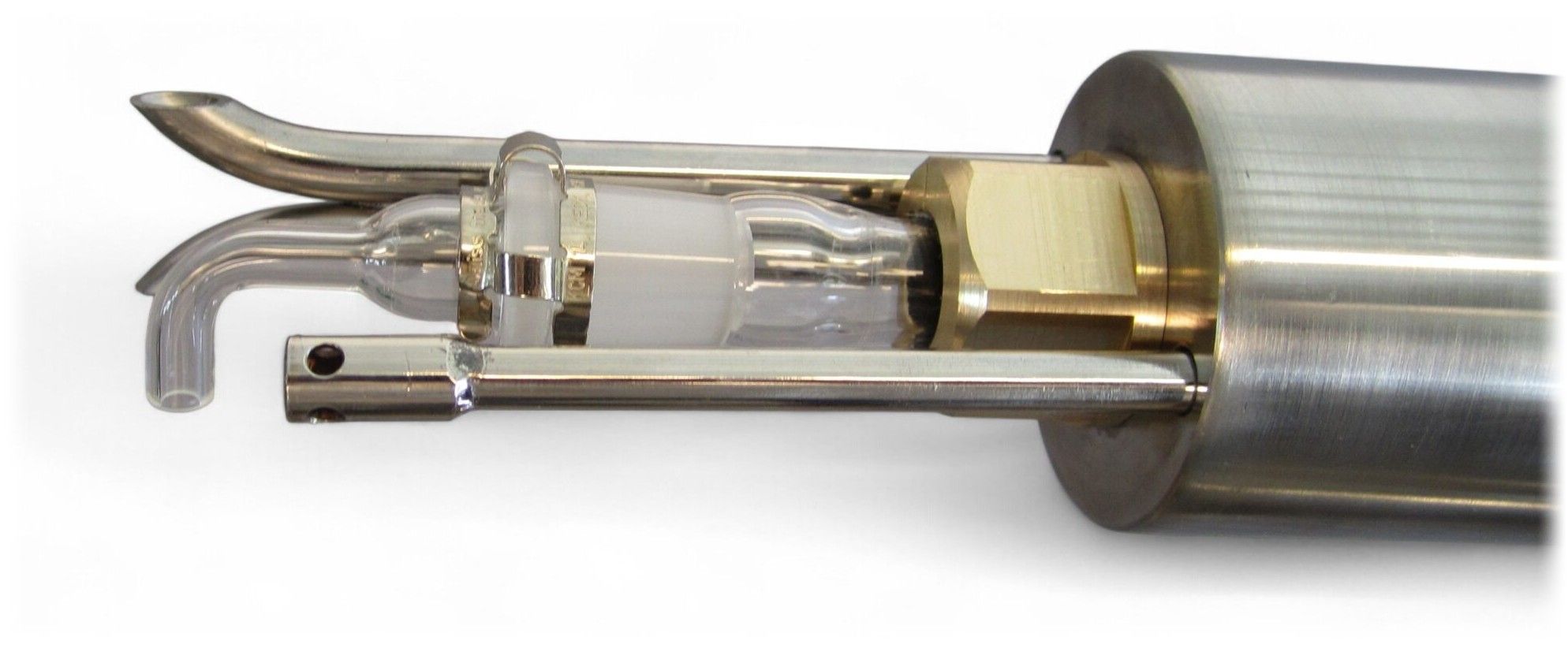 DX21-103
EVA Light glass probe for metals sampling
Heated glass probe for isokinetic sampling of mercury and metals, with an S-type pitot tube and thermocouple.
-
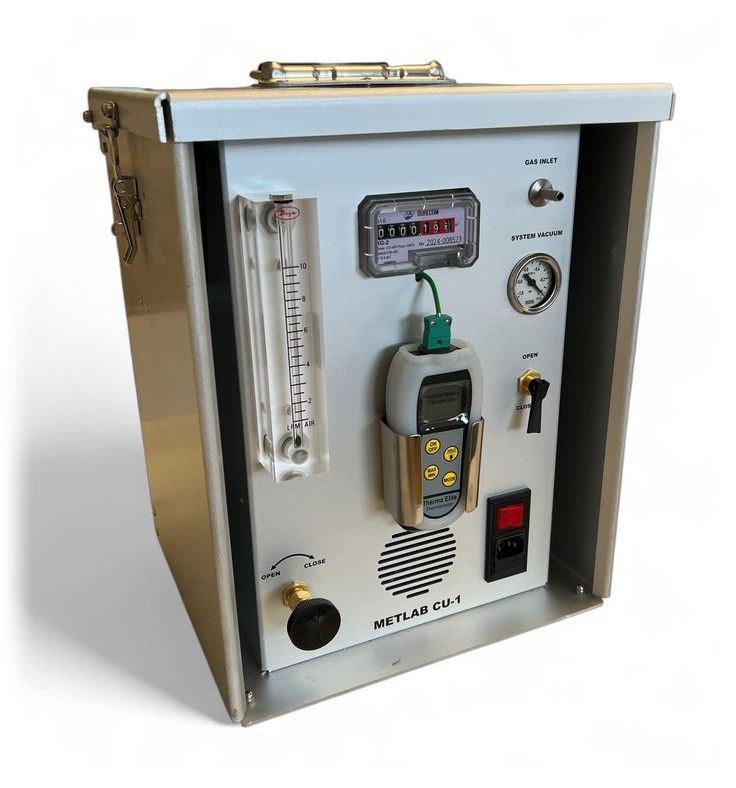 GM11-101 · GM11-102
CU-1-10 and CU-1-20 control units
Portable unit with a vacuum pump, drying tower, flow meter and gas meter, for sample flows up to 10 or 20 l/min.
Frequently asked questions about mercury measurement
Is the mercury measurement accredited?
Yes, the sampling. METLAB's Swedac accreditation covers the sampling of total mercury according to EN 13211, and the analysis is done by an accredited laboratory.
How long does a mercury measurement take?
A sample lasts between 30 minutes and 8 hours; Energiforsk's Emissionsmäthandbok (the Swedish emission measurement handbook) recommends at least one hour. The BAT conclusions' values refer to the average of three consecutive samples.
Can mercury be measured at the same time as metals?
Yes. Mercury and metals can be sampled from the same probe and filter, each with its own side stream and absorption solution and with the same sampling time. Bottles and tubing are kept apart, because the permanganate solution contains manganese, which interferes with the metals analysis.
What is required of the measurement site?
The same as for dust measurement: sampling ports on a straight run of duct, a safe working platform and electricity for the probe heating and the pump. If the flue gas is very homogeneous, the standard allows sampling at a single point near the centre of the duct.
How is a continuous mercury monitor (AMS) calibrated?
According to EN 14884 and EN 14181: at least 15 parallel measurements against EN 13211 during normal operation. At very low concentrations the samples may be extended to at most two hours and their number reduced to at least five over three days. The converter's efficiency must be at least 90 %.
What is long-term sampling of mercury?
Flue gas is drawn continuously through paired sorbent traps in the duct, which are analysed after typically one day to two weeks. The BAT conclusions for waste incineration accept the method only for waste with a proven low and stable mercury content. Such a system is also calibrated against the reference method.
How low a concentration can be measured?
From 0.05 µg/Nm3 at normal sampling time, according to our method list. The uncertainty grows at low concentrations: when the standard was validated, the reproducibility (the difference two measurement teams can get on the same flue gas) was 36 % at about 100 µg/m3 and 62 % at about 6 µg/m3.