
On this page
When do you need to measure HF?
- Permit conditions. The environmental permit sets the emission limit value for HF and how often it is to be checked.
- Waste incineration and co-incineration (the Swedish Ordinance on Waste Incineration, SFS 2013:253): HF is measured continuously or, under certain conditions, periodically. Automated measuring systems are checked every year against the reference method – QAL2 and AST.
- Large combustion plants: the BAT conclusions give emission levels and periodic measurement of HF when firing solid biomass, peat and coal.
- Process industry: the BAT conclusions have emission levels for HF for primary aluminium, glass, mineral wool, cement, pelletisation plants, foundries and mixed-acid pickling.
- Performance tests and troubleshooting: guarantee values for new flue gas cleaning, or a check when the fuel or the raw material is changed.
How the sampling train is built
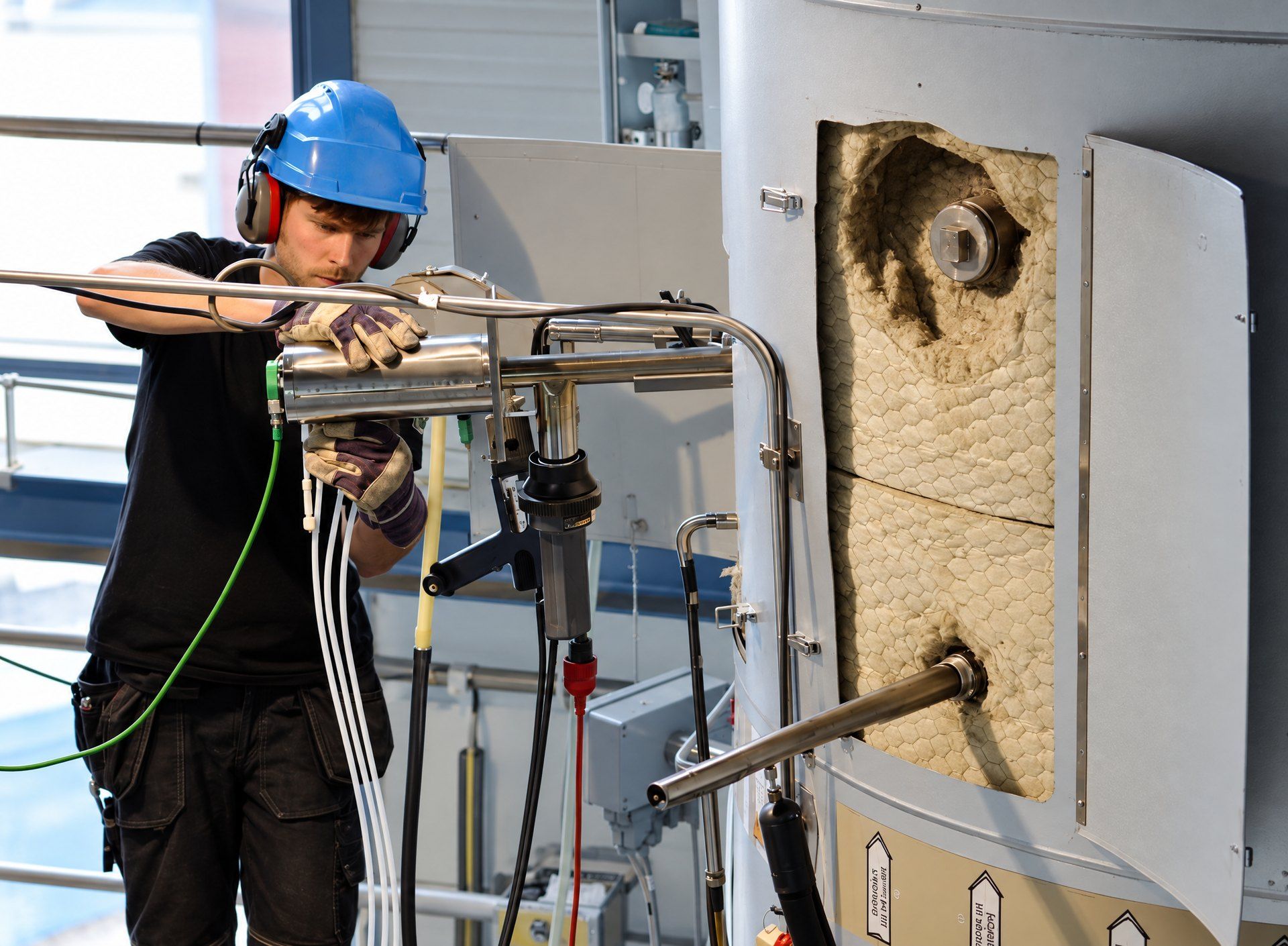
The measuring principle is wet chemical absorption. The sample gas is drawn out through a heated probe with a particle filter, which retains dust and particle-bound fluorides. The gas then bubbles through two absorption bottles in series with 0.1 M sodium hydroxide, where the gaseous fluorides dissolve as fluoride ions. An empty bottle catches splashes, and a drying tower with silica gel dries the gas before the valve, pump and flow meter. Finally a dry gas meter with a thermometer measures the sample gas volume drawn.
- 1. Probe with filter holder, heated
- 2. Absorption bottles with absorption solution, in a cooling bath
- 3. Knock-out bottle
- 4. Drying tower
- 5. Valve
- 6. Sampling pump
- 7. Flow meter
- 8. Gas meter
- 9. Thermometer at the gas meter
Fluorides can react with glass. ISO 15713 therefore specifies, for example, quartz glass for the probe and quartz glass, polypropylene or polyethylene for the bottles, and the filter support may not be a glass frit. CEN/TS 17340 also accepts PTFE and borosilicate glass (for the bottles if the solution is then transferred to a plastic bottle), but not glass fibre filters. The probe and the filter are kept at not less than 150 °C and at least 20 °C above the dew point of the flue gas.
How is an HF measurement done?
Measurement plan
In homogeneous flue gas one measurement point is enough. According to ISO 15713 the gas is homogeneous when the temperature and the oxygen content deviate by at most 5 % from the mean over the cross-section. Otherwise several points are sampled, at least 3 minutes at each.
Field blank and leak test
The field blank is taken before the measurement series, at least once a day: the equipment is connected and rinsed as for a sample, but no flue gas is drawn through it. Before each sub-sample the leak rate must be at most 2 % of the sample gas flow.
Sampling
The sample gas is drawn through the bottles at a steady flow, normally about 6 l/min, which may not change by more than 10 %. A sub-sample takes at least 30 minutes, for a cyclic process at least one whole cycle.
Rinsing
The solution is poured into a plastic sample bottle. The bottles and the unheated tubing from the filter are rinsed with deionised water, which is added to the sample. If condensation is seen in the probe, the sample is rejected.
Analysis
An accredited laboratory determines the fluoride content of the sample and the field blank: with an ion-selective electrode according to ISO 15713, or by ion chromatography or spectrophotometry according to CEN/TS 17340.
Calculation and report
The amount of fluoride is converted to HF with the factor 20/19 and divided by the dry sample gas volume at 0 °C and 101.3 kPa. The result is reported in mg/Nm3 with measurement uncertainty.
The requirements in ISO 15713
ISO 15713 sets the basic requirements. The newer CEN/TS 17340 adds requirements for the field blank and the measurement uncertainty.
| Requirement | Value |
|---|---|
| Measuring range | Below 200 mg/m3 (ISO 15713) · 0.1–10 mg/m3 (CEN/TS 17340) |
| Materials | Resistant to fluorides – no glass frit under the filter |
| Filtration temperature | At least 150 °C and at least 20 °C above the dew point |
| Absorption | At least 95 % – according to CEN/TS 17340 checked every measurement day |
| Leak rate | At most 2 % of the sample gas flow, before and after the sample |
| Sampling time | At least 30 min; at least 3 min per measurement point |
| Field blank | At most 10 % of the emission limit value (CEN/TS 17340) |
| Measurement uncertainty | At most 30 % of the daily emission limit value, or 0.6 mg/m3 when it is below 2 mg/m3 (CEN/TS 17340) |
What does the method measure – HF or fluorides?
Both methods determine gaseous fluorides, expressed as HF: everything that passes the heated filter and gives fluoride ions in the solution is counted. Fluorocarbons are not measured. Particle-bound fluorides stay on the filter, which according to ISO 15713 is not analysed. An automated measuring system that measures optically, on the other hand, determines HF specifically and can therefore show a different value.
CEN/TS 17340 from 2020 is a European technical specification, written as a reference method but not yet an EN standard. It has two cases: gaseous fluorides only, or gaseous and particle-bound fluorides together. In the second case the sample is taken isokinetically and the filter is analysed too.
If the gas contains droplets, as after a wet scrubber, isokinetic sampling at several measurement points is required: the droplets can contain dissolved fluorides. According to our method this also applies when fluorides and ammonia are present in the gas at the same time. 1 ppm HF corresponds to 0.89 mg/Nm3.
Where does HF come from?
HF forms when the fuel or the raw material contains fluorine. In combustion the fluorine comes with the fuel. The BAT conclusions have emission levels for HF when firing coal, solid biomass and peat, and the Swedish Ordinance on Waste Incineration (SFS 2013:253) when incinerating waste.
In the process industry the fluorine comes from the raw material or an additive: the cryolite bath in the electrolysis cells for primary aluminium, fluorspar and cryolite in the batch for special glass, calcium fluoride as a flux in cupola furnaces and the hydrofluoric acid in the mixed acid that pickles high-alloy steel.
The emission is limited with fuels and raw materials low in fluorine and with flue gas cleaning: a wet scrubber, or dry sorbent (hydrated lime or sodium bicarbonate) upstream of a bag filter. For electrolysis cells in aluminium smelters the BAT conclusions specify a dry scrubber with alumina as adsorbent, followed by a fabric filter.
Which emission limit values apply to HF?
The emission limit values for HF are low: at waste incineration plants a tenth of the value for HCl. They are in the permit, in the Swedish Ordinance on Waste Incineration (SFS 2013:253) or in the BAT conclusions, whose emission levels apply as limit values no later than four years after publication (the Swedish Industrial Emissions Ordinance, SFS 2013:250). The ordinances on large and medium combustion plants (SFS 2013:252 and SFS 2018:471) have no emission limit values for HF.
| Plant and averaging period | HF, mg/Nm3 | Source |
|---|---|---|
| Waste incineration, daily (11 % O2) | 1; BAT-AEL < 1 (daily or sampling period) | SFS 2013:253, section 57; BAT conclusions (EU) 2019/2010, BAT 27 |
| Waste incineration, half-hourly (11 % O2) | 4, or 2 during 97 % of the half-hours of the year | SFS 2013:253, section 61 |
| Cement kiln (10 % O2) | 1 as a daily average when co-incinerating waste; BAT-AEL < 1 (daily or sampling period) | SFS 2013:253, section 68; BAT conclusions 2013/163/EU, BAT 26 |
| Solid biomass or peat from 50 MW, sampling period (6 % O2) | < 1; existing plants below 100 MW < 1.5 | BAT conclusions (EU) 2021/2326, BAT 25 |
| Primary aluminium, electrolysis cells | ≤ 1.0; total fluorides ≤ 1.5 | BAT conclusions (EU) 2016/1032, BAT 67 |
| Glass melting furnaces | < 1–5 for container glass, domestic glass and mineral wool; < 1–4 for flat glass | BAT conclusions 2012/134/EU |
| Mixed-acid pickling, daily or sampling period | < 1 | BAT conclusions (EU) 2022/2110, BAT 24 |
What does an HF measurement cost?
The price depends on the number of stacks or ducts and operating conditions and on the number of sub-samples. Low concentrations require a longer sampling time, and every sample and field blank is analysed in a laboratory. If HF is measured during the same visit as HCl, SO2 and dust, travel and set-up are shared. Sampling at several measurement points, difficult access and a long journey raise the cost. Request a quote – we reply within two working days. Approximate prices for the most common measurements are in the price guide.
How often must HF be measured?
As often as the permit says. At waste incineration plants HF is measured continuously, or periodically like the metals if the flue gas cleaning ensures that the emission limit value for HCl is met: every three months during the first twelve months of operation, then at least twice a year. The BAT conclusions then require at least every six months and stable HCl levels. For solid biomass and peat and for mixed-acid pickling the BAT conclusions specify once a year, every three months for coal and continuous or yearly measurement in aluminium smelters.
Measure HF yourself
-
 GM11-101
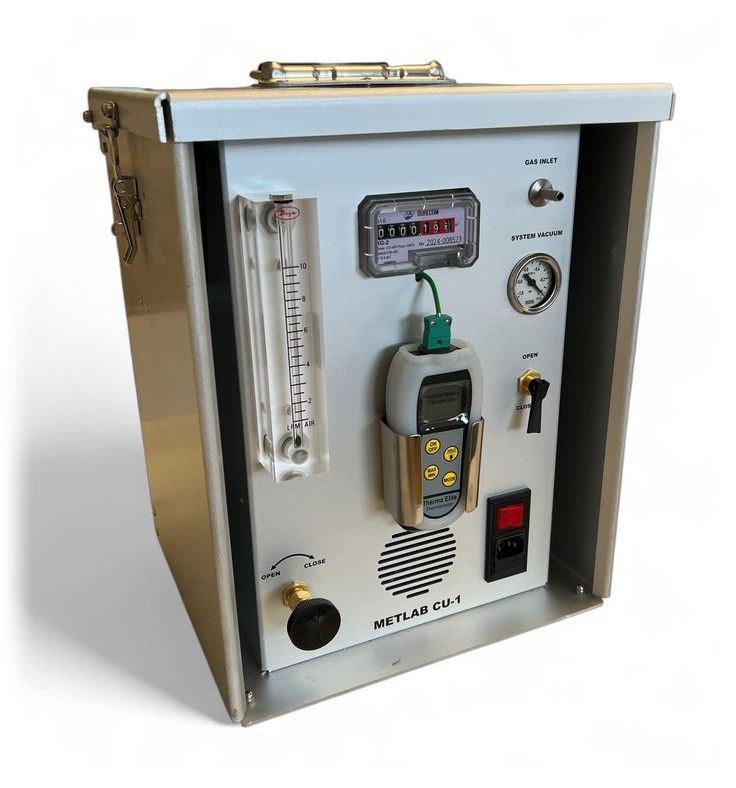
CU-1-10 gas sampler
Control unit with pump, drying tower, flow meter and gas meter. The CU-1-10 gives up to 10 l/min, the CU-1-20 up to 20.
-
 GM25-101 · GM25-102
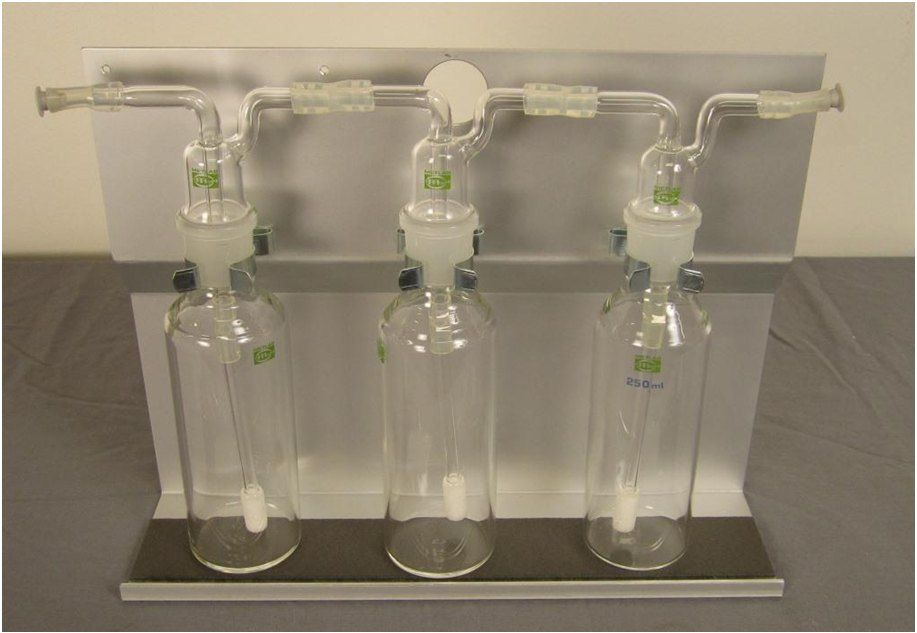
Bottle rack with absorption bottles
Rack for two or three bottles (impingers) in series. The bottles are changed quickly between sub-samples.
Frequently asked questions about HF measurement
Is the HF measurement accredited?
Yes. Sampling according to ISO 15713 and CEN/TS 17340 is within METLAB's Swedac accreditation. The analysis is done by an accredited laboratory, and the report gives the result with measurement uncertainty and field blank.
Which standard applies to HF?
There is still no EN standard for HF, as the BAT conclusions for waste incineration also note. ISO 15713 is used in practice and is named in the BAT conclusions for non-ferrous metals; CEN/TS 17340 is newer and sets more quality requirements. We are accredited for both.
How long does an HF measurement take?
Each sub-sample takes at least 30 minutes, and the BAT conclusions use the average of three consecutive sub-samples. At low concentrations the sampling time is extended: ISO 15713 estimates the detection limit at 0.1 mg/m3 with 0.1 m3 of sample gas, and a larger sample volume gives a lower limit.
Can HF be measured at the same time as HCl and SO2?
Yes. From the same heated probe and filter, sample streams are led to parallel bottle racks, each with its own absorption solution. CEN/TS 17340 also allows deionised water as the absorption solution, so that HCl and HF can be determined in the same bottles.
What is required of the measurement site?
A sampling port, a safe working platform and electricity for the probe heating and the pump. When several measurement points are to be sampled (after a wet scrubber or in stratified flue gas), a measurement site according to EN 15259 is needed, as for dust measurement.