
On this page
When do you need to measure SO3?
- Permit conditions. The environmental permit sets an emission limit value for SO3 or sulphuric acid and how often it is to be checked.
- Large combustion plants with SCR: the BAT conclusions require SO3 to be measured once a year. There is no EN standard, so the handbook's method is used.
- Emission limit values for SOx (the sum of SO2 and SO3 expressed as SO2) in the BAT conclusions for refineries, glass, cement, iron and steel, and pickling with sulphuric acid.
- Performance tests and troubleshooting: SO2 conversion over the SCR catalyst, the acid dew point upstream of the air preheater and the stack, ammonium bisulphate deposits, a blue plume.
- Calibration of SO2 measuring systems. The reference method for SO2 also captures SO3. At high SO3 concentrations both are sampled together, so that they can be told apart at QAL2 and AST.
How the sampling train is built
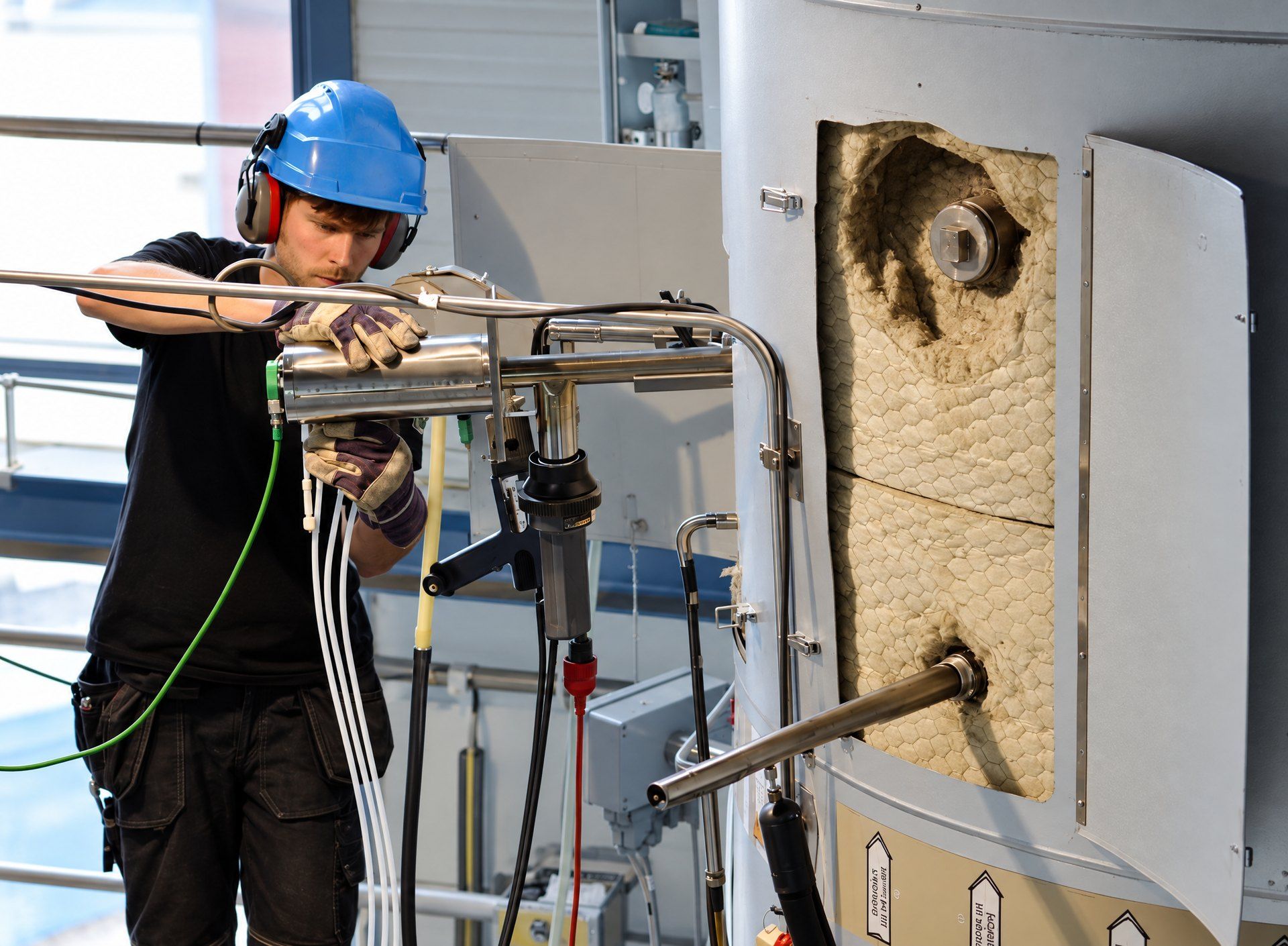
The sample gas is drawn through a heated probe of borosilicate or quartz glass with a quartz fibre filter, kept at 200 °C so that no sulphuric acid is deposited on the way. The gas then passes a condenser that a thermostatic bath keeps at 60–90 °C, above the water dew point but below the acid dew point, so that the sulphuric acid condenses on the walls of the condenser and in a sintered glass filter while SO2 and water vapour pass on. A gas wash bottle protects the equipment from acid gases, a drying tower dries the gas, and after a control valve, a pump and a flow meter a gas meter with a thermometer measures the sample gas volume.
- 1. Probe with filter holder, heated
- 2. Absorption bottles with absorption solution, in a cooling bath
- 3. Knock-out bottle
- 4. Drying tower
- 5. Valve
- 6. Sampling pump
- 7. Flow meter
- 8. Gas meter
- 9. Thermometer at the gas meter
The handbook also describes the 2-propanol method, where SO3 is absorbed in 80 % 2-propanol and dissolved SO2 is driven off with air after the sample; it is needed in completely dry gases.
How is an SO3 measurement done?
Measurement plane and measurement point
The measurement site must meet EN 15259. In homogeneous flue gas one measurement point is enough; downstream of a rotary air preheater with air in-leakage, SO3 can be unevenly distributed, and then we sample at several points.
Heating and leak test
The probe and the filter are heated to 200 °C, at least 20 °C above the acid dew point, and the bath of the condenser is set to about 90 °C. With the probe nozzle plugged, the leak rate may be at most 2 % of the sample gas flow.
Field blank and sampling
A field blank before each measurement series shows that the equipment is clean. The sample gas is then drawn at 1 l/min for at least 30 minutes, or long enough that the condensate is calculated to give at least 0.1 mg/l sulphate. The gas meter and the temperature are read every five minutes until the temperature is stable.
Washing out
After the sample the condenser is rinsed with wash solution with indicator, 40 ml and then 10 ml at a time, until the colour shows that all the acid has come out. The condenser is dried with acetone before the next sample.
Analysis and report
An accredited laboratory determines the sulphate content by ion chromatography; the handbook also allows titration with sodium hydroxide. We convert to mg SO3/Nm3 dry gas at the reference oxygen content and report the result with its measurement uncertainty.
The requirements in chapter 5.14 of the handbook
These requirements decide whether an SO3 sampling by controlled condensation is valid.
| Requirement | Value |
|---|---|
| Filtration temperature | 200 ± 5 °C, and at least 20 °C above the acid dew point |
| Condenser | Thermostatic bath at about 90 °C, never below 60 °C – water must not condense |
| Materials | Probe of borosilicate or quartz glass, filter of quartz fibre |
| Leak rate | At most 2 % of the expected sample gas flow |
| Sample gas flow and sampling time | 1 l/min ± 10 %, at least 30 min and at least 0.1 mg/l sulphate in the analysis solution |
| Sample volume | Uncertainty below 1 %; the gas meter's uncertainty below 2 % |
SO3, sulphuric acid and the acid dew point
In combustion the sulphur in the fuel becomes almost entirely SO2. Only a small part (in flue gas from combustion plants usually less than 5 % of the SO2 concentration) is oxidised further to SO3 in the flame and catalytically on ash and hot surfaces. An SCR catalyst oxidises a further part, normally less than 1 %. When the flue gas is cooled in the air preheater, SO3 binds water vapour to form sulphuric acid. At 200 °C almost all the SO3 is sulphuric acid vapour.
The acid dew point lies well above the water dew point: in coal-fired boilers around 120–140 °C, and higher the more SO3 and water the gas contains. Below it the acid condenses: corrosion in air preheaters, ducts and the stack, and a fine acid mist that gives a blue plume and that a wet scrubber captures only partly. With ammonia from SNCR or SCR, sticky ammonium bisulphate also forms and fouls air preheaters. SO3 is therefore measured mainly when firing coal and heavy fuel oil, downstream of SCR and in processes with sulphuric acid.
Which emission limit values apply to SO3?
The ordinances on large and medium combustion plants and on waste incineration set emission limit values for SO2, not for SO3. Limit values for SO3 come from the permit and from BAT conclusions where the parameter is SOx, the sum of SO2 and SO3 expressed as SO2: refineries, glass, cement, iron and steel. For pickling with sulphuric acid the BAT-AEL for SOx, including sulphuric acid aerosol, is < 1–6 mg/Nm3 as a daily average or as an average over the sampling period. For large combustion plants there is no emission level for SO3, only the requirement to measure once a year when SCR is used.
What does an SO3 measurement cost?
The price depends on the number of stacks or ducts, operating conditions and sub-samples, on the sampling time (which grows when the concentration is low) and on the laboratory analysis of every sample and field blank. SO3 is often sampled together with SO2 in the same sampling train, and if dust, NOx and oxygen are measured during the same visit, travel and set-up are shared. Difficult access and a long journey raise the cost. Request a quote – we reply within two working days. Approximate prices for the most common measurements are in the price guide.
How often must SO3 be measured?
As often as the permit says. The ordinances set no requirements for SO3 measurement. The BAT conclusions for large combustion plants require a measurement once a year when SCR is used; those for refineries require periodic measurement, for example when the SO2 measuring system is calibrated; and for pickling with sulphuric acid SOx is measured once a year. For performance tests and troubleshooting the purpose decides the number of samples.
Measure SO3 yourself
-
 GM11-101
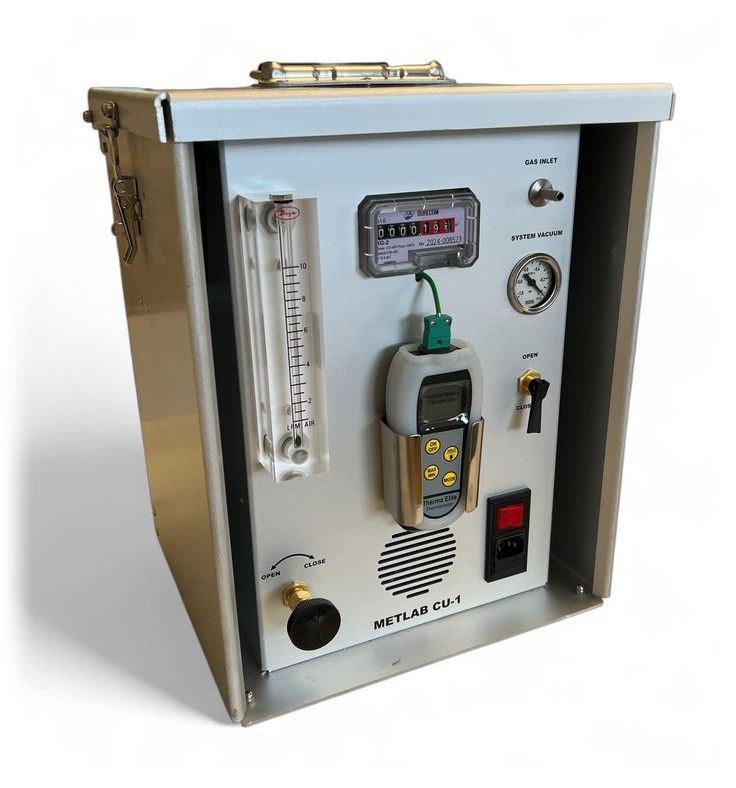
CU-1-10 gas sampler
Control unit with vacuum pump, drying tower, flow meter and gas meter. Up to 10 l/min – the CU-1-20 handles 20.
-
 GM25-101 · GM25-102
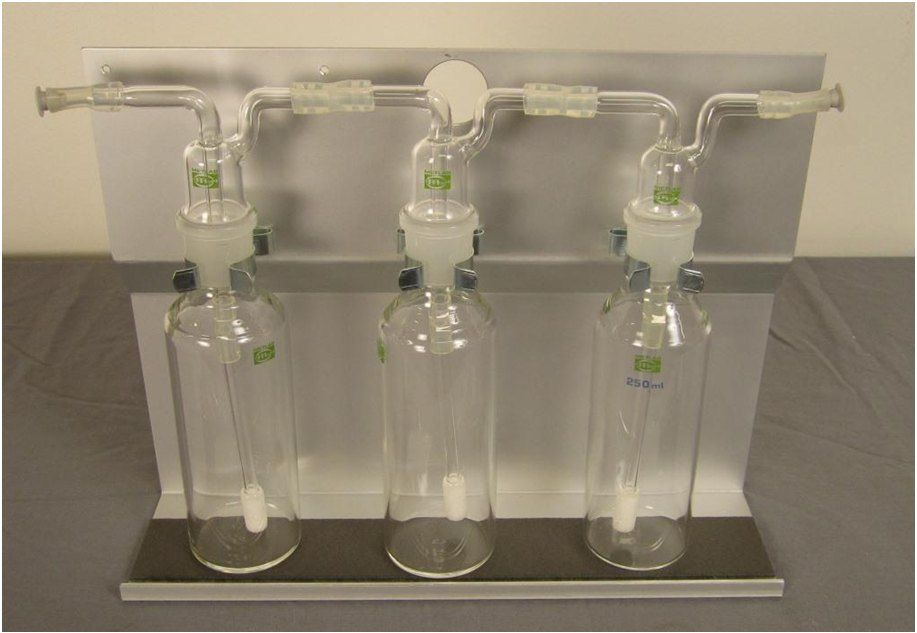
Bottle rack with absorption bottles
Two or three bottles (impingers) in series, 250 ml borosilicate glass with a glass insert and frit, for 2-propanol or hydrogen peroxide.
Frequently asked questions about SO3 measurement
Is the SO3 measurement accredited?
Yes, the sampling. METLAB's Swedac accreditation covers sampling of SO3 according to chapter 5.14 of Energiforsk's Emissionsmäthandbok 2015; the analysis is done by an accredited laboratory. The detection limit is 0.3 mg/Nm3 at a normal sampling time, according to our method list, and is lowered by a longer sampling time.
Can SO3 be measured at the same time as SO2?
Yes. SO2 passes the condenser unaffected and is captured in absorption bottles with hydrogen peroxide downstream of it, so both are determined from the same sample. That is also the way to tell them apart, since the reference method for SO2 on its own counts SO3 as SO2.
Why must the probe and the filter be so hot?
Below the acid dew point the sulphuric acid condenses, and on the filter it can react with dust, especially alkaline dust. That part never reaches the condenser. At 200 °C, or at least 20 °C above the acid dew point in hot flue gas, the acid follows the sample gas.
How long does an SO3 measurement take?
Each sub-sample takes at least 30 minutes at 1 l/min, and at low concentrations the sampling time is extended so that the analysis gets enough sulphate. Between sub-samples the condenser is washed out and dried, so count on a large part of a working day for a measurement series.
What is required of the measurement site?
A sampling port where the probe reaches a representative point, a safe working platform and electricity for the probe heating, the thermostatic bath and the pump, according to EN 15259. Where SO3 is unevenly distributed, as downstream of a rotary air preheater with air in-leakage, measurement at several points is needed.