On this page
Who needs to determine the biogenic fraction?
- Waste incineration in the EU Emissions Trading System. Swedish waste-to-energy plants have been included since 2013. Biogenic carbon dioxide has an emission factor of zero, so the biogenic fraction must be determined and reported every year.
- Mixed fuels: recovered wood, solid recovered fuel, tyres and plastics in CHP plants, cement kilns and lime kilns, where the fuel composition varies and is hard to establish from fuel samples.
- Carbon capture (bio-CCS): it is the captured biogenic carbon dioxide that counts as a removal in the EU certification framework, Regulation (EU) 2024/3012, so a mixed stream must be split into its biogenic and fossil parts.
- Climate reporting and customer requirements: owners, district heating customers and waste suppliers ask for the plant's fossil emissions, and a measured value replaces the default value.
How the carbon-14 method works
Carbon-14 (14C) is a radioactive carbon isotope that is formed in the atmosphere by cosmic radiation and taken up by everything that grows. When the organism dies, the isotope decays with a half-life of 5,730 years. Oil, coal and natural gas are so old that all the carbon-14 is gone, while wood, paper and food waste have roughly the concentration the air had when they grew. The share of carbon-14 in the carbon dioxide of the flue gas therefore shows how much of the carbon is biogenic.
The laboratory measures the concentration by accelerator mass spectrometry (AMS) or liquid scintillation counting and states it as percentage modern carbon, pmC. The biogenic fraction is the sample's pmC divided by the reference value for fully biogenic carbon: 104 pmC for biomass from 2011, so that a sample with 52 pmC has 50 % biogenic carbon dioxide. The reference value is above 100 because the nuclear weapons tests of the 1960s almost doubled the carbon-14 in the air, and it falls by about 0.3 % a year. The fraction times the plant's total carbon dioxide emissions gives the tonnes of biogenic and the tonnes of fossil CO2.
How the sampling train is built
The flue gas is extracted through a probe with a filter and led in a heated sample line to a gas conditioning unit that removes the moisture, so that dry gas goes to the absorbent. A pump keeps a surplus flow past the sampler, which draws a small sample stream in proportion to the plant's flow signal. The sample stream bubbles through a bottle of sodium hydroxide, which binds the carbon dioxide. After the bottle an oxygen sensor measures the remaining gas: if the concentration differs from that in the stack, air has leaked in.
- 1. Probe with filter
- 2. Heated sample line
- 3. Gas conditioning that removes the moisture
- 4. Pump that keeps a surplus flow past the sampler
- 5. Flow control, driven by the plant's flow signal
- 6. Bottle with sodium hydroxide that binds the carbon dioxide
- 7. Oxygen sensor that reveals air leaks
The sampler is our own C14G2. In short campaigns we sample at constant flow: a sample stream of the conditioned sample gas is pumped through two gas wash bottles with sodium hydroxide in series, or into a gas-tight sample bag.
How is the sampling done?
Measurement site and sampling plan
A homogeneity test shows whether the carbon dioxide concentration is even across the duct's cross-section; if it is, one sampling point is enough. Operating data show whether the flue gas flow varies so much that the sample must be taken in proportion to the flow.
Absorbent and leak test
Carbonate-free sodium hydroxide, 4 mol/l, is delivered in ready-filled bottles. Before the start the probe is plugged: the sample gas flow must fall towards zero. Less than 2 % of the normal flow is accepted.
Sampling
During the sampling period, normally one month, the sampler draws about 5 ml/min in proportion to the flue gas flow, and the oxygen concentration after the bottle is compared continuously with that in the stack. A short campaign usually runs for 24 hours at constant flow, about 50 ml/min.
Bottle change and blank sample
The bottle is changed, sealed at once and weighed. The sodium hydroxide also takes up carbon dioxide from the air, so a blank sample that has been handled the same way but without flue gas goes to the laboratory with it.
Carbon-14 analysis
An accredited laboratory drives the carbon dioxide out of the solution with acid, converts it to graphite and measures carbon-14 by AMS. With flow-proportional sampling the amount of carbon dioxide collected is also checked.
Calculation and report
We convert the laboratory's pmC value into the share of biogenic and fossil carbon dioxide and evaluate the sampling: flow, proportionality, leak tightness and blank sample. The result is reported with its expanded measurement uncertainty.
The requirements in EN ISO 13833
These requirements decide whether a sample is valid. The carbon dioxide in air contains carbon-14 like biomass: if air leaks in, or the sodium hydroxide takes up carbon dioxide from the air, the biogenic fraction comes out too high.
| Requirement | Value |
|---|---|
| Measuring range | Biogenic fraction 2–100 % of the carbon dioxide. Below 10 % the carbon dioxide in the combustion air must be taken into account |
| Sampling time | From 1 hour up to 1 month per sample |
| Constant sample flow | Allowed when the flue gas flow varies by at most 55 % during the sampling time, counted as two coefficients of variation. Otherwise in proportion to the flow |
| Flow-proportional sampling | Flow controller within 5 % of reading. The amount of carbon dioxide collected is verified by chemical analysis |
| Absorbent | At least 1 mol/l sodium or potassium hydroxide, with more than 25 % of the capacity left after the sample |
| Blank samples | Laboratory and field blanks must show that no carbon dioxide from the air has got in |
| Reference value for 100 % biogenic carbon | 104 pmC for biomass from 2011, minus about 0.3 % a year. Well-documented local values may be used |
| Measurement uncertainty (expanded, k = 2) | 5 % of the value at a biogenic fraction of 10–100 %, 10 % at 2–10 % |
Carbon-14 or calculation?
Regulation (EU) 2018/2066 accepts several ways of determining the biogenic fraction.
| Method | Based on | Points to consider |
|---|---|---|
| Carbon-14 in the flue gas, EN ISO 13833 | A sample of the carbon dioxide leaving the stack | Needs no knowledge of the fuel. The flue gas mixes everything that is burnt, so one sample covers the whole period |
| The balance method, ISO 18466 | A calculation model with operating data (waste quantity, steam production, flue gas flow, O2 and CO2) and typical values for biogenic and fossil material | Gives continuous values without a laboratory, but needs accurate instruments. According to the standard the results can be verified with carbon-14 |
| Fuel samples | Samples of the waste, analysed by carbon-14 or selective dissolution, for example | Mixed waste is hard to sample representatively. An analysis is required for every 5,000 tonnes of untreated solid waste, at least four times a year |
What do the rules say?
The requirement is in the EU's Monitoring and Reporting Regulation for the Emissions Trading System, (EU) 2018/2066, which applies directly in Sweden. The method must be stated in the plant's monitoring plan; the Swedish Environmental Protection Agency (Naturvårdsverket) is the permit authority.
| Question | What applies | Rule |
|---|---|---|
| Biogenic carbon dioxide | Biomass has an emission factor of zero. Where the Renewable Energy Directive's sustainability criteria apply, they must be met; otherwise the carbon counts as fossil | (EU) 2018/2066, Article 38 |
| Method in the stack | Carbon-14 according to EN ISO 13833, the balance method ISO 18466 or an estimation method published by the Commission | Article 43(4) |
| How often | Flue gas samples are analysed for every 50,000 tonnes of carbon dioxide, but at least once a month. The sampling plan must be representative of the whole reporting year | Article 43(4) and Annex VII |
| Sweden | Waste-to-energy plants have been in the Emissions Trading System since 2013 | The Swedish Ordinance on Certain Greenhouse Gas Emissions (SFS 2020:1180), Annex 1 |
| The rest of the EU | Municipal waste incineration has been monitored and reported since 1 January 2024. On 17 July 2026 the Commission proposed that allowances be surrendered step by step from 2031 and in full from 2034. The proposal has not been adopted | Directive 2003/87/EC |
What does it cost to determine biogenic CO2?
The price depends on the number of flue gas ducts, sampling periods per year and carbon-14 analyses, normally one analysis per duct and month. It also matters whether you own the sampler or we provide it, how much of the bottle changes and supervision your own staff handle, and whether a probe, gas conditioning and a flow signal are already in place. Short campaigns are quoted per occasion. Request a quote and we will reply within two working days. Approximate prices for the most common measurements are in the price guide.
Sample yourself with the C14G2
-
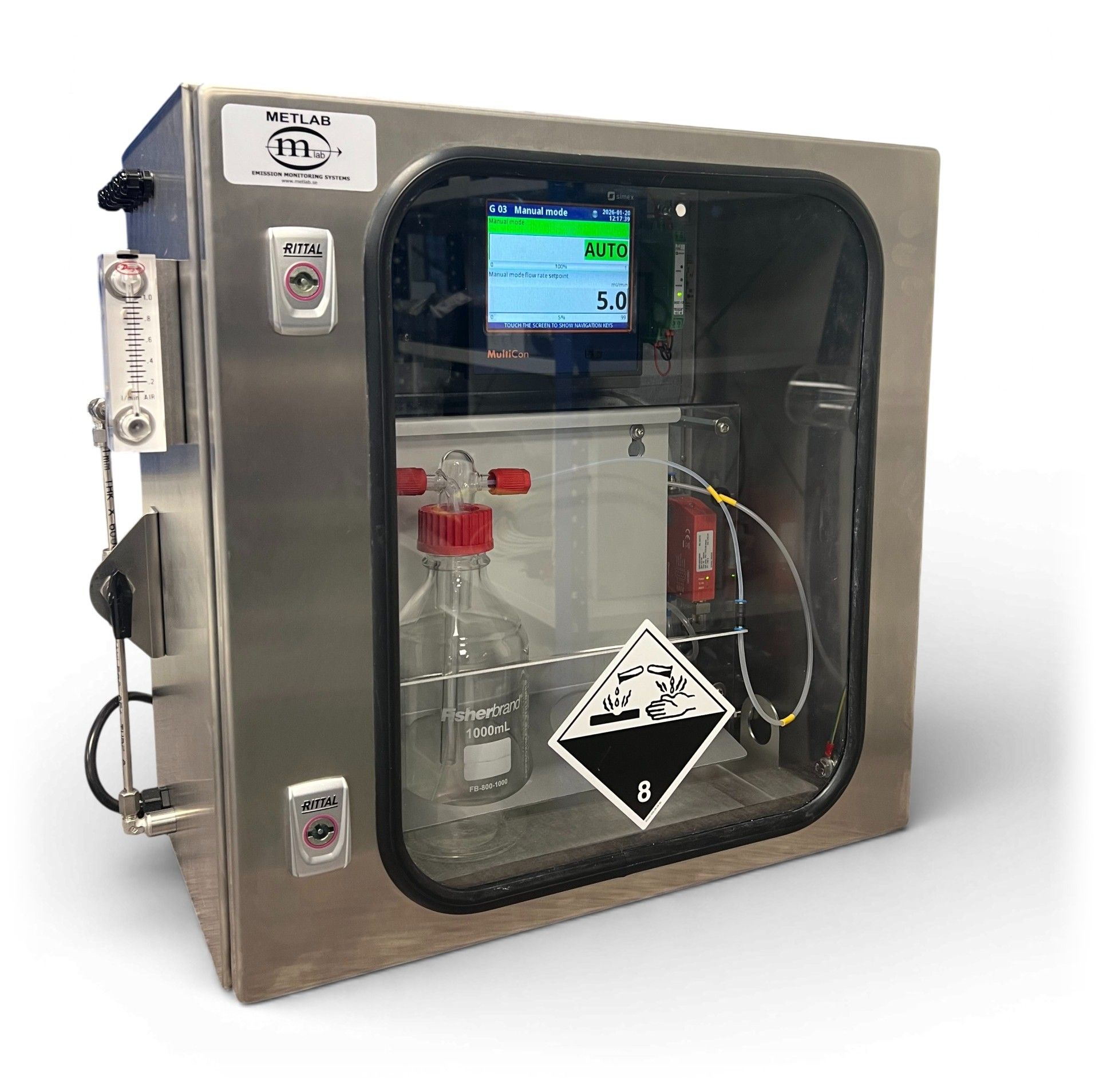 C1411-101
C14G2 sampler for biogenic CO2
Flow-proportional sampling according to EN ISO 13833 with a built-in leak check. Buy the sampler and run the sampling yourself.
-
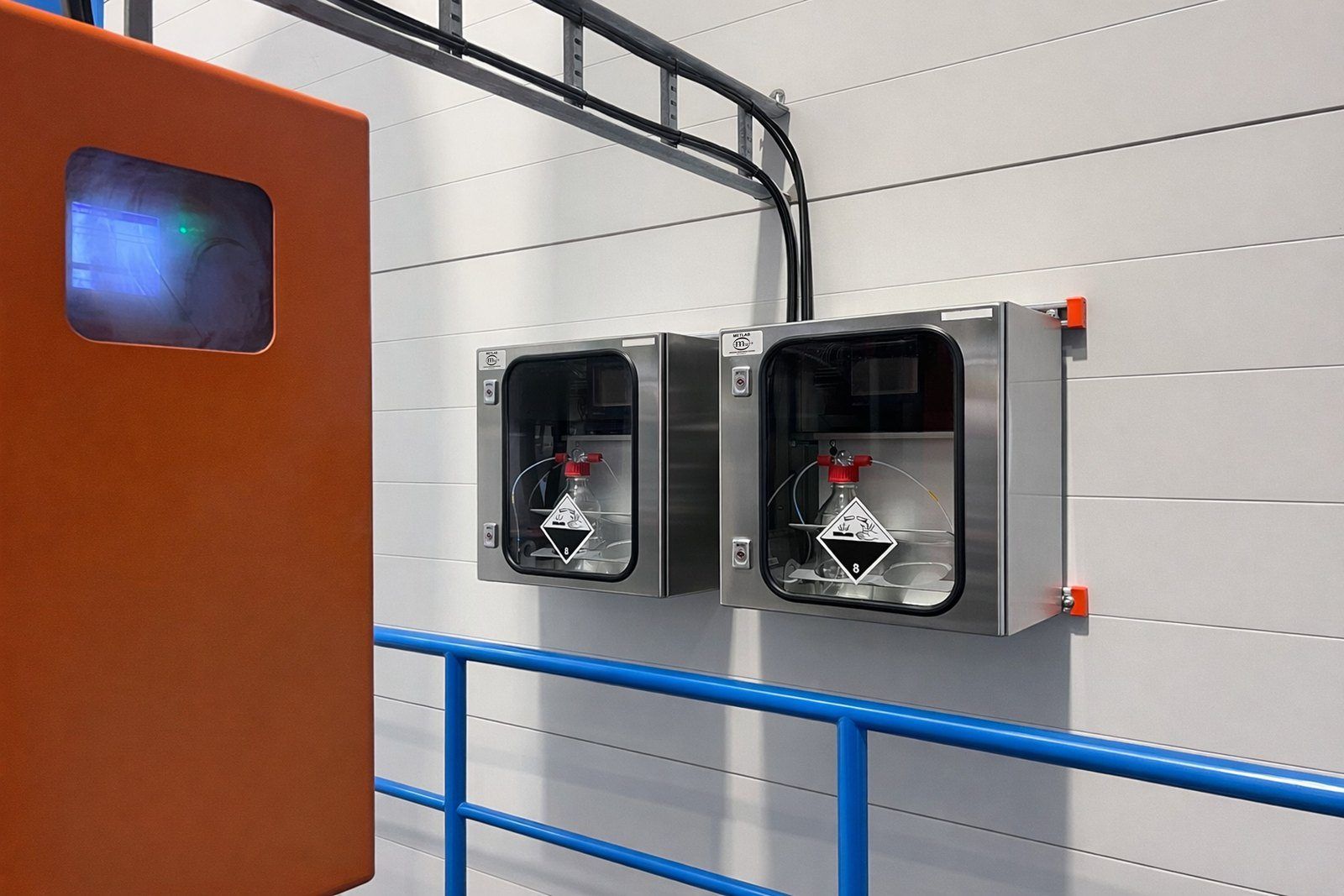 Full service
Absorbent, analysis and report
We deliver ready-made absorbent, install the sampler, take care of the samples and arrange the carbon-14 analysis, evaluation and report.
Frequently asked questions about biogenic CO2
How long is a sampling period?
Normally one month per sample. That is the longest sampling time EN ISO 13833 describes, and Regulation (EU) 2018/2066 requires an analysis at least once a month. If the plant emits more than 50,000 tonnes of carbon dioxide in a month, samples are needed more often.
Can the sampler run unattended?
Yes. The sample flow is controlled by the plant's flow signal, and the oxygen sensor monitors the leak tightness throughout the period. The operating values can be brought into the control room. Our first permanent installation has been in operation since 2015.
Is the determination of biogenic CO2 accredited?
Yes, the sampling. METLAB's Swedac accreditation covers the sampling of biogenic and fossil carbon dioxide according to EN ISO 13833, both in proportion to the flow and at constant flow. The carbon-14 analysis is done by an accredited laboratory.
Does the method work after a flue gas condenser or at a low carbon dioxide concentration?
Yes. The sample gas is always dried before the absorbent, also when the flue gas is saturated after a scrubber or condenser. The sample flow and sampling time are adapted to the carbon dioxide concentration, and a few millilitres of carbon dioxide are enough for AMS analysis. What needs extra care is a low biogenic fraction, below 10 %.
How is the result used in the emissions report?
The biogenic fraction for each sampling period is multiplied by the period's total carbon dioxide emissions, which the plant measures in the stack from the carbon dioxide concentration and the flue gas flow, or calculates. The sum over the year gives the tonnes of biogenic and the tonnes of fossil carbon dioxide, and the emissions from biomass with an emission factor of zero are deducted from the total.
How much of the carbon dioxide from waste incineration is biogenic?
That depends on the waste. In the standard's validation studies at waste incineration plants in the Netherlands, Belgium and Switzerland, about half of the carbon dioxide was biogenic. A Swedish project at seven plants, reported in 2012, found that about a third of the carbon was fossil.