
On this page
When do you need to measure TOC?
- Permit conditions. The environmental permit sets an emission limit value for TOC, VOC or hydrocarbons and how often it is to be checked.
- Waste incineration (the Swedish Ordinance on Waste Incineration, SFS 2013:253): TOC is measured continuously, and the measuring system is checked every year by parallel measurements according to EN 12619 (QAL2 and AST).
- Organic solvents (the Swedish Ordinance on the Use of Organic Solvents, SFS 2013:254): in painting, printing and coating, the emission must be measured where abatement equipment is needed to meet the limit value, continuously above 10 kg of carbon per hour.
- BAT conclusions for surface treatment using organic solvents, the chemical industry, waste treatment, wood-based panels and smoke chambers in the food industry, among others, specify periodic measurement according to EN 12619.
- Checking the abatement plant: measurement before and after thermal or catalytic oxidation or an activated carbon filter shows the removal efficiency, for example at a performance test.
- Combustion control: together with CO, TOC shows how much unburnt matter leaves the boiler.
How the sampling train is built
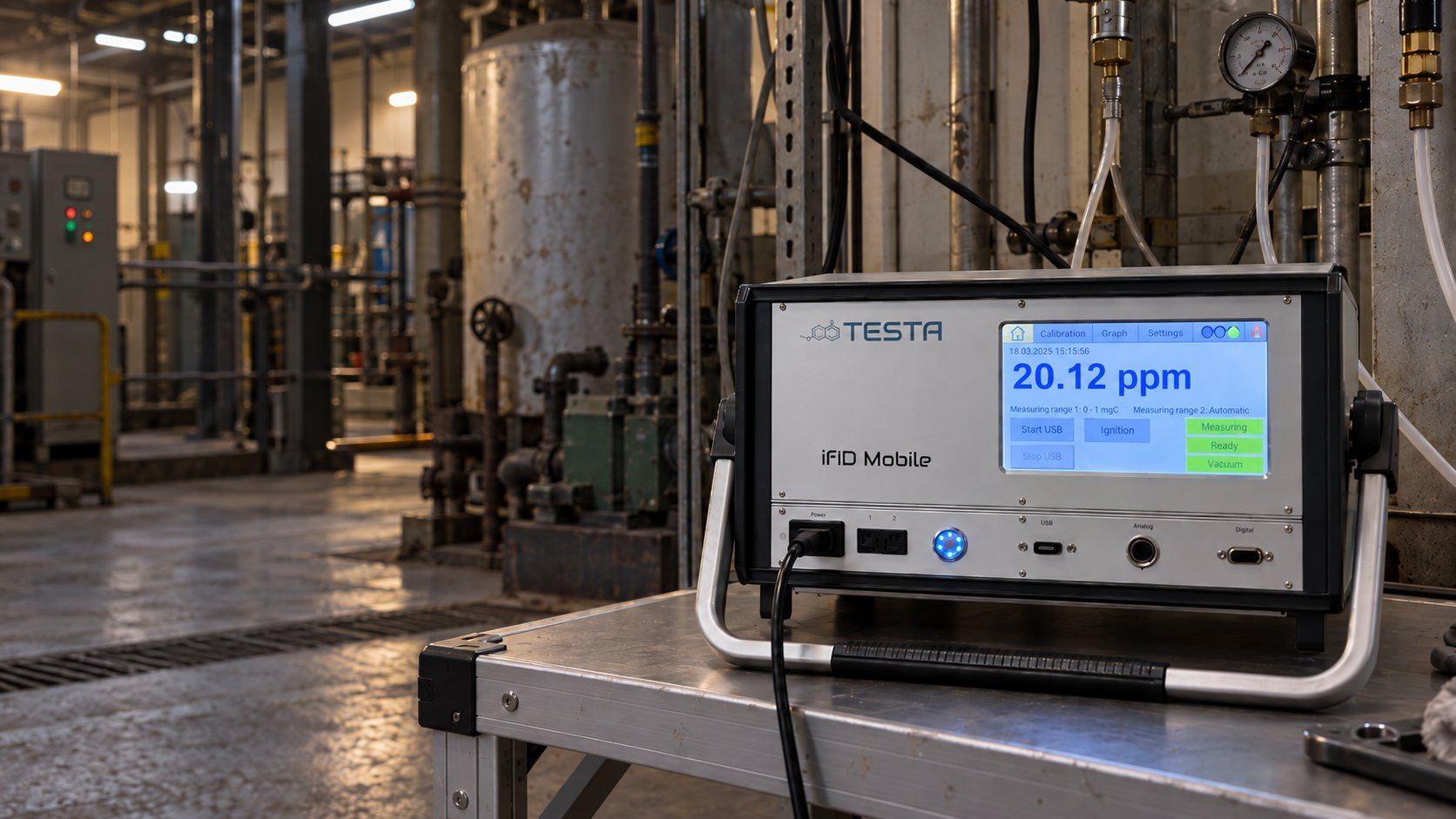
A sample stream of the gas is drawn out through a probe with a coarse filter and led through a heated sample line and a heated fine filter straight to the analyser. Nothing is cooled or dried: the whole sampling line is kept at a minimum of 180 °C, so that neither water nor solvents condense on the way. In the flame ionisation detector (FID) the sample gas is burnt in a hydrogen flame. Organically bound carbon then forms ions, and the current between two electrodes is proportional to the carbon concentration. The values are logged continuously, and zero and span gas can be connected at the probe.
- 1. Probe with coarse filter
- 2. Heated sample line
- 3. Fine filter, heated
- 4. Flame ionisation detector (FID), heated
- 5. Data acquisition
- 6. Zero and span gas (propane)
The signal follows the sample gas flow almost proportionally. A filter that clogs therefore gives readings that are too low, and the flow is monitored throughout the measurement. Heavy hydrocarbons and aerosols can stick in the sampling line and be released slowly, which shows as the instrument returning sluggishly to zero when the zero gas is connected.
How is a TOC measurement done?
Measurement plan and operating conditions
The measurement is planned according to EN 15259. According to the BAT conclusions, periodic measurements are made as far as possible when the emission is expected to be highest under normal operation.
Calibration and check
The sampling line is heated to at least 180 °C. Zero gas and span gas (propane of known concentration) are first led straight to the instrument, which is adjusted, and then in at the probe. If the readings differ by more than 2 % of the span gas value, we look for leaks or contamination in the line.
Measurement
TOC is measured continuously and logged. A measurement period is at least 30 minutes, and the BAT conclusions use the average of three in a row. The moisture content is measured at the same time, and for combustion also oxygen.
Check after the measurement
After the measurement period, and at least once a day, the zero and span points are checked again. If they have drifted by more than 2 % of the span gas value the readings are corrected; at more than 5 % the measurement is invalid.
Calculation and report
The readings are converted from ppm propane to mg C/Nm3 (dry gas at 0 °C and 101.3 kPa) and where needed to the reference oxygen content. You receive the result with its measurement uncertainty in an accredited, digitally signed report.
The requirements in EN 12619
These requirements in the standard decide whether a TOC measurement is valid. The sampling line, response time and drift are checked at every measurement, linearity and interferences at least once a year.
| Requirement | Value |
|---|---|
| Measuring range | Up to 1,000 mg C/m3 |
| Temperature in the sampling line | At least 180 °C all the way to the detector |
| Residence time and response time | The sample gas reaches the detector in less than 60 seconds, and the response time is at most 200 seconds |
| Span gas | Propane of known concentration, uncertainty at most 2 % |
| Check of the sampling system | At most 2 % difference from the direct calibration, relative to the span gas value |
| Zero and span drift | Above 2 % of the span gas value the readings are corrected; above 5 % the measurement is invalid |
| Linearity, the effect of oxygen and other interferences | At most 2 % of the measuring range each |
TOC, TVOC, VOC and NMHC: what is the difference?
The detector counts carbon atoms. It is calibrated with propane, and the result is given as organically bound carbon: 1 ppm propane corresponds to 1.61 mg C/Nm3. So the value says how much carbon the gas contains, but not which compounds the carbon sits in or what they weigh. The detector also responds with different strength to different compounds: those with oxygen in the molecule, such as alcohols, ketones and esters, give a lower signal than pure hydrocarbons.
| Term | What it means |
|---|---|
| TOC | Total organic carbon. The word used in the Swedish Ordinance on Waste Incineration and in many permits. |
| TVOC | Total volatile organic carbon: what the detector actually measures, since the filter in the sampling line removes particles and droplets. That is how the standard and the newer BAT conclusions write it, and the authorities normally accept the measurement as TOC. Oil mist is sampled on a filter in the duct, according to SS 28427 (Swedish standard). |
| VOC | Volatile organic compounds: a group of compounds defined by their vapour pressure. Solvent balances are counted in kilograms of solvent, concentrations in waste gases in mg of carbon. |
| NMHC or NMVOC | Hydrocarbons other than methane: TOC minus methane, which is measured with the same kind of detector after a converter. |
From ppm propane to mg C/Nm3
The detector measures in wet gas and shows ppm propane equivalents. The limit values refer to dry gas, and for combustion also to a given oxygen content. So the result is converted in up to three steps.
| Step | How we calculate | Example |
|---|---|---|
| 1. Convert to carbon | ppm propane × 1.61 | 5 ppm × 1.61 = 8.05 mg C/Nm3 in wet gas |
| 2. Convert to dry gas | Concentration × 100 / (100 − moisture content in vol %), with the moisture content measured at the same time | At 15 % moisture: 8.05 × 100/85 = 9.5 mg C/Nm3 |
| 3. Convert to the reference oxygen content | Concentration × (21 − reference O2) / (21 − measured O2) | From 8 to 11 % O2: 9.5 × 10/13 = 7.3 mg C/Nm3 |
Step 3 applies to combustion. For solvent processes the concentration is not converted to any oxygen content, and if the moisture content is below 2 % the standard requires no conversion to dry gas.
Which emission limit values apply to TOC?
The emission limit value for TOC is in the permit, in the ordinance for the activity or in a BAT conclusion. The BAT conclusions give ranges, where the upper value applies as the limit value under the Swedish Industrial Emissions Ordinance (SFS 2013:250). The ordinances on medium and large combustion plants have no limit value for TOC.
| Activity | TOC, mg C/Nm3 | Rule |
|---|---|---|
| Waste incineration | 10 as a daily average. Half-hourly average 20, or 10 for 97 % of the year. At 11 % O2 | SFS 2013:253, sections 57 and 59 |
| Waste incineration according to the BAT conclusions | Daily average < 3–10. At 11 % O2 | BAT 30, waste incineration |
| Co-incineration of waste in a large combustion plant | Annual average < 0.1–5 and daily average 0.5–10. At 6 % O2 | BAT 71, large combustion plants |
| Coating of wood, more than 25 tonnes of solvent per year | 75 from a coating process and 50 from a drying process, both operated under contained conditions | SFS 2013:254, section 57 |
| Coating of metal and plastic surfaces (except vehicles) according to the BAT conclusions | 1–20 as a daily average or as the average over the sampling period, up to 35 where the solvent is recovered | The BAT conclusions for surface treatment using organic solvents, table 11 |
Under the Swedish Ordinance on the Use of Organic Solvents (SFS 2013:254), a limit value is met at a periodic measurement if the average of all readings meets the value and no hourly average is more than 1.5 times as high.
What does a TOC measurement cost?
The price depends on the number of stacks or ducts and operating conditions, how long the measurement is to run, the conditions at the measurement site and the travel distance. There is no laboratory analysis: the result comes from the instrument on site. If methane and NMHC are to be reported, or the removal efficiency determined by measuring before and after the abatement plant, more instruments and more time are needed. If moisture, oxygen and gas flow are measured at the same time, the cost per parameter is lower. Request a quote – we reply within two working days. Approximate prices for the most common measurements are in the price guide.
How often must TOC be measured?
As often as the permit says. At waste incineration plants TOC is measured continuously, and the measuring system is checked against the reference method at least once a year. The Swedish Ordinance on the Use of Organic Solvents (SFS 2013:254) requires continuous measurement where the emission after abatement is above 10 kg of carbon per hour. Otherwise the measurement may be periodic, with no fixed interval but with at least three readings per measurement occasion. The BAT conclusions for surface treatment using organic solvents specify once a year for every stack below 10 kg of carbon per hour, and for the chemical industry every six months below 2 kg of carbon per hour, continuous above that.
Frequently asked questions about TOC measurement
Is the measurement accredited?
Yes. Both sampling and analysis of TOC according to EN 12619 are within METLAB's Swedac accreditation, as are methane according to EN ISO 25140, NMHC calculated from the two, and gaseous hydrocarbons according to SS 028427. The accredited measuring range for TOC is 0.05–10,000 ppm.
What applies when my permit refers to EN 13526?
EN 13526 covered TOC from processes using solvents. In 2013 it was merged with the EN 12619 of that time, which covered low concentrations at waste incineration and elsewhere. Today's EN 12619 covers both uses, up to 1,000 mg C/m3.
Can you measure individual solvents, for example toluene or ethanol?
Not with an FID: it shows the sum as carbon. If the composition is known, the result can be converted to the amount of solvent with response factors. Otherwise a sample is taken on activated carbon and analysed in a laboratory according to CEN/TS 13649. Ask us, and we will suggest a method.
Does the oxygen content affect the measurement?
Yes. Oxygen in the sample gas lowers the detector's signal, most at around 10 % oxygen. We therefore determine each instrument's sensitivity to oxygen with mixtures of nitrogen and oxygen, and correct the readings for the oxygen content measured at the same time.
Can TOC be measured at the same time as other parameters?
Yes. Moisture and oxygen are measured at the same time when the result is to be converted to dry gas and the reference oxygen content, and NOx, CO and other gases with a separate, cooled measuring system. With the gas flow, the emission can also be given in kg of carbon per hour.
What is required of the measurement site?
A sampling port where the probe reaches a representative point in the duct, a safe place to work and electricity for the heated line and the instrument. The requirements are in EN 15259. The instrument must stand close to the sampling port, since the sample gas must reach the detector in less than a minute.