
On this page
When do you need to measure H2S?
- Permit conditions. The environmental permit sets an emission limit value for hydrogen sulphide and how often it is to be checked.
- Kraft pulp mills: the BAT conclusions specify measurement of total reduced sulphur (TRS), which includes H2S, from the recovery boiler, the lime kiln and the dedicated TRS burner.
- Biological waste treatment such as composting and anaerobic digestion: H2S is measured every six months according to the BAT conclusions, unless the odour concentration is measured instead.
- Process industry with BAT-associated emission levels (BAT-AELs) for H2S: stone wool furnaces, the recycling of salt slag from aluminium and the processing of animal by-products.
- Performance tests and troubleshooting: removal efficiency across a scrubber or filter, H2S in raw gas and process gas, and checks of a permanently installed analyser.
How the sampling train is built
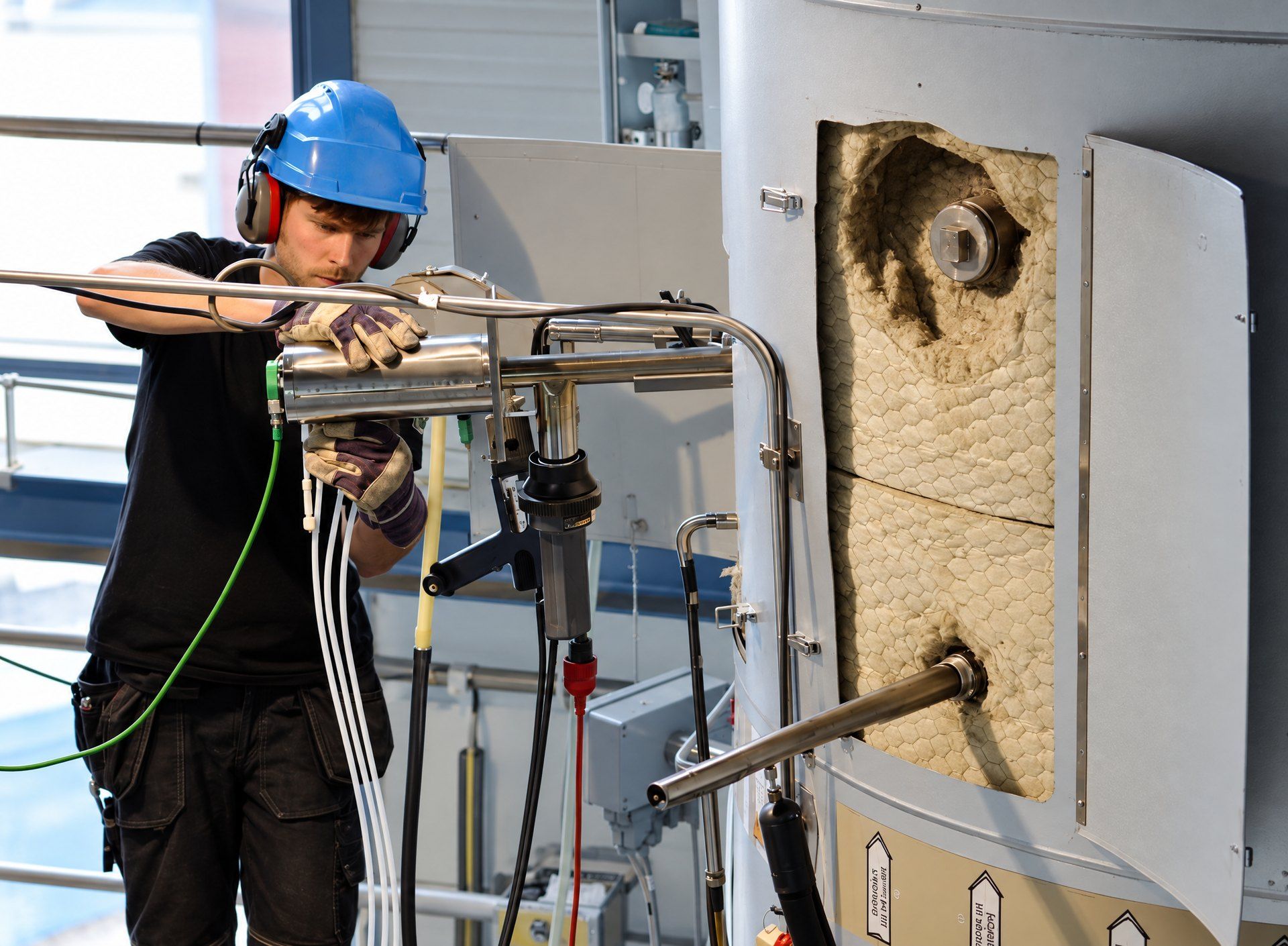
The measuring principle is wet chemical absorption with precipitation. The sample gas is drawn through a heated probe with a quartz fibre particle filter and bubbles through two absorption bottles with zinc acetate solution in a cooling bath, where the hydrogen sulphide is precipitated as zinc sulphide. Where needed, an empty knock-out bottle catches splashes and a drying tower with silica gel dries the gas. After the valve, pump and flow meter, a dry gas meter with a thermometer measures the sample gas volume.
- 1. Probe with filter holder, heated
- 2. Absorption bottles with absorption solution, in a cooling bath
- 3. Knock-out bottle
- 4. Drying tower
- 5. Valve
- 6. Sampling pump
- 7. Flow meter
- 8. Gas meter
- 9. Thermometer at the gas meter
The VDI 3486-2 guideline prescribes cadmium acetate. We use zinc acetate, 0.02 mol/l, and the sulphide is determined according to SMWW 4500-S2−. In raw gas and process gas with high concentrations a stronger solution is used. The bottles have tapered dispersion tubes instead of a frit.
How is an H2S measurement done?
Planning
The sampling time, the flow and the strength of the solution are calculated from the concentration expected: the sample should collect at least ten times more sulphide than the detection limit of the analysis, as a guide 10 mg/l.
Connection and leak test
Two absorption bottles are filled with about 70 ml of zinc acetate solution each. With the probe plugged, the train is tested for leaks; the leak rate may be at most 2 % of the sample gas flow.
Sampling
The probe and filter are kept at least 5 °C warmer than the gas. The sample gas is drawn through the bottles at 3–4 l/min for at least 30 minutes and must be colder than 20 °C after them.
Sample recovery
The tube is rinsed with absorption solution and the bottles with dilute acetic acid, and everything is collected in a sample bottle that is weighed. Zinc sulphide that remains is transferred mechanically.
Field blank
Before each measurement series, or once a day, a field blank is taken: the same handling, but without starting the pump.
Analysis and report
The laboratory determines the sulphide, which is converted to H2S and divided by the volume of dry sample gas at standard conditions. The result is reported in ppm or mg/Nm3 (dry gas at 0 °C and 101.3 kPa), with its measurement uncertainty.
The requirements in VDI 3486-2 and our method
VDI 3486-2 is a German guideline from 1979 with few detailed requirements. These requirements therefore also come from our accredited method description.
| Requirement | Value |
|---|---|
| Probe and filter temperature | At least 5 °C above the gas temperature |
| Materials | Probe of quartz glass or steel, for example; particle filter of quartz fibre |
| Absorption | Two bottles in series; at most 5 % of the sulphide in the second one, and no precipitate there |
| Leak rate | At most 2 % of the sample gas flow |
| Field blank | At most 10 % of the emission limit value; lower measured values are reported as ≤ the field blank |
| Interferences | If the gas contains anything else that consumes iodine, the precipitate is filtered off before the analysis |
| Measurement uncertainty | Expanded uncertainty at most 20 % of the emission limit value |
H2S, TRS and odour
The method determines hydrogen sulphide: the gas is precipitated as zinc sulphide, and it is the sulphide the laboratory measures. TRS, total reduced sulphur, is a broader measure: in the BAT conclusions for pulp mills it is the sum of hydrogen sulphide, methyl mercaptan, dimethyl sulphide and dimethyl disulphide, counted as sulphur. A permit condition for TRS can therefore not be checked with this method alone. 1 ppm H2S corresponds to 1.52 mg/Nm3, or 1.43 mg of sulphur per Nm3.
Sulphide in solution is oxidised by the oxygen in the air. Precipitation as zinc sulphide binds the sulphur in a more stable form, so that the sample can be sent to a laboratory.
The smell is noticed far below what the method can measure: the WHO puts the odour threshold at about 11 µg/m3, more than a hundred times below the detection limit of 1 ppm. A concentration below the detection limit therefore does not mean that the emission is odourless. Odour studies use other methods, such as olfactometry according to EN 13725. Above about 100 ppm the sense of smell is numbed, so the smell is no reliable warning.
Which emission limit values apply to H2S?
The Swedish ordinances on combustion plants and on waste incineration have no emission limit values for hydrogen sulphide. Limit values are set in the permit or in the sector's BAT conclusions, whose upper values apply as limit values four years after publication, once they have been entered in the Swedish Industrial Emissions Ordinance (SFS 2013:250). For pulp mills the values refer to TRS, counted as sulphur.
| Activity | BAT-AEL | Source |
|---|---|---|
| Recovery boiler, kraft pulp mill | TRS: 1–5 mg S/Nm3 as a yearly average; 1–10 as a daily average when strong gases are not burned. At 6 % O2 | BAT 21, 2014/687/EU |
| Lime kiln | TRS: < 1–10 mg S/Nm3 as a yearly average, up to 40 when strong gases are burned. At 6 % O2 | BAT 25, 2014/687/EU |
| Stone wool melting furnace | H2S: < 2 mg/Nm3 | BAT 61, 2012/134/EU |
| Salt slag recycling (aluminium) | H2S: ≤ 2 mg/Nm3 | BAT 89, (EU) 2016/1032 |
| Processing of animal by-products | H2S: < 0.1–1 mg/Nm3, where H2S is relevant | BAT 25, (EU) 2023/2749 |
What does an H2S measurement cost?
The price depends on the number of stacks or ducts and operating conditions, the number of sub-samples and the sampling time, and on the laboratory analysis of the samples and the field blank. Low concentrations need a longer sampling time or a more sensitive analysis. When H2S is measured during the same visit as other parameters, travel and set-up are shared. Request a quote and we will reply within two working days. Approximate prices for the most common measurements are in the price guide.
How often must H2S be measured?
As often as the permit says. The BAT conclusions for pulp mills specify continuous measurement of TRS from the recovery boiler and periodic or continuous measurement from the lime kiln and the dedicated TRS burner. In biological waste treatment H2S is measured every six months, unless odour is measured instead, and in salt slag recycling and the processing of animal by-products once a year.
Measure H2S yourself
-
 GM11-101
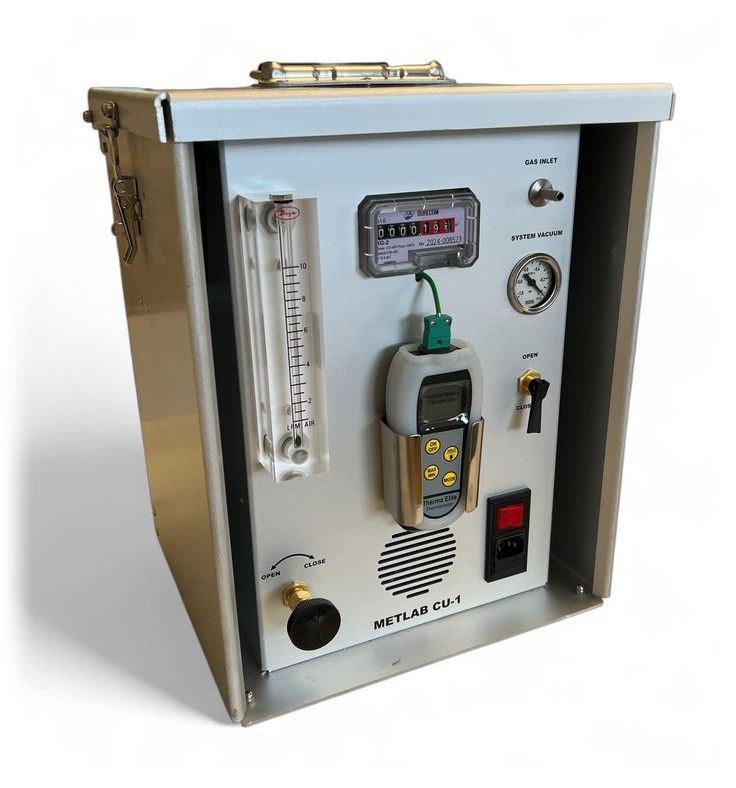
CU-1-10 gas sampler
Control unit with a vacuum pump, drying tower, flow meter and gas meter. Up to 10 l/min; the CU-1-20 up to 20.
-
 GM25-101 · GM25-102
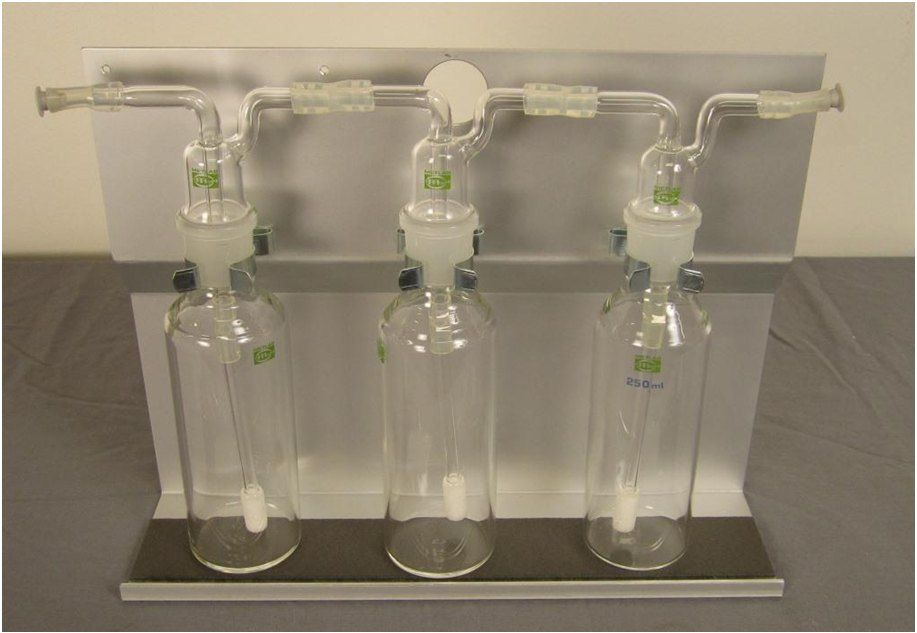
Bottle rack with absorption bottles
Two or three bottles in series, 250 ml borosilicate glass. For H2S, inserts with dispersion tubes without a frit are used.
Frequently asked questions about H2S measurement
Is the H2S measurement accredited?
Yes, the sampling of hydrogen sulphide according to VDI 3486-2 is within METLAB's Swedac accreditation. The analysis is done by an accredited laboratory, and the measurement uncertainty is given in the report.
How long does an H2S measurement take?
Each sub-sample takes at least 30 minutes, and the BAT conclusions use the average of three consecutive sub-samples. At low concentrations the sampling time is extended.
How low a concentration can you measure?
With normal sampling the detection limit is about 1 ppm, 1.5 mg/Nm3. For lower concentrations, for example BAT-AELs of 1–2 mg/Nm3, the sampling time is extended and the laboratory chooses a more sensitive analysis: the methylene blue method determines sulphide from 0.1 mg/l, iodometric titration from 1 mg/l.
Can H2S be measured continuously?
The wet chemical method gives an average for the sampling time. A curve over time requires an instrument, for example an SO2 analyser with a converter that first oxidises the hydrogen sulphide to SO2.
What is required of the measurement site?
A sampling port, a safe place to work and electricity for the probe heating and the pump. In homogeneous gas one measurement point is enough. If the gas contains droplets, for example after a scrubber, the sample is taken isokinetically, and the measurement site must meet the requirements for dust measurement.