
On this page
When do you need to measure HCl?
- Permit conditions. The environmental permit sets the emission limit value for HCl and how often it is to be checked.
- Waste incineration and co-incineration (the Swedish Ordinance on Waste Incineration, SFS 2013:253): HCl is measured continuously, and the measuring system is checked against EN 1911 at QAL2 and AST.
- Large combustion plants firing solid biomass fuel, peat or coal: the BAT conclusions set BAT-associated emission levels (BAT-AELs) and a measurement frequency for HCl.
- Hydrochloric acid pickling in the rolling, wire drawing and hot-dip galvanising of steel: the BAT conclusions require measurement according to EN 1911 at least once a year.
- Performance tests and troubleshooting: guarantee values for new flue gas cleaning, checks of scrubbers and sorbent dosing.
How the sampling train is built
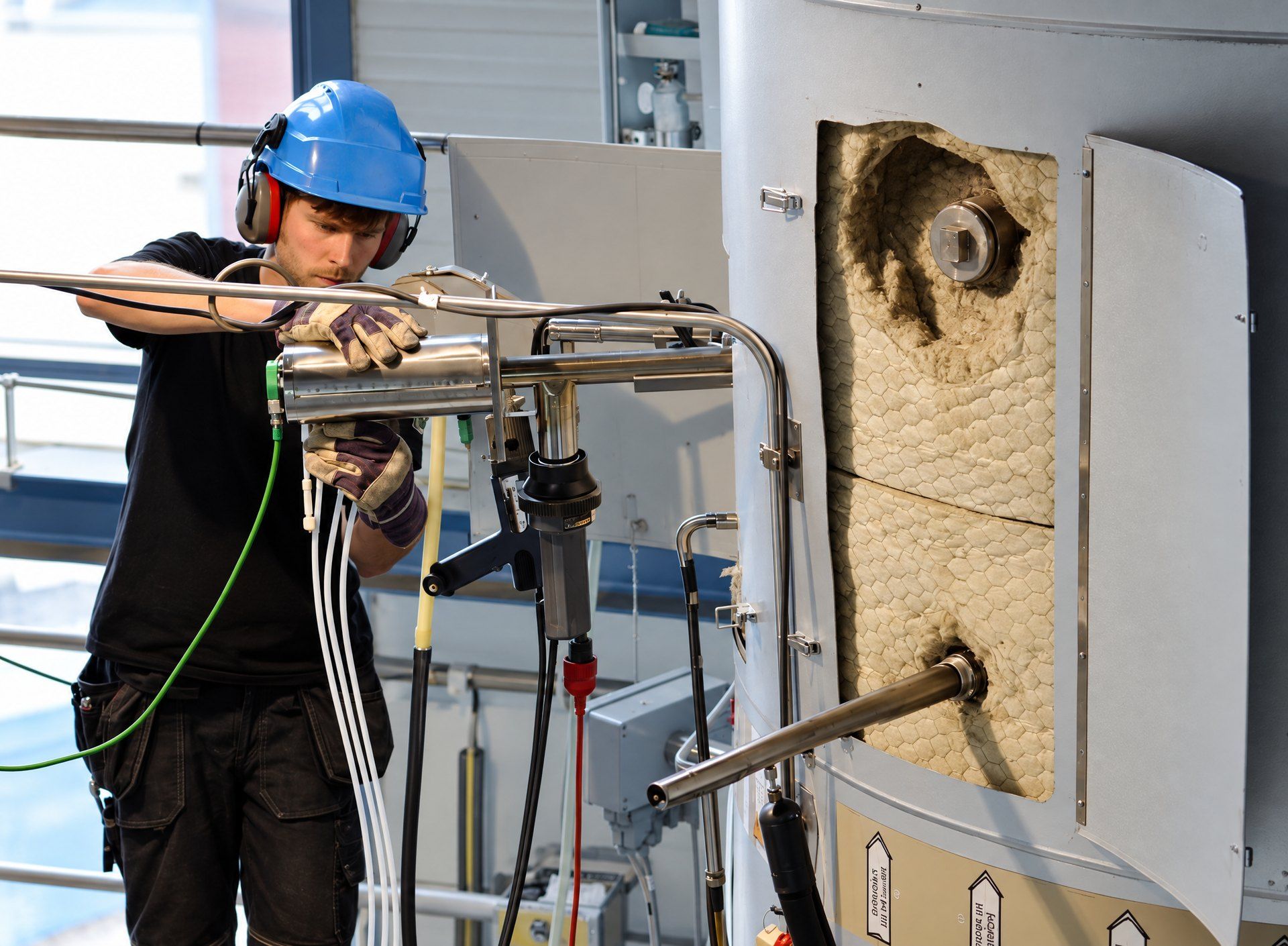
The measuring principle is wet chemical absorption. The sample gas is drawn through a heated probe with a filter, which stops the particles, and then bubbles through at least two absorption bottles with deionised water in a cooling bath, where the chlorides dissolve. An empty knock-out bottle catches splashes and a drying tower dries the gas. After the valve, pump and flow meter, a dry gas meter with a thermometer measures the sample gas volume.
- 1. Probe with filter holder, heated
- 2. Absorption bottles with absorption solution, in a cooling bath
- 3. Knock-out bottle
- 4. Drying tower
- 5. Valve
- 6. Sampling pump
- 7. Flow meter
- 8. Gas meter
- 9. Thermometer at the gas meter
Everything the sample gas meets before the bottles is made of borosilicate glass, titanium or PTFE: stainless steel can cause losses of chlorides. The probe and filter are kept at least 20 °C above the dew point of the flue gas, and our method recommends at least 180 °C.
How is an HCl measurement done?
Measurement plan
The measurement site must meet EN 15259. In homogeneous flue gas one measurement point is enough; otherwise the sample is taken at several. Sampling time and flow are chosen according to the concentration expected.
Field blank and leak test
Before each measurement series, and at least once a day, a field blank is taken: the same handling as a sample, but without drawing flue gas through the equipment. Before each sub-sample the train is tested for leaks; the leak rate may be at most 2 % of the sample gas flow.
Sampling
The probe and filter are heated, and the sample gas is drawn through the bottles at normally 4–10 l/min for at least 30 minutes per sub-sample. The filter temperature and the flow are checked during the sample.
Rinsing
After each sub-sample, the unheated tube between the filter and the first bottle is rinsed into the bottle with deionised water. The solution and the rinse water are collected in a labelled sample bottle.
Analysis
An accredited laboratory determines the chloride content of the sample and the field blank with one of the standard's methods: ion chromatography, potentiometric titration with silver nitrate or spectrophotometry.
Calculation and report
The amount of chloride is converted to HCl and divided by the volume of dry sample gas at standard conditions. The result is reported in mg/Nm3 (dry gas at 0 °C and 101.3 kPa) at the plant's reference oxygen content, with its measurement uncertainty.
The requirements in EN 1911
These requirements in EN 1911 decide whether an HCl measurement is valid.
| Requirement | Value |
|---|---|
| Measuring range | 1–5,000 mg/m3, expressed as HCl |
| Materials before the bottles | Borosilicate glass, titanium or PTFE (not stainless steel) |
| Filtration temperature | At least 20 °C above the dew point of the flue gas |
| Filter | Retains more than 99.5 % of particles of 0.3 µm |
| Absorption | At least two bottles in series, at most 5 % of the chloride in the last one |
| Leak rate | At most 2 % of the sample gas flow |
| Field blank | Below 10 % of the emission limit value, otherwise the measurement is invalid |
| Measurement uncertainty | Expanded uncertainty below 30 % at the daily emission limit value |
What does the method measure: HCl or chlorides?
EN 1911 determines gaseous chlorides, expressed as HCl: everything that is volatile at the filter temperature and gives chloride ions in the water is included. Particles of chloride salts must stay on the filter.
If the flue gas contains droplets, for example after a wet scrubber, the standard requires isokinetic sampling as in dust measurement. According to our method the same applies when chlorides and ammonia are present in the gas at the same time.
An automated measuring system (AMS) with infrared technology measures HCl specifically and can therefore show something other than the reference method, which is worth knowing at QAL2. 1 ppm HCl corresponds to 1.63 mg/Nm3.
Where does the HCl in the flue gas come from?
HCl forms when the fuel or the raw material contains chlorine. In waste, about half of the chlorine on average comes from PVC, according to the European Commission's Green Paper on PVC (2000). Waste wood that may contain organic halogen compounds from wood preservatives or surface treatment is covered by the Ordinance on Waste Incineration.
Biomass fuels such as straw also contain chlorine. The BAT conclusions for large combustion plants have a higher upper level for the yearly average (15 mg/Nm3 for new and 25 mg/Nm3 for existing boilers) when the chlorine content of the fuel is at least 0.1 % by weight. The same 25 mg/Nm3 applies to existing boilers that add sulphur to convert alkali chlorides.
The concentration is reduced with low-chlorine fuels and with flue gas cleaning: a wet scrubber, or a dry sorbent such as hydrated lime or sodium bicarbonate before a bag filter. According to the BAT conclusions for waste incineration, a wet scrubber reaches the lower part of the range.
Which emission limit values apply to HCl?
The emission limit value is set in the permit, in the Swedish Ordinance on Waste Incineration (SFS 2013:253) or in the sector's BAT conclusions, whose BAT-AELs apply as limit values under the Swedish Industrial Emissions Ordinance (SFS 2013:250). The Swedish ordinances on large and medium combustion plants (SFS 2013:252 and SFS 2018:471) have no emission limit values for HCl.
| Plant and averaging period | HCl, mg/Nm3 | Source |
|---|---|---|
| Waste incineration, daily (11 % O2) | 10 | SFS 2013:253, section 57 |
| Waste incineration, half-hourly (11 % O2) | 60, or 10 during 97 % of the year's half-hours | SFS 2013:253, section 60 |
| Waste incineration, daily, BAT-AEL (11 % O2) | < 2–6 new, < 2–8 existing | BAT conclusions (EU) 2019/2010, BAT 27 |
| Cement kiln firing waste, daily (10 % O2) | 10 | SFS 2013:253, section 68 |
| Other co-incineration, daily | Calculated with the mixing rule from the waste limit value 10 and the plant's process limit value | SFS 2013:253, sections 93 and 97 |
| Solid biomass or peat from 50 MW (6 % O2) | Yearly: 1–7 (new) and 1–15 (existing) below 100 MW; 1–5 from 100 MW, but 1–9 for existing plants of 100–300 MW. Daily or sampling period: 1–12; 1–35 for existing plants below 100 MW. | BAT conclusions (EU) 2021/2326, BAT 25 |
| Hydrochloric acid pickling, daily or sampling period | < 2–10, batch hot-dip galvanising < 2–6 | BAT conclusions (EU) 2022/2110, BAT 24 and 62 |
What does an HCl measurement cost?
The price depends on the number of stacks or ducts and operating conditions, the number of sub-samples and the sampling time, and on the laboratory analysis of each sample. When HCl is measured together with HF, SO2 or dust at the same measurement site, the price per parameter is lower. Isokinetic sampling, difficult access and a long journey add to the cost. Request a quote and we will reply within two working days. Approximate prices for the most common measurements are in the price guide.
How often must HCl be measured?
As often as the permit says. At waste incineration plants HCl is measured continuously, and the measuring system is checked against the reference method at least once a year. The BAT conclusions for large combustion plants specify measurement according to EN 1911 every three months when firing coal, and continuous measurement for solid biomass and peat, or periodic measurement at least every six months once the emissions have proved stable.
Measure HCl yourself
-
 GM11-101
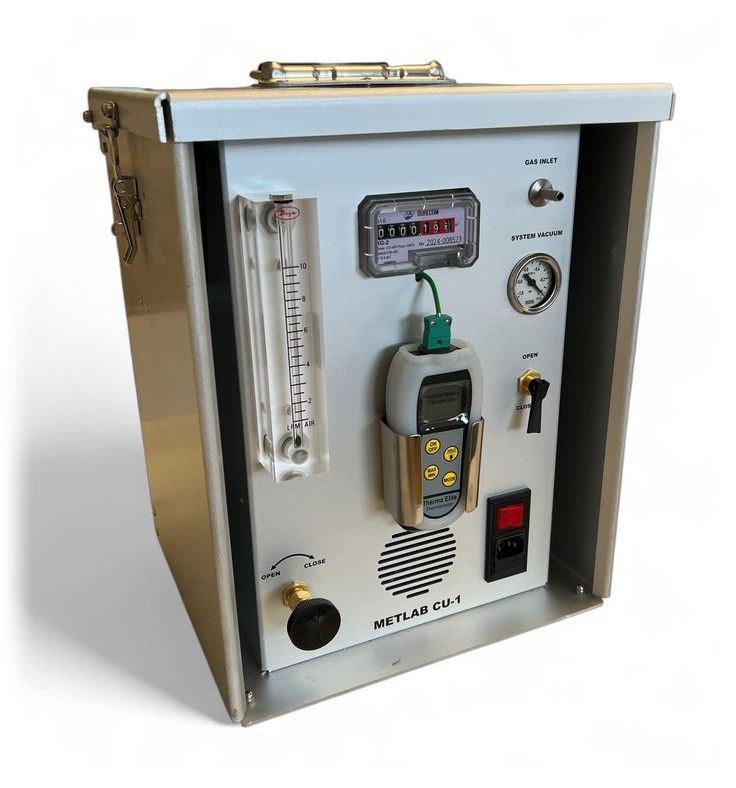
CU-1-10 gas sampler
Control unit with a vacuum pump, drying tower, flow meter and gas meter. Up to 10 l/min; the CU-1-20 up to 20.
-
 GM25-101 · GM25-102
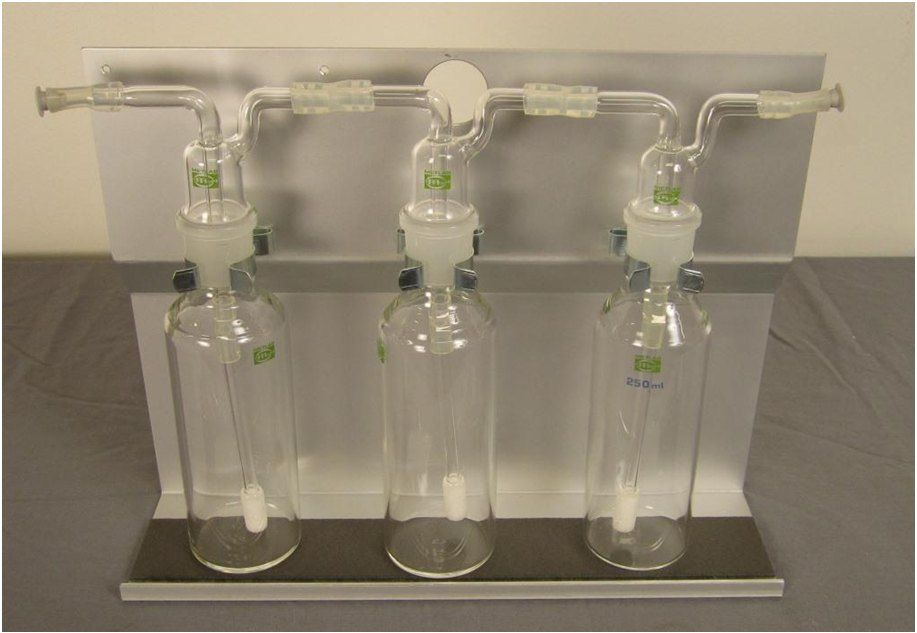
Bottle rack with absorption bottles
Two or three absorption bottles (impingers) in series, 250 ml borosilicate glass with a glass insert and frit.
Frequently asked questions about HCl measurement
Is the HCl measurement accredited?
Yes. Sampling according to EN 1911 is within METLAB's Swedac accreditation. The analysis is done by an accredited laboratory, and the report gives the result with its measurement uncertainty. The same applies to HBr and HCN.
How long does an HCl measurement take?
Each sub-sample takes at least 30 minutes, and the BAT conclusions use the average of three consecutive sub-samples. At QAL2 at least 15 data pairs, each a reference value and the measuring system's value for the same period, are needed over at least three days.
Can HCl be measured at the same time as HF and SO2?
What is required of the measurement site?
Sampling ports, a safe working platform and electricity for the probe heating and the pump, according to EN 15259. After a wet scrubber, where the sample is taken isokinetically at several points, the measurement site must be the same as for dust measurement.
Do you measure HBr and HCN too?
Yes. Hydrogen bromide (HBr) is sampled with the same equipment according to a modified EN 1911. Hydrogen cyanide (HCN) is sampled according to Energiforsk's Emissionsmäthandbok 2015 (the Swedish emission measurement handbook), chapter 5.16, with 0.5 M sodium hydroxide as the absorption solution. Read more on the pages about HBr measurement and HCN measurement.