
On this page
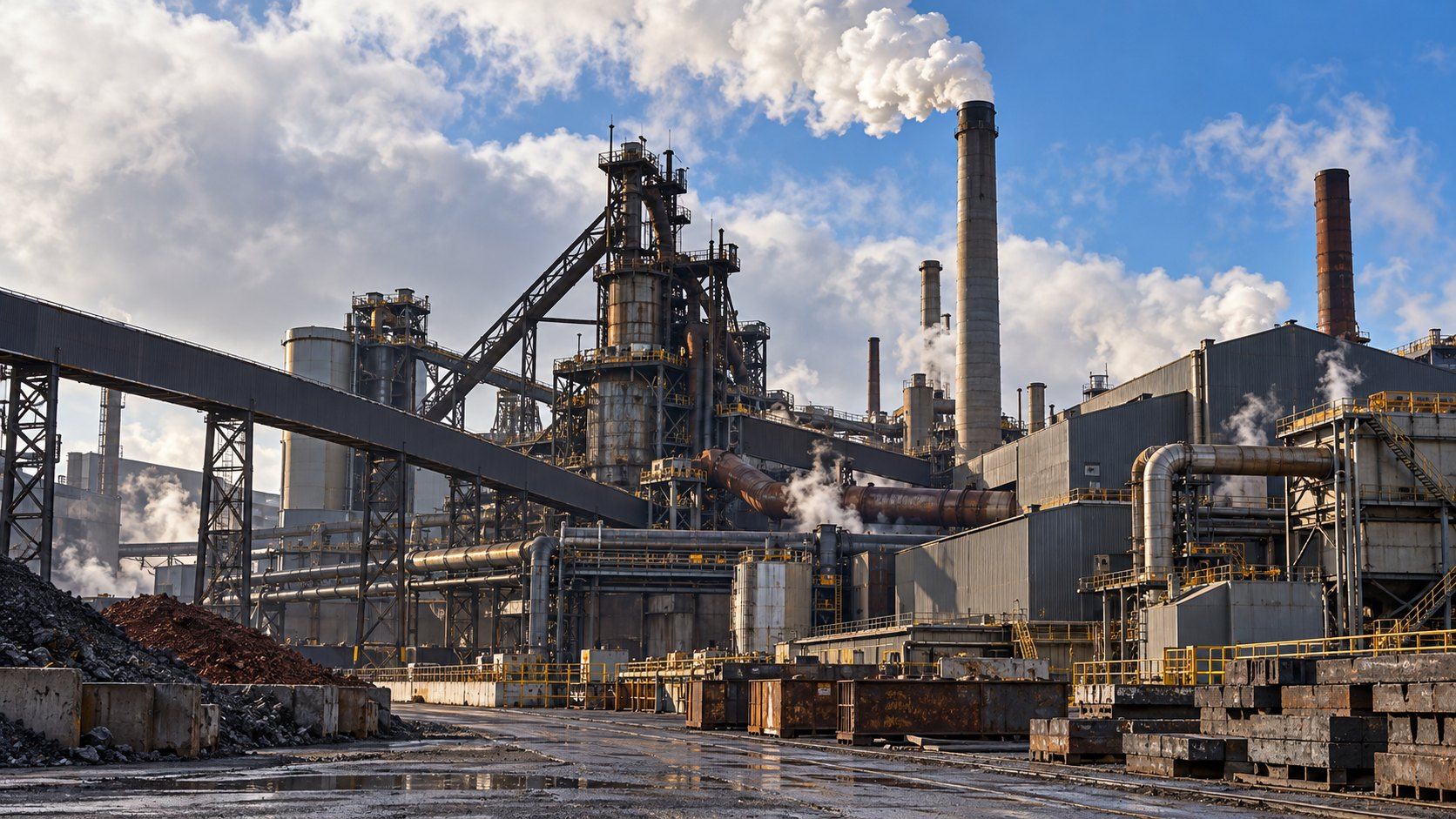
Where do the emissions come from?
- Electric arc furnace and ladle furnace: dust with zinc and other metals, mercury from the scrap and dioxins formed when scrap with paint, oil and plastics is melted.
- Reheating and heat treatment furnaces: NOx and CO from gas- or oil-fired furnaces in rolling mills and foundries, SO2 with sulphur-containing fuel.
- Pickling and hot-dip galvanising: HCl from hydrochloric acid baths, HF and NOx from mixed acid for stainless steel, dust and zinc from the galvanising kettle.
- Melting furnaces, core making and fettling in foundries: dust, HCl, SO2 and dioxins from cupola furnaces, TVOC, amines, phenol and formaldehyde from the binders, dust from shake-out and grinding.
Which rules apply?
| Plant | Regulation | What it means for the measurement |
|---|---|---|
| Steelworks with an electric arc furnace, integrated steelworks | The BAT conclusions for iron and steel production (2012/135/EU), binding since 8 March 2016 | Dust from large electric arc furnaces continuously, as is dust from sinter plants, the blast furnace cast house and the secondary dedusting of the basic oxygen furnace. The rest, including PCDD/F and mercury, periodically (BAT 14–15). |
| Hot rolling mills above 20 tonnes of crude steel per hour, hot-dip galvanising above 2 tonnes per hour, pickling baths above 30 m3 | The BAT conclusions for ferrous metals processing ((EU) 2022/2110), binding from 4 November 2026 | Dust, NOx and SO2 from reheating furnaces continuously at mass flows above 2, 15 and 10 kg/h respectively, otherwise every six months or once a year. HCl, HF and NOx from pickling, dust and zinc from galvanising once a year (BAT 7). |
| Iron and steel foundries above 20 tonnes per day, non-ferrous foundries above 20 tonnes per day (lead and cadmium 4 tonnes) | The BAT conclusions for smitheries and foundries ((EU) 2024/2974), binding from 6 December 2028 | Once a year per source and relevant parameter, from dust and metals to amines and PCDD/F. Dust continuously on cupola furnaces above 0.5 kg/h (BAT 12). |
| Smaller foundries, galvanising plants below 2 tonnes per hour, the plant's own boilers | The permit, for notified category C activities the municipality's conditions · boilers of 1–50 MW: the Swedish Ordinance on Medium Combustion Plants (SFS 2018:471) · the NOx charge at 25 GWh or more per year | The requirements are in the permit or the monitoring programme. Boilers: periodic measurement every three years up to 20 MW, every year above. NOx charge: comparison measurement every calendar year. |
The permit can set stricter requirements, and the statutory text is what applies. BAT-associated emission levels (BAT-AELs) apply as limit values under normal operation four years after publication, under chapter 1, section 8 of the Swedish Industrial Emissions Ordinance (SFS 2013:250); the upper value of the range may not be exceeded. A plant permitted after the publication counts as new.
What is measured – and what is typical?
| Parameter | Why in this industry | Typical level or requirement | Method |
|---|---|---|---|
| Dust | All furnaces and all processing | BAT-AEL: electric arc furnace < 5 mg/Nm3 (daily average), reheating furnaces < 2–10, galvanising < 2–5, foundry furnaces and fettling 1–5, cupola furnace 1–7 | EN 13284-1 |
| Metals, zinc and mercury | Scrap, alloys and zinc baths | Mercury at electric arc furnaces BAT-AEL < 0.05 mg/Nm3 (BAT 88); lead 0.02–0.1 at cupola furnaces; other metals and zinc are measured once a year where relevant | EN 14385, mercury EN 13211 (sampling) |
| Dioxins and furans | Chlorine and organic material in the scrap | Electric arc furnace < 0.1 ng I-TEQ/Nm3; foundry furnaces < 0.01–0.08 ng WHO-TEQ/Nm3; 6–8 hour sample | EN 1948 (sampling) |
| NOx | Fuel-fired furnaces, nitric acid pickling | Reheating with natural gas 80–200 mg/Nm3 for new and 100–350 for existing plants (3 % O2); heat treatment in foundries 20–120; nitric acid pickling 10–200 | EN 14792 |
| SO2 | Sulphur in the fuel, coke in cupola furnaces | Reheating furnaces 50–200 mg/Nm3 in hot rolling, 20–100 in cold rolling, no value with natural gas or electricity; cupola furnaces 30–150 | EN 14791 (sampling) |
| HCl and HF | Pickling, cupola furnaces, aluminium melting | Pickling HCl < 2–10 mg/Nm3, HF < 1; cupola furnace HCl 10–30, HF 1–3; aluminium foundry HCl 1–3, HF < 1 | EN 1911, ISO 15713 (sampling) |
| TOC (TVOC) | Binders in core making, casting and shake-out; also amines, phenol, formaldehyde and benzene | 15–50 mg C/Nm3 in moulding and shake-out, 5–30 in melting, 5–20 in sand reclamation; amines < 0.5–2.5 mg/Nm3 | EN 12619 |
mg/Nm3 dry gas at 273.15 K and 101.3 kPa, BAT-AELs unless stated otherwise: daily average with continuous measurement, average of three measurements of at least 30 minutes with periodic. Reheating furnaces are converted to 3 % O2, the foundries' values apply without oxygen correction. CO has indicative levels only. Concentrations depend on scrap, fuel, binders and flue gas cleaning.
What the measurement year looks like
Establish what applies
Which BAT conclusions each unit is covered by, from when, and what the permit requires beyond that. In foundries the inventory of input materials and emissions (BAT 2) decides which parameters are relevant.
Periodic measurement, normally once a year
When the emissions are expected to be at their highest under normal operation, as the average of three samples of at least 30 minutes; dioxins 6–8 hours. We measure several sources in the same campaign and deliver an accredited report.
QAL2 and AST for automated measuring systems
Fixed dust monitors and gas analysers above the mass flow thresholds are quality assured according to EN 14181: QAL2 when the system is new and at least every five years, AST every year. We carry out the parallel measurements.
Annual environmental report by 31 March
Plants with a permit report the year's measurements and how the BAT conclusions are complied with. If a BAT-AEL is exceeded, the supervisory authority must be informed immediately (chapter 1, section 9 of the Swedish Industrial Emissions Ordinance).
Three dates to keep track of
On 4 November 2026 the BAT-AELs for ferrous metals processing become limit values for rolling mills, pickling lines and hot-dip galvanising plants. Check that every stack has been measured at the frequency BAT 7 states and that the mass flows that govern the frequency are documented.
On 6 December 2028 the same applies to foundries above 20 tonnes per day; on 11 December 2025 the Government proposed how the conclusions are to be written into the Swedish Industrial Emissions Ordinance. A first measurement now shows where the foundry stands against the BAT-AELs and leaves two years for corrective measures.
The conclusions for iron and steel production from 2012 apply until further notice; the EU's revision of them started on 6 March 2026; new conclusions have not been decided.
What does a measurement cost in the steel and foundry industry?
The price depends on how many stacks and parameters are included, whether dioxins and metals with laboratory analysis are to be sampled, whether automated measuring systems are to be calibrated with QAL2 or AST, how the measurement sites are reached and the travel distance. Several sources in the same campaign lower the cost per measurement. Request a quote – we reply within two working days. Approximate prices for the most common measurements are in the price guide.
Frequently asked questions
What emission requirements apply to a small foundry?
Above 10 tonnes per year you notify the municipality of the activity, and it sets the conditions; above 500 tonnes per year a category B permit is required. The BAT conclusions for foundries apply only above 20 tonnes per day. Parameters and frequency are in the conditions.
How often must a steelworks measure dioxins?
The conclusions for iron and steel require periodic measurement of PCDD/F without a stated frequency, so the interval is in the permit. The sample is taken over 6–8 hours at stable operation. The foundry conclusions state once a year for cupola furnaces.
What applies to hot-dip galvanising?
Above 2 tonnes of crude steel per hour, the conclusions for ferrous metals processing apply from 4 November 2026: dust below 2–5 mg/Nm3 after the kettle, dust and zinc measured once a year. Smaller galvanising plants follow their category B permit.