On this page
Where do the emissions come from?
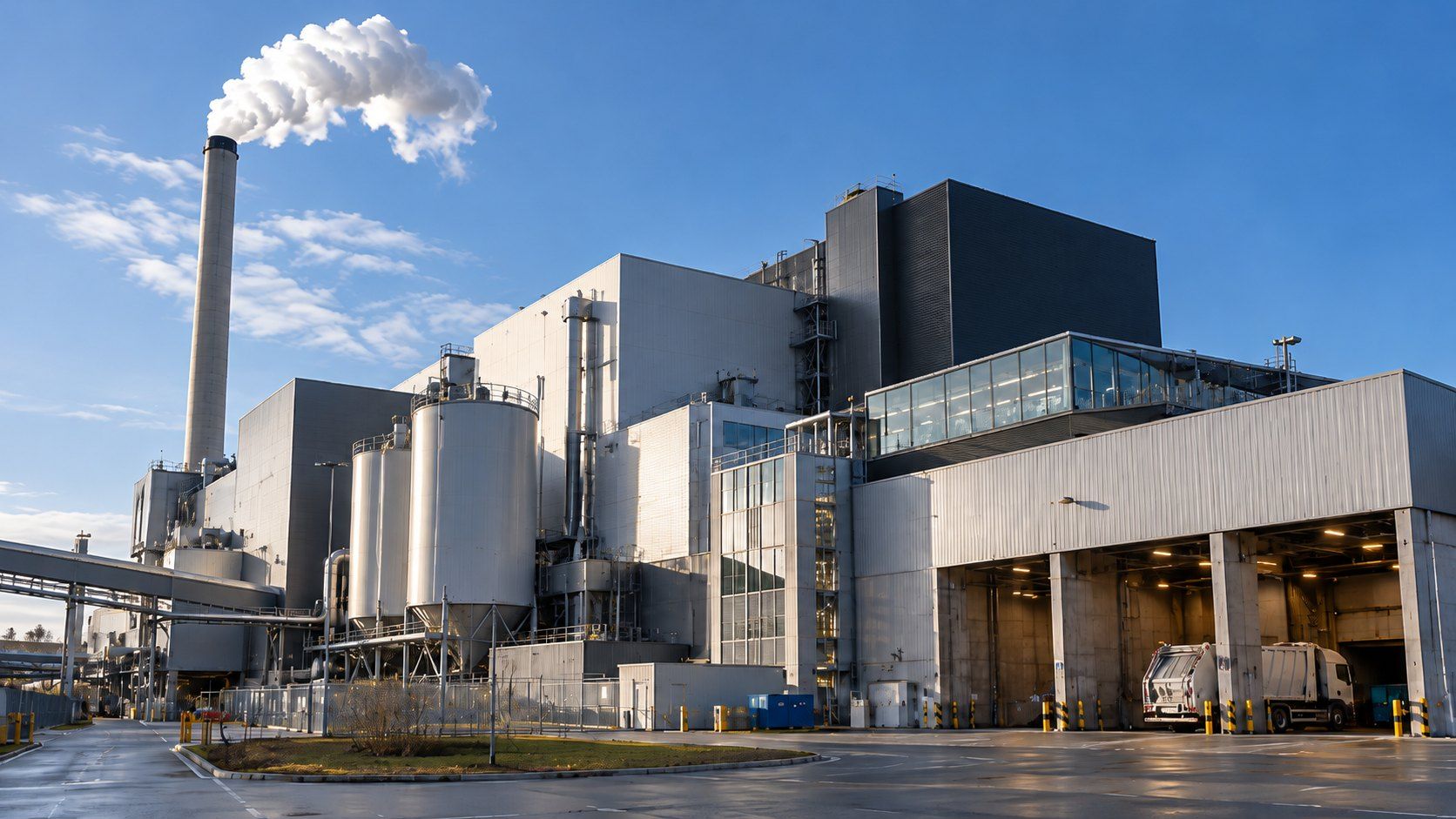
- The waste boiler. A grate or fluidised bed boiler for household and commercial waste. This is where dust, HCl, HF, SO2, NOx, CO, TOC, metals, mercury and dioxins form; a fluidised bed and SNCR with urea can also give nitrous oxide.
- The flue gas cleaning. Filters, dry or wet cleaning and SNCR or SCR decide what reaches the stack. Ammonia that passes the SNCR or SCR is a parameter of its own in the BAT conclusions.
- The co-incineration boiler. A district heating or industrial boiler that fires recovered wood or another waste fuel. The same measurement requirements as the waste boiler; the limit values are derived with the mixing rule.
- Start-up, shutdown and auxiliary firing. Auxiliary burners for oil or gas are used at start-up and shutdown. Under BAT 5, the emissions during the periods when no waste is being burnt are to be estimated with measurement campaigns, for example every three years.
Which rules apply?
| Plant | Regulation | What it means for the measurement |
|---|---|---|
| Waste incineration plant, all sizes | The Swedish Ordinance on Waste Incineration (SFS 2013:253) · EN 14181 for the automated measuring systems | Continuously dust, TOC, HCl, HF, SO2, NOx, CO and O2. Metals, mercury and dioxins at least twice a year. AST every year, QAL2 at least every five years. |
| IED activity (covered by the Industrial Emissions Directive): more than 3 tonnes of non-hazardous waste per hour or 18,000 tonnes per year, or more than 10 tonnes of hazardous waste per day | The BAT conclusions (EU) 2019/2010, binding since 3 December 2023 | Lower BAT-associated emission levels (BAT-AELs). NH3 continuously with SNCR or SCR, mercury continuously (long-term sampling is accepted if the concentration has been shown to be low and stable), dioxins every six months, N2O yearly with a fluidised bed or SNCR with urea. |
| Co-incineration plant, for example a recovered wood boiler | SFS 2013:253 · according to the Swedish Environmental Protection Agency, most larger ones also fall under the BAT conclusions for large combustion plants | The same measurement requirements as the waste boiler; the daily value is derived with the mixing rule (section 71). |
| Boiler with at least 25 GWh of useful energy per year | The Swedish NOx charge: the Act on Environmental Charges on Nitrogen Oxides (SFS 1990:613) and NFS 2016:13 · comparison measurement | Continuous NOx and flow measurement. A comparison measurement by an accredited laboratory at least once per calendar year. Declaration by 25 January. |
| Waste-to-energy plant in the EU ETS | The Swedish Ordinance on Certain Greenhouse Gas Emissions (SFS 2020:1180) and the EU Monitoring and Reporting Regulation (MRR), (EU) 2018/2066 ·biogenic CO2 | Only fossil carbon dioxide requires allowances. The biogenic share is determined by carbon-14 analysis of the flue gas (EN ISO 13833), at least once a month, or with a balance method (ISO 18466). |
The permit can set stricter conditions and require more frequent measurement. The text of the ordinance and the BAT conclusions is what applies.
What is measured – and what is typical?
| Parameter | Why in this industry | Typical level or requirement | Method |
|---|---|---|---|
| Dust | Fly ash and salts | Limit 10 · BAT-AEL < 2–5 | EN 13284-1 |
| HCl and HF | Chlorine and fluorine in the waste | HCl: limit 10 · BAT-AEL < 2–8 (new < 2–6) HF: limit 1 · BAT-AEL < 1 | EN 1911 · ISO 15713 |
| SO2 | Sulphur in the waste | Limit 50 · BAT-AEL 5–40 (new 5–30) | EN 14791 |
| NOx | Formed in the combustion; the basis for the NOx charge | Limit 200 · BAT-AEL 50–150 (new 50–120) | EN 14792 |
| CO and TOC | Show how complete the combustion is | CO: limit 50 · BAT-AEL 10–50 TOC: limit 10 · BAT-AEL < 3–10 | EN 15058 · EN 12619 |
| Mercury | Follows the content of the waste | Limit 50 µg/Nm3 · BAT-AEL < 5–20 µg/Nm3 | EN 13211 |
| Metals | Cd + Tl and Sb, As, Pb, Cr, Co, Cu, Mn, Ni, V from the waste | Cd + Tl: limit 0.05 · BAT-AEL 0.005–0.02 others: limit 0.5 · BAT-AEL 0.01–0.3 | EN 14385 |
| Dioxins and furans | Formed in small amounts, captured in the flue gas cleaning | Limit 0.1 ng/Nm3 · BAT-AEL < 0.01–0.06 (new < 0.01–0.04) ng I-TEQ/Nm3 | EN 1948, 6–8 hour sample |
| Biogenic share of CO2 | Decides how many allowances must be surrendered | About half fossil: 52 % at Sysav in Malmö, 42 % at Högdalenverket (the Swedish Environmental Protection Agency's register Utsläpp i siffror, latest reported year) | EN ISO 13833 (carbon-14) |
mg/Nm3 (dry gas at 0 °C and 101.3 kPa) at 11 % O2 unless stated otherwise. Limit = daily average under sections 56–66 of SFS 2013:253. BAT-AEL = the levels the EU's reference documents say well-run plants achieve, as a daily average for an existing plant (new plant in brackets); the upper value is binding for an IED activity. Concentrations depend on the waste and the flue gas cleaning.
What the measurement year looks like
Establish what applies
The permit, the monitoring programme and the monitoring plan for the EU ETS govern the measurement year. The ordinance applies on top of the permit conditions (section 19).
Continuous measurement and QAL3
The automated measuring systems measure all the time and the plant's emission data system validates the values. You do the zero and span checks (QAL3) yourself.
AST every year, QAL2 at least every five
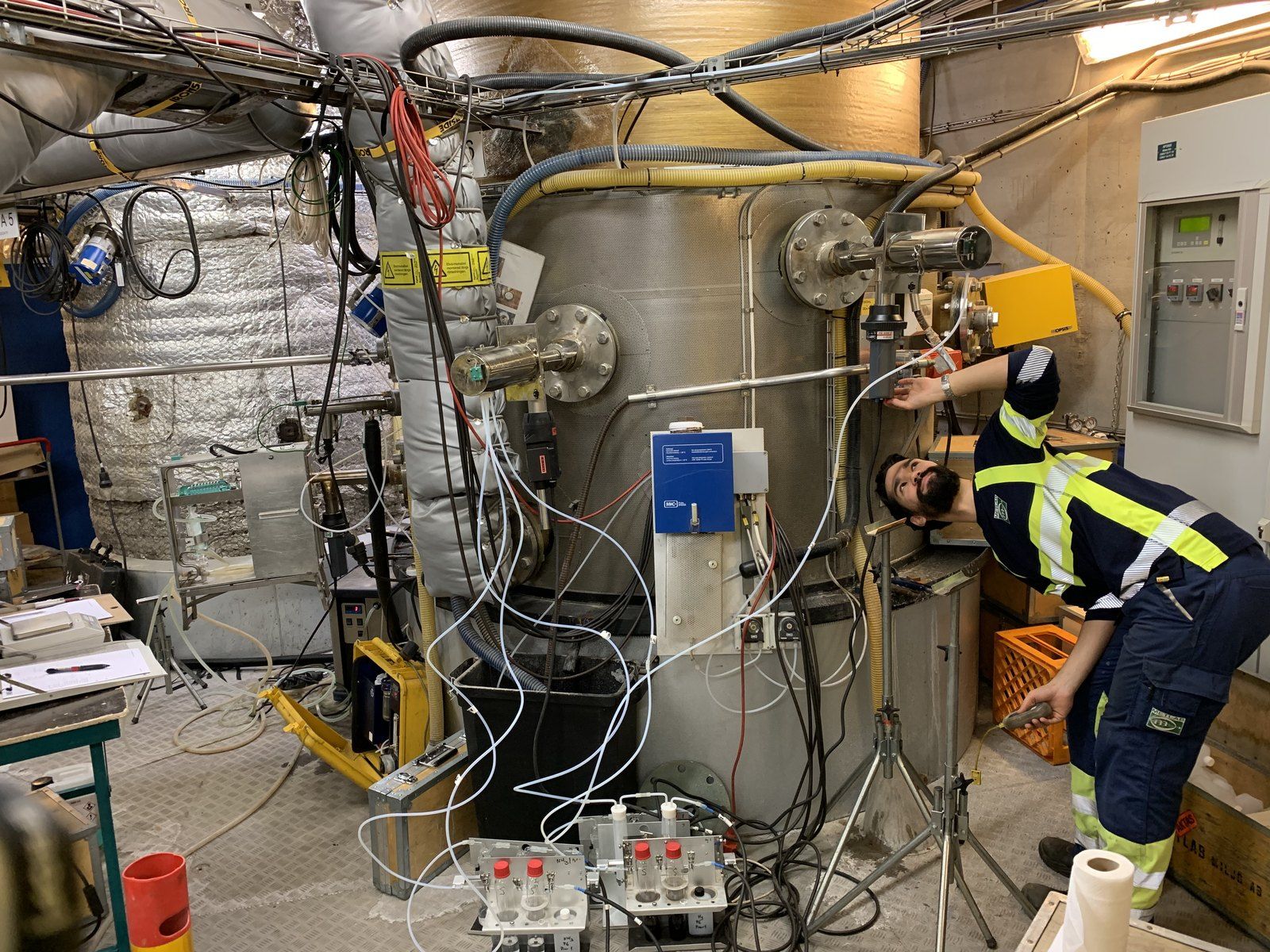
We carry out the parallel measurements with reference methods: at least five at an AST, at least 15 over at least three days at a QAL2. Read more about QAL2 and AST.
Periodic sampling at least twice a year
Metals, mercury, dioxins, and HF if it is not measured continuously. We take the samples; an accredited laboratory analyses them. Coordinate it with the AST or QAL2 if you can.
Comparison measurement for the NOx charge
For boilers with at least 25 GWh we check the NOx measurement and the flue gas flow once per calendar year, before the declaration on 25 January.
Biogenic share and reports
The carbon-14 samples for the EU ETS are taken throughout the year. The annual environmental report is submitted by 31 March, the allowances are surrendered by 30 September.
The EU ETS now and going forward
In Sweden, waste-to-energy plants are already in the EU ETS (the Swedish Ordinance on Certain Greenhouse Gas Emissions, SFS 2020:1180, annex 1). At EU level, municipal waste incineration plants above 20 MW have had to monitor and report their emissions since 1 January 2024 without surrendering allowances. In July 2026 the Commission presented a proposal to bring the incineration of non-hazardous waste into emissions trading in stages from the early 2030s; the proposal has not been adopted (October 2026). Allowances are needed only for the fossil carbon dioxide, so the biogenic share should be determined with a method that holds up at verification.
What does a measurement cost at a waste incineration plant?
The price depends on the number of boilers and automated measuring systems, whether it is a QAL2 with at least three measurement days or an AST, how many periodic parameters and analyses are included, the number of carbon-14 samples and how accessible the measurement site is. If you coordinate the AST or QAL2 with the sampling you save travel and measurement days. Request a quote – we reply within two working days. Approximate prices for the most common measurements are in the price guide.
Frequently asked questions
How often must we measure dioxins and metals?
At least twice a year under SFS 2013:253, and every three months during the first twelve months of operation. If the plant follows the BAT conclusions, every six months applies, and for dioxins long-term sampling every month unless the emissions have been shown to be stable.
Does our recovered wood boiler count as waste incineration?
As a starting point, yes. Wood waste is exempt only if it cannot be assumed to contain organic halogen compounds or heavy metals from wood preservatives or surface treatment, and the Swedish Environmental Protection Agency assumes that recovered wood chips on the market are covered. The boiler is then a co-incineration plant.
How do we determine the fossil share of the carbon dioxide?
The Monitoring and Reporting Regulation (MRR) accepts carbon-14 analysis of the flue gas (EN ISO 13833), a balance method (ISO 18466) or an estimation method from the Commission. With the flue gas method, samples are taken at least once a month, normally one month of flow-proportional sampling per sample.
Who may carry out the measurements?
The reference measurements at QAL2 and AST must be made by a laboratory accredited according to ISO/IEC 17025, as must the comparison measurement for the NOx charge. METLAB is accredited by Swedac for QAL2, AST, the comparison measurement and the sampling.