
On this page
When do you need to measure ammonia?
- Permit conditions. The environmental permit may have a condition for ammonia when NOx is reduced with SNCR or SCR.
- Waste incineration: the BAT conclusions specify continuous measurement of NH3 where SNCR or SCR is used. The measuring system is checked against EN ISO 21877 at QAL2 and AST.
- Large combustion plants: continuous measurement where SNCR or SCR is used, according to the BAT conclusions.
- Cement kilns with SNCR: continuous measurement according to the BAT conclusions. In glass furnaces and lime kilns ammonia is measured continuously or periodically.
- Ferrous metals processing and the chemical industry: the BAT conclusions specify measurement according to EN ISO 21877 (once a year and every six months respectively) where SNCR or SCR is used.
- Tuning and performance tests: ammonia is measured together with NOx when the dosing is set up and when the guarantee value for ammonia slip is to be demonstrated.
How the sampling train is built
Ammonia is captured wet chemically in sulphuric acid. The sample gas is drawn out through a heated glass probe and a quartz fibre plane filter at not less than 175 °C, which removes the dust. The gas then bubbles through two absorption bottles in a cooling bath with 0.05 M sulphuric acid, where the ammonia is bound as ammonium ions. An empty bottle can catch splashes, and a drying tower can dry the gas before the valve, pump and flow meter. A dry gas meter with a thermometer measures the sample gas volume.
- 1. Probe with filter holder, heated
- 2. Absorption bottles with absorption solution, in a cooling bath
- 3. Knock-out bottle
- 4. Drying tower
- 5. Valve
- 6. Sampling pump
- 7. Flow meter
- 8. Gas meter
- 9. Thermometer at the gas meter
Glass and a high temperature are chosen so that the ammonia reaches the bottles: ammonia is adsorbed on surfaces, considerably more on steel than on glass, and at 170–180 °C reactions on the filter between ammonia and HCl, SO2 or SO3 are avoided. If it gets too hot, the ammonia can instead react with NOx, especially when the fly ash contains heavy metals.
How is an ammonia measurement done?
Measurement plan
Sampling time, flow and the amount of sulphuric acid are chosen for the expected concentration: the ammonium content of the sample should be at least 0.2 mg/l, and the acid in the first bottle must be enough for ten times the emission limit value. In homogeneous flue gas one measurement point is enough.
Leak test and field blank
With the probe inlet plugged and the pump running, the leak rate may be at most 2 % of the sample gas flow. A field blank is taken before every measurement series, at least once a day, and also after the series if the bottles are washed and reused on site.
Sampling
The sample gas is drawn through about 70 ml of sulphuric acid in each bottle for at least 30 minutes. During the sample it is checked that the filter stays at not less than 175 °C and that the gas after the bottles is colder than 20 °C.
Rinsing and weighing
The tubing from the filter is rinsed with about 20 ml of absorption solution into the first bottle. The sample is transferred to a sample bottle and weighed (the volume must be known to within 1 %) and stored in the dark below 5 °C until the analysis.
Analysis
An accredited laboratory determines the ammonium content of the sample and the field blank by spectrophotometry (the indophenol method), flow analysis or ion chromatography, the methods the standard specifies.
Calculation and report
The amount of ammonium is converted to NH3 and divided by the dry sample gas volume at 0 °C and 101.3 kPa. The result is given in mg/Nm3 at the reference oxygen content, with measurement uncertainty; a value below the field blank is reported as at most the field blank.
The requirements in EN ISO 21877
The requirements in EN ISO 21877 decide whether an ammonia measurement is valid; the temperature at the filter is specified in our accredited method description.
| Requirement | Value |
|---|---|
| Validated range | About 8–65 mg/m3; lower concentrations are measured with a longer sampling time or a more sensitive analysis |
| Probe and filter | Probe of titanium, quartz glass, borosilicate glass or PTFE; plane filter of quartz fibre |
| Temperature | At least 15 °C above the dew point all the way to the bottles – according to our method at least 175 °C at the filter |
| Absorption | At least 95 % in the first bottle, or the concentration in the second below the quantification limit of the analysis |
| Leak rate | At most 2 % of the sample gas flow |
| Field blank | Below 10 % of the emission limit value; not subtracted from the measured value |
| Sampling time | At least 30 min |
| Measurement uncertainty | Expanded uncertainty at most 20 % of the emission limit value |
Ammonia slip – why it occurs
To reduce NOx, ammonia or urea is injected into the flue gas, in the furnace at 800–1,000 °C (SNCR) or upstream of a catalyst (SCR). The ammonia that does not react leaves with the flue gas: ammonia slip.
The slip increases when the dosing is higher than the NOx concentration requires, when the ammonia is distributed unevenly over the cross-section of the duct, when it is injected outside the temperature window and when the catalyst ages. It also depends on how high the NOx concentration is to begin with and how much it is to be reduced.
With sulphur oxides and chlorides the ammonia can form ammonium sulphate and ammonium chloride, salts that are deposited in gas coolers and are counted by the wet chemical methods for SO2 and HCl; a smaller part is bound to the ash particles. A wet scrubber absorbs unreacted ammonia – that is why the BAT conclusions have a higher upper value for existing plants with SNCR without wet abatement.
What does the method measure – ammonia or ammonium?
EN ISO 21877 determines volatile ammonia: everything that is gaseous at the temperature of the filter and gives ammonium ions in the sulphuric acid counts as NH3, including gaseous ammonium salts. Ammonium bound to the dust stays on the filter and is not included; the standard does not cover analysis of the dust.
If the flue gas contains droplets, for example after a wet scrubber, they can contain ammonia. The sample is then taken isokinetically at several measurement points, and the probe is heated so that the droplets evaporate before the filter. According to our method we also sample isokinetically when ammonia occurs together with HCl, HBr or HF or as volatile ammonium salts.
Automated measuring systems measure optically (with UV, IR or a diode laser, in the duct or in heated sample gas) and determine NH3 specifically; the wet chemical method also counts gaseous ammonium salts, so the two can differ. 1 ppm NH3 corresponds to 0.76 mg/Nm3.
Which emission limit values apply to ammonia?
The ordinances on waste incineration and on large and medium combustion plants (SFS 2013:253, 2013:252 and 2018:471) have no emission limit values for ammonia. The limit value is in the permit or in the sector's BAT conclusions, whose emission levels apply as limit values under the Swedish Industrial Emissions Ordinance (SFS 2013:250). All values below apply where SNCR or SCR is used.
| Plant with SNCR or SCR | NH3, mg/Nm3 | Source |
|---|---|---|
| Waste incineration, daily (11 % O2) | 2–10; 15 for existing plants with SNCR without wet abatement | BAT conclusions (EU) 2019/2010, BAT 29 |
| Combustion plant from 50 MW, yearly or sampling period | < 3–10; 15 for biomass boilers with varying load and for engines firing oil | BAT conclusions (EU) 2021/2326, BAT 7 |
| Cement kiln with SNCR, daily (10 % O2) | < 30–50 | BAT conclusions 2013/163/EU, BAT 20 |
| Lime kiln with SNCR, daily or sampling period (11 % O2) | < 30 | BAT conclusions 2013/163/EU, BAT 46 |
| Glass melting furnace | < 5–30 | BAT conclusions 2012/134/EU, BAT 10 |
| Chemical industry, sampling period | < 0.5–8 | BAT conclusions (EU) 2022/2427, BAT 17 |
What does an ammonia measurement cost?
The price depends on the number of stacks or ducts, operating conditions and sub-samples, the sampling time and the laboratory analysis of every sample and field blank. If ammonia is measured during the same visit as NOx and other gases, travel and set-up are shared. Isokinetic sampling after a wet scrubber, difficult access and a long journey raise the cost. Request a quote – we reply within two working days. Approximate prices for the most common measurements are in the price guide.
How often must ammonia be measured?
As often as the permit says. The BAT conclusions for waste incineration and large combustion plants specify continuous measurement where SNCR or SCR is used; the manual method then calibrates the measuring system. In large combustion plants with SCR one measurement a year is enough if the levels have proved stable, and plants below 100 MW operated for less than 1,500 hours a year are measured at least every six months.
Measure ammonia yourself
-
 GM11-101
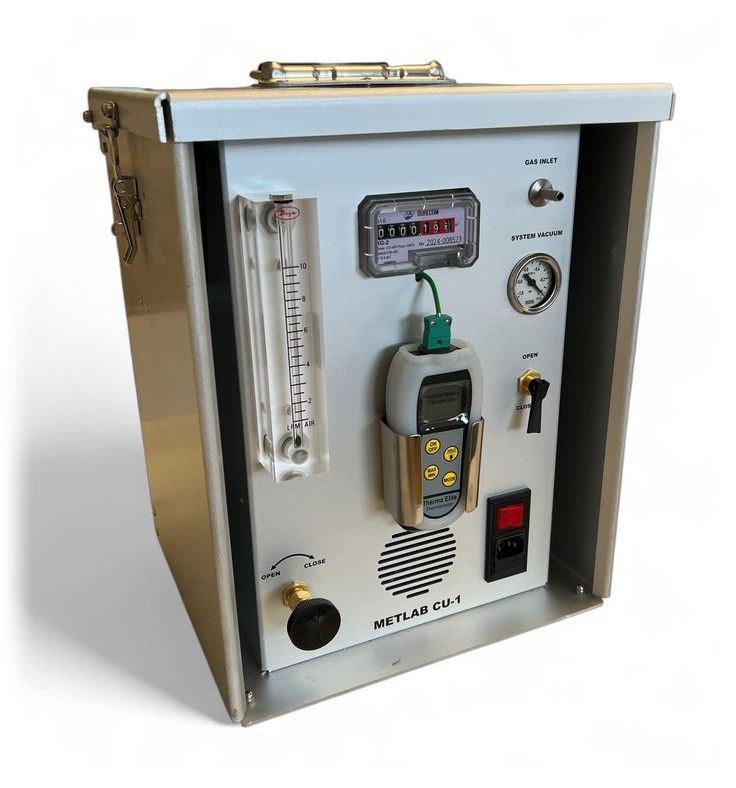
CU-1-10 gas sampler
Built-in vacuum pump, drying tower with silica gel, flow meter and gas meter – and a vacuum gauge for a quick leak test.
-
 GM25-101 · GM25-102
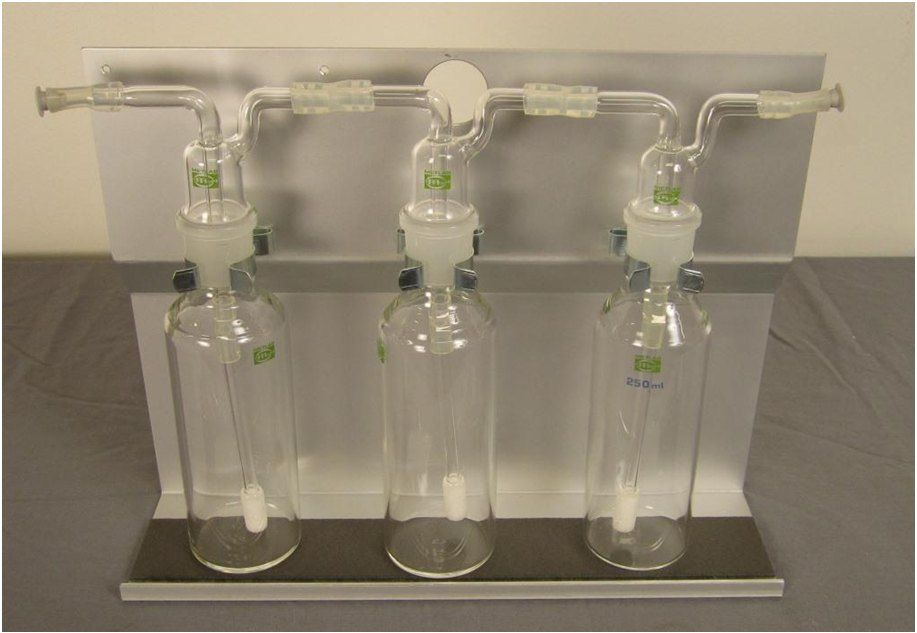
Bottle rack with absorption bottles
Two or three bottles (impingers) in series, 250 ml borosilicate glass with a glass insert and frit.
Frequently asked questions about ammonia measurement
Is the ammonia measurement accredited?
Yes. Sampling according to EN ISO 21877 is within METLAB's Swedac accreditation. The analysis is done by an accredited laboratory. The report gives the result with measurement uncertainty, the field blank and any deviations from the method.
How long does an ammonia measurement take?
Each sub-sample takes at least 30 minutes, and the BAT conclusions use the average of three consecutive sub-samples. At QAL2 of an automated measuring system at least 15 data pairs (a reference value and the measuring system's value for the same period) over at least three days are needed, at the annual surveillance test (AST) at least five.
Why is ammonia measured wet chemically and not with an instrument like NOx?
Ammonia is very soluble in water and cannot be measured in cooled, dried sample gas. Automated measuring systems therefore measure in the duct or in heated sample gas, and the wet chemical method is the independent reference method they are calibrated against and that newer BAT conclusions specify for periodic measurement.
Can ammonia be measured at the same time as NOx, HCl and SO2?
Yes. NOx and oxygen are measured with instruments during the sample; HCl and SO2 are sampled from the same probe with their own bottle racks and gas meters, and ammonia has its own set of bottles with sulphuric acid. With HCl or HF in the gas we sample isokinetically.
Does ammonia interfere with other measurements?
Yes. With SNCR, ammonium chloride and ammonium sulphate can form and are counted by the wet chemical reference methods for HCl and SO2. The handbook for EN 14181 from Avfall Sverige (the Swedish waste management association) therefore recommends limiting the ammonia dosing during QAL2. In a gas cooler ammonia can cause losses of SO2.
What is required of the measurement site?
A sampling port, a safe working platform and electricity for the probe heating. If the sample is taken at one point, one sampling port is enough. After a wet scrubber, where the sample is taken isokinetically at several measurement points, a measurement site as for dust measurement is needed.