
On this page
When do you need to measure the gas flow?
- Isokinetic sampling. Dust, metals and dioxins are sampled isokinetically, and then the gas velocity is measured at every measurement point.
- Emissions as mass flow. If the emission is to be stated in kg/h or kg per year, as in the annual environmental report, the concentration is multiplied by the flue gas flow.
- The Swedish NOx charge. The comparison measurement also covers the flue gas flow, and the laboratory should measure it in the first instance.
- Fixed flow monitors are calibrated and checked against pitot tube measurement (QAL2 and AST according to EN ISO 16911-2), for example at waste incineration and where CO2 is measured for emissions trading.
- Performance tests and a new measurement site: flow and flue gas temperature are checked against guarantee values, and the velocity profile shows whether a measurement plane meets EN 15259.
How the measuring equipment is built
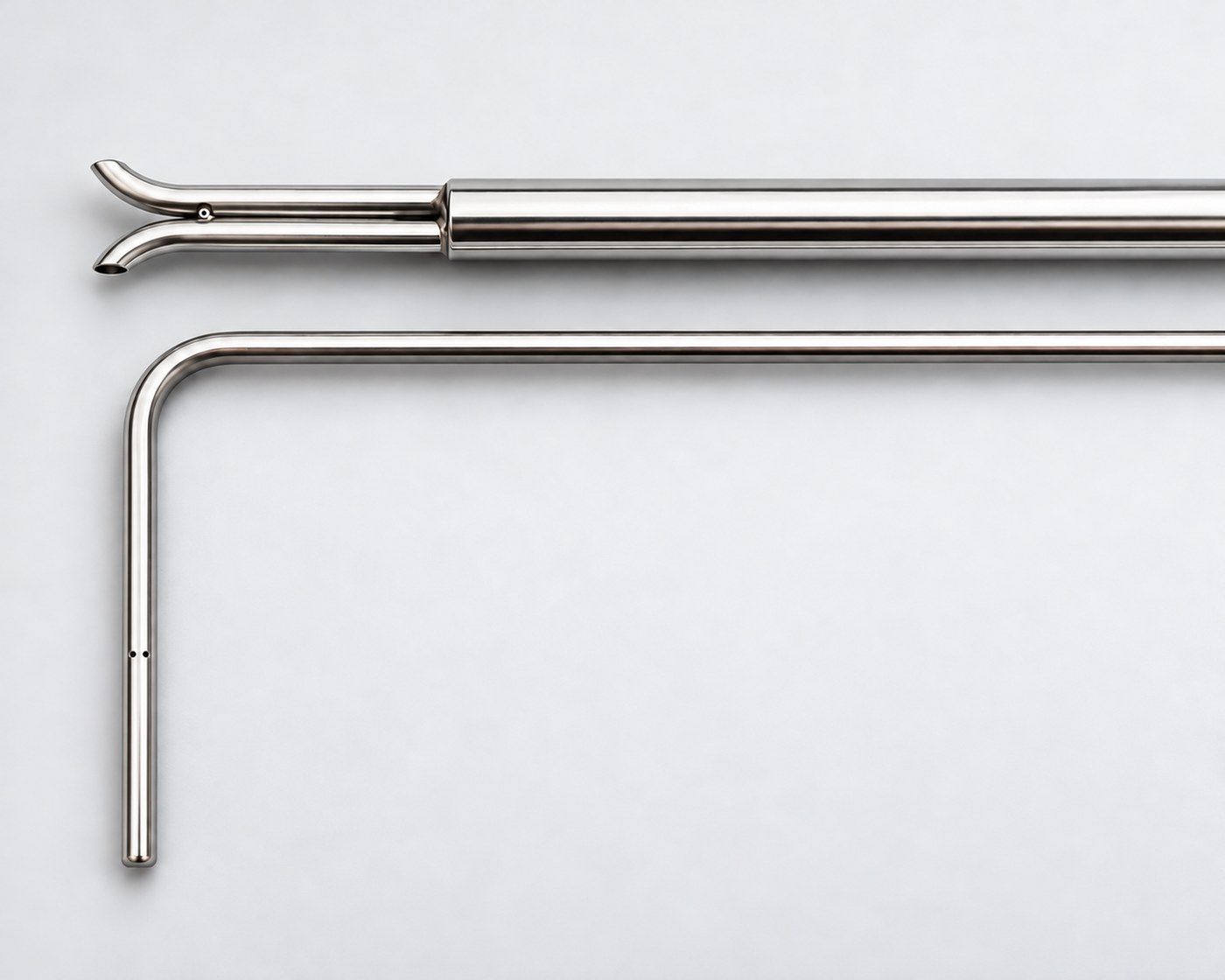
The gas velocity is measured as a differential pressure. An L-type or S-type pitot tube is inserted through the sampling port with one pressure tap facing the gas stream, and twin tubing carries the pressures to an electronic micromanometer outside the duct. At the same time the static pressure in the duct, the flue gas temperature with a type K thermocouple and the atmospheric pressure with a barometer are measured. Together with the gas composition (oxygen, carbon dioxide and moisture) they give the gas density, which is needed to convert pressure to velocity.
- 1. Pitot tube (S- or L-type), facing the gas stream
- 2. Differential pressure gauge (micromanometer)
- 3. Pressure gauge, static pressure in the duct
- 4. Temperature sensor (type K thermocouple)
- 5. Barometer
- 6. Oxygen, carbon dioxide and moisture, which give the gas density
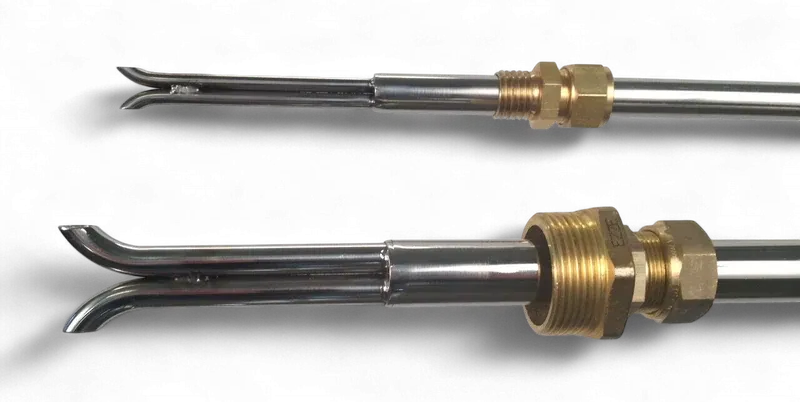
The L-type pitot tube suits clean gas. The S-type is used when the pressure holes can be blocked by dust or droplets, when the sampling port is small and at low velocities. If the flow varies, a fixed pitot tube logs the pressure at one point throughout the measurement.
How is a gas flow measurement done?
Measurement plane and duct dimensions
The measurement plane must lie on a straight run of duct according to EN 15259. The internal dimensions of the duct are measured on site in at least two directions at right angles (an error of 1 % in the diameter gives 2 % in the flow), and the area decides the number of measurement points.
Leak test and repeatability
The pitot tube and pressure tubing are pressurised before and after the measurement, and the pressure must be stable after five minutes. Before the start, five readings at the same measurement point must give a repeatability within 5 % of the velocity.
Traverse
The pitot tube is moved to every measurement point and aligned with the gas stream, within 15°. The differential pressure is read as a one-minute mean at each point, and the static pressure, temperature and atmospheric pressure are measured meanwhile.
Gas composition
Oxygen and carbon dioxide are measured during the traverse, and the moisture content is determined with an accredited method (read more about moisture in flue gas). Together with temperature and pressure, that gives the gas density, with an uncertainty of at most 0.05 kg/m3.
Calculation and report
The mean velocity times the duct area gives the flow. It is reported at duct conditions and as Nm3/h (0 °C and 101.3 kPa), for wet and dry gas, with measurement uncertainty.
The requirements in EN ISO 16911-1
These requirements decide whether a gas flow measurement is valid. They are in EN ISO 16911-1, EN 15259 and our accredited method description.
| Requirement | Value |
|---|---|
| Measuring range | 3–50 m/s (our accredited measuring range) |
| Lowest differential pressure | 5 Pa, about 3 m/s in air at 20 °C |
| Number of measurement points | 4 in a measurement plane of 0.1–1 m2, 20 above 4 m2. In circular ducts on two diameters |
| Flow in the measurement plane | At most 15° from the duct axis, no reverse flow, the highest velocity less than three times the lowest |
| Straight run | Normally at least 5 hydraulic diameters downstream of the nearest disturbance, 2 upstream of the next and 5 from the top of the stack |
| Leak test | Pressure stable for 5 minutes, before and after the measurement |
| Calibration | Pitot tube and pressure gauges traceably calibrated, the pitot tube at several velocities |
| Measurement uncertainty | Calculated for every measurement – in the standard's field validation ±0.98 m/s at 18–21 m/s (95 % confidence) |
From differential pressure to velocity
The pitot tube has two pressure taps: one facing the gas stream and one facing away from it or across it. The pressure difference Δp grows with the square of the velocity: v = K · √(2 · Δp / ρ), where K is the pitot tube's coefficient and ρ the gas density. That is why low velocities are hard to measure: in flue gas at 125 °C, 20 m/s gives about 175 Pa on an L-type pitot tube, but 5 m/s only 11 Pa. The S-type pitot tube gives about 40 % higher pressure at the same velocity.
From concentration to emission
The gas flow has no limit value of its own, but it decides how large the emission is. 50 mg/Nm3 in 100,000 Nm3/h of dry gas is 5 kg/h, about 40 tonnes over 8,000 operating hours. An error of 5 % in the flow gives a 5 % error in the emission.
Concentration and flow must be stated in the same conditions, normally dry gas at standard conditions (273.15 K and 101.3 kPa), and at the same oxygen content if the concentration has been converted to the reference oxygen content. In a duct at 150 °C and 20 % moisture, 100,000 m3/h corresponds to about 52,000 Nm3/h of dry gas.
Measure or calculate the flue gas flow?
In a combustion plant the flue gas flow can also be calculated from the composition and calorific value of the fuel, the fuel flow or the energy produced, and the O2 or CO2 concentration. The method is in the Swedish Environmental Protection Agency's information sheet on calculating flue gas flow, and our accreditation covers it too.
For the Swedish NOx charge the flow may be measured or calculated, but at the comparison measurement the laboratory should measure in the first instance. The calculation is also a good plausibility check of a measurement: a discrepancy can point to errors in the fuel data, the plant's output meter or the duct dimensions.
What does a gas flow measurement cost?
The price depends on the number of ducts and operating conditions, the size of the duct, whether moisture and gas composition are to be determined at the same time, the conditions at the measurement site and the travel distance. If the flow is measured together with dust or gases, the price per parameter is lower. Calibration of a fixed flow monitor takes longer, at least five hours of measurement. Request a quote – we reply within two working days. Approximate prices for the most common measurements are in the price guide.
How often must the gas flow be measured?
As often as the permit says – and every time an emission is to be reported as a mass flow or a sample is taken isokinetically. For the Swedish NOx charge the flow determination is checked at least once per calendar year, and fixed flow monitors are checked with an AST every year. The BAT conclusions specify continuous measurement of the flue gas flow at waste incineration and periodic or continuous determination at large combustion plants.
Measure the gas flow yourself
We make the pitot tubes in our workshop in Enköping. For the measurement to be valid the pitot tube needs a traceable calibration, and we also calibrate pitot tubes you already have.
-
 S-type pitot tube
Length 300–4,000 mm, stainless steel or Inconel, with accredited calibration at 5–35 m/s.
-
 GF22-101
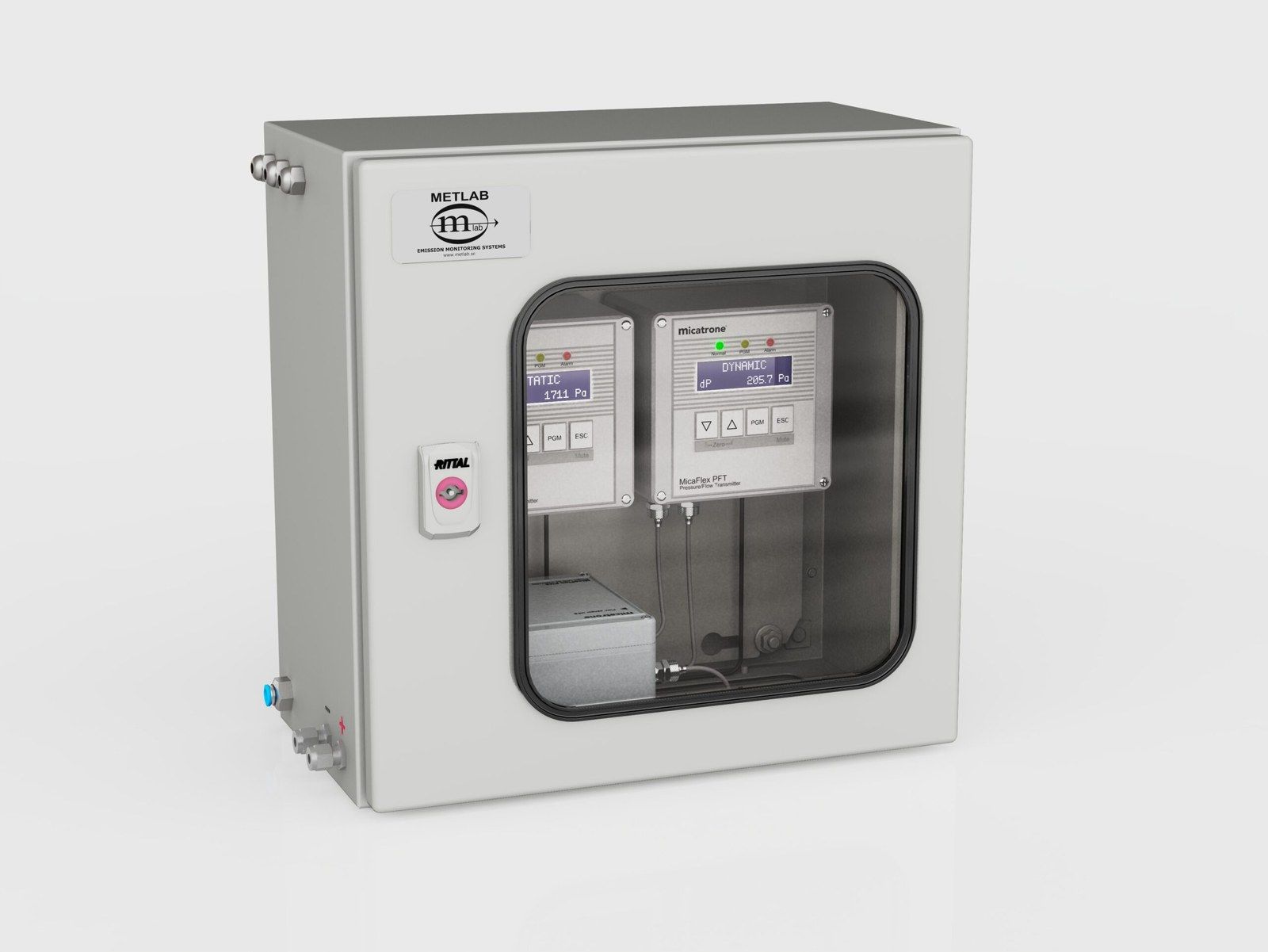
FlowGuard 100
Continuous flow measurement with a pitot tube, 5–35 m/s, with automatic purging of the pressure lines.
Frequently asked questions about gas flow measurement
Is the gas flow measurement accredited?
Yes, both the measurement and the calculation. Gas flow with pitot tubes according to EN ISO 16911-1 and ISO 10780 is within METLAB's Swedac accreditation, as are pressure, flue gas temperature and the calculation of flue gas flow according to the Swedish Environmental Protection Agency's information sheet.
How long does a gas flow measurement take?
The differential pressure is read for one minute at every measurement point. A traverse therefore takes a few minutes in a small duct and up to an hour in a large duct with 20 measurement points. The flow is usually measured at the same time as dust and gases.
What is required of the measurement site?
A straight run of duct and sampling ports that reach the whole cross-section (in a circular duct at least two ports at 90° to each other), and a safe working platform. The straight runs in EN 15259 are a recommendation: what decides is the flow in the measurement plane. Swirl above 15° is outside the accredited method.
Do you measure the flue gas temperature and pressure too?
Yes. The flue gas temperature is measured with a type K thermocouple according to chapter 5.29 of Energiforsk's Emissionsmäthandbok (the Swedish emission measurement handbook), and the pressure in the duct with a differential pressure gauge. Both are within the accreditation. They are needed for the density and the standard conditions, but can also be the main point, for example when a guaranteed flue gas temperature is to be checked.
Can you calibrate our fixed flow monitor?
Yes. The flow monitor is compared with pitot tube measurement according to EN ISO 16911-2: at least 15 data pairs (a reference value and the flow monitor's value for the same period) at QAL2 and at least 5 at the annual surveillance test (AST), spread over at least five hours and over the plant's normal flow range.