
On this page
When do you need to measure dioxins?
- Permit conditions. The environmental permit sets the emission limit value and how often dioxins are to be measured, sometimes dioxin-like PCB too.
- Waste incineration and co-incineration: the Swedish Ordinance on Waste Incineration (SFS 2013:253) requires at least two measurements a year and sets the emission limit value at 0.1 ng/Nm3.
- The BAT conclusions for waste incineration have lower BAT-associated emission levels (BAT-AELs) than the ordinance, also for the sum of dioxins and dioxin-like PCB.
- Process industry with BAT conclusions on dioxins: sinter plants, electric arc furnaces, cement and lime kilns, non-ferrous metal smelters and iron foundries.
- Performance tests after new or rebuilt flue gas cleaning, and measurement campaigns during planned start-ups and shutdowns at waste incineration plants.
How the sampling train is built
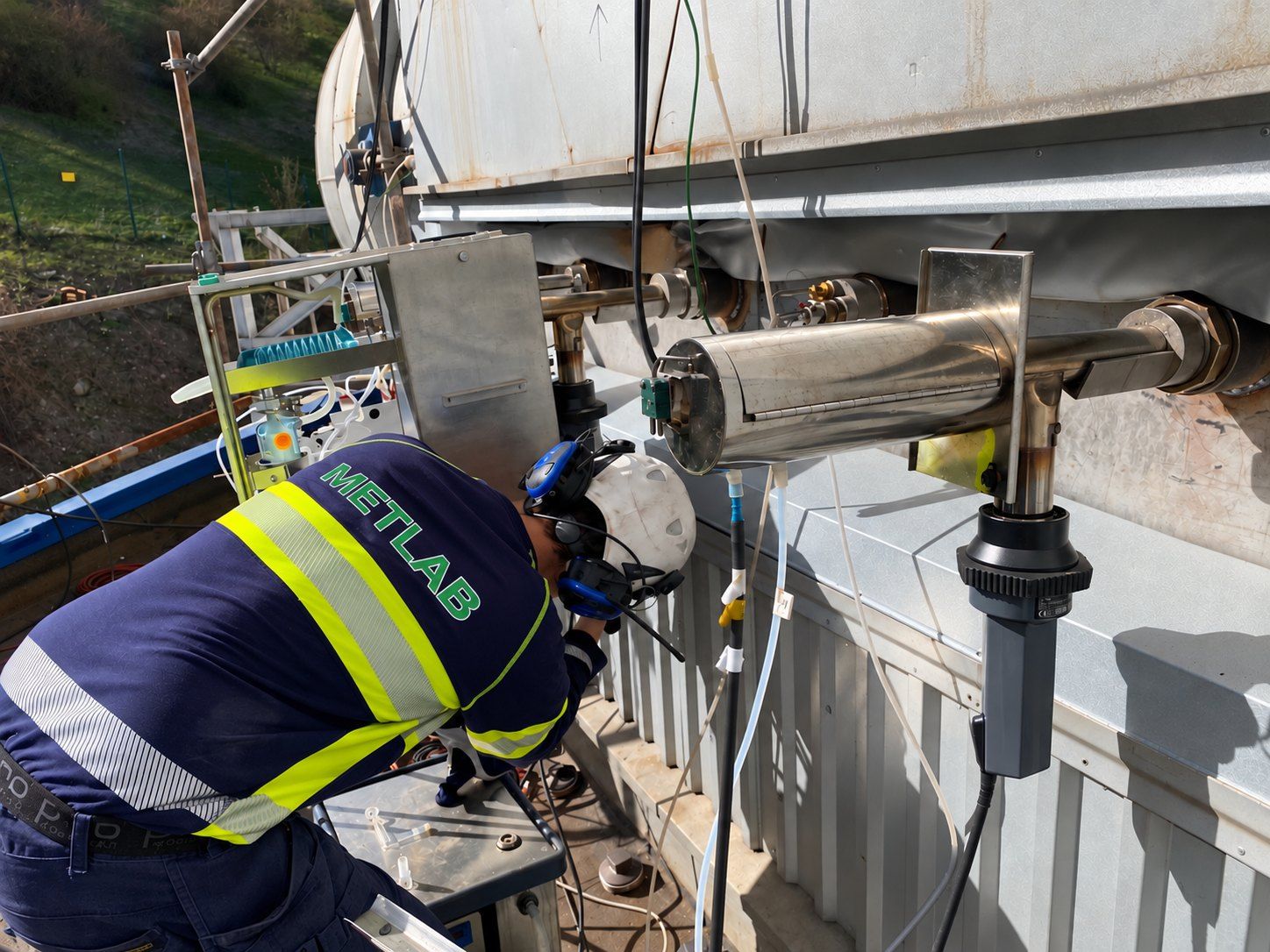
We sample with the filter/condenser method of EN 1948-1. The sample gas is drawn out isokinetically through a nozzle and a heated glass probe to a plane filter in a heated filter box, where particle-bound dioxins are caught. The gas is then cooled in a glass cooler (the condenser) and passes, together with the condensate, a cartridge with the adsorbent XAD-2, which captures the gaseous dioxins. The condensate is separated, the gas is dried with silica gel, and a pump draws it through the control unit, which regulates the flow and measures the sample volume.
- 1. Glass nozzle, facing the gas stream
- 2. Glass probe, heated
- 3. Plane filter in a heated filter box
- 4. Glass cooler with circulating coolant
- 5. Cartridge with adsorbent (XAD-2)
- 6. Condensate bottle
- 7. Drying tower with silica gel
- 8. Control valve
- 9. Gas-tight pump
- 10. Dry gas meter
- 11. Temperature sensor at the gas meter
- 12. Temperature sensor, flue gas temperature (type K thermocouple)
- 13. Pressure gauge, static pressure in the duct
- 14. Pressure gauge, dynamic pressure (micromanometer)
- 15. Pitot tube (L- or S-type) for gas velocity
- 16. Barometer
How is a dioxin measurement done?
Planning and measurement site
The measurement plane is chosen as for dust measurement: a straight run of duct, a working platform and sampling ports so that the probe reaches measurement points along at least two lines across the duct.
Prepared equipment
The glass parts, filter and adsorbent are cleaned before each sample, and a known amount of 13C-labelled furans is added. Their recovery shows whether the sampling has worked.
Preliminary measurement and leak test
Gas velocity, temperature, oxygen and moisture are measured, and the nozzle is chosen for isokinetic sampling. With the nozzle plugged, the leak rate must be below 5 % of the sample gas flow.
Field blank
Before each measurement series a complete sampling train is assembled and tested for leaks, without the probe being inserted into the duct and without gas being drawn through it.
Sampling for 6–8 hours
The probe is moved between the measurement points, with a new leak test at each change of sampling port. Gas velocity, sample gas flow and temperatures are recorded at least every 15 minutes, and the oxygen content is measured during the sample.
Analysis and report
The sample is stored in the dark and analysed by an accredited laboratory with high-resolution gas chromatography and mass spectrometry (EN 1948-2 and EN 1948-3). We convert the result to ng TEQ/Nm3 (dry gas at 0 °C and 101.3 kPa) at the reference oxygen content.
The requirements in EN 1948-1
These requirements decide whether a dioxin sampling is valid.
| Requirement | Value |
|---|---|
| Deviation from isokinetic sampling | −5 to +15 %, according to EN 13284-1 |
| Filter temperature | Below 125 °C, to avoid chemical reactions on the filter, but above the dew point of the flue gas |
| Sample gas after the cooler | Below 20 °C |
| Materials | Glass, quartz or titanium in contact with the sample gas; seals of PTFE, no grease |
| Leak rate | Below 5 % of the sample gas flow, before and after each sample |
| Field blank | At most 10 % of the emission limit value. Not subtracted from the measured value; lower measured values are reported as ≤ the field blank |
| Labelled sampling standard | Recovery above 50 % |
Why does the sample take six to eight hours?
The emission limit value of 0.1 ng/Nm3 is one ten-billionth of a gram per cubic metre of flue gas. For the laboratory to be able to determine each congener, several cubic metres must pass the filter and adsorbent: EN 1948-1 recommends at least 4 m3 and requires that each congener can be quantified down to 0.5 pg/m3 counted as toxic equivalent, a two-hundredth of the limit value. Our sampler takes up to 20 l/min, so six hours give at most just over 7 m3.
The sampling time is also a requirement in itself: the Swedish Ordinance on Waste Incineration (SFS 2013:253) states the limit value as an average over 6–8 hours, and the Swedish Environmental Protection Agency (Naturvårdsverket) reads the BAT conclusions' sampling period as one single continuous measurement. Then there is cleanliness: at emissions far below 0.1 ng/Nm3 the field blank can be at the same level as the measured value.
What does TEQ mean?
Dioxins and furans are 210 related compounds, congeners, but only the 17 with chlorine in positions 2, 3, 7 and 8 count. Each congener has a toxic equivalency factor (TEF) that states its toxicity compared with 2,3,7,8-TCDD, and the sum of concentration times factor is the sample's TEQ. The factors exist in two systems, and five of the 17 differ. The Swedish Ordinance on Waste Incineration (SFS 2013:253) and the BAT value for PCDD/F are based on I-TEF. The BAT value for PCDD/F and dioxin-like PCB is given in WHO-TEQ, which also includes twelve PCB congeners; the conclusions do not say which version of the factors.
| Congener | I-TEF (NATO 1988) | WHO-TEF (2005) |
|---|---|---|
| 2,3,7,8-TCDD | 1 | 1 |
| 1,2,3,7,8-PeCDD | 0.5 | 1 |
| 2,3,4,7,8-PeCDF | 0.5 | 0.3 |
| 1,2,3,7,8-PeCDF | 0.05 | 0.03 |
| OCDD and OCDF | 0.001 | 0.0003 |
| PCB 126 | – | 0.1 |
Which emission limit values apply to dioxins?
The emission limit value is set in the permit, in the Swedish Ordinance on Waste Incineration (SFS 2013:253) or in the sector's BAT conclusions. The BAT conclusions' ranges (BAT-AEL) apply with their upper value as a limit value four years after publication, for waste incineration since 3 December 2023. There either the value for PCDD/F or the value for PCDD/F and dioxin-like PCB applies, and for long-term samples the upper value is 0.02 ng higher. The values refer to samples of at least six hours, normally 6–8.
| Plant | Emission limit value or BAT-AEL | Rule |
|---|---|---|
| Waste incineration | 0.1 ng/Nm3 (I-TEQ) at 11 % O2 | SFS 2013:253, section 65 |
| Co-incineration of waste | 0.1 ng/Nm3: combustion plant at 6 % O2 (solid fuel), cement kiln at 10 % O2 | SFS 2013:253, sections 70, 96 and 99 |
| Waste incineration, PCDD/F | < 0.01–0.04 ng I-TEQ/Nm3 (new plant), < 0.01–0.06 (existing) | BAT 30, (EU) 2019/2010 |
| Waste incineration, PCDD/F and dioxin-like PCB | < 0.01–0.06 ng WHO-TEQ/Nm3 (new plant), < 0.01–0.08 (existing) | BAT 30, (EU) 2019/2010 |
| Large combustion plant co-incinerating waste with biomass, peat or coal | < 0.01–0.03 ng I-TEQ/Nm3 | BAT 71, (EU) 2021/2326 |
| Electric arc furnace, cement and lime kiln, non-ferrous metals | Upper value 0.1 ng I-TEQ/Nm3; ferro-alloys 0.05, sinter plants with bag filters 0.2 | 2012/135/EU, 2013/163/EU, (EU) 2016/1032 |
What does a dioxin measurement cost?
The price depends mainly on the number of samples: each sample takes a working day on site and requires cleaned glassware, a new filter and new adsorbent. The laboratory analysis is a large part of the cost, larger if dioxin-like PCB are included, and the field blank is analysed too. When dust, metals and gases are measured during the same visit, travel and set-up are shared. Request a quote and we will reply within two working days. Approximate prices for the most common measurements are in the price guide.
How often must dioxins be measured?
As often as the permit says. For waste incineration and co-incineration, the Swedish Ordinance on Waste Incineration (SFS 2013:253) requires at least two measurements a year, and one every three months during the first twelve months of operation. The BAT conclusions for waste incineration add long-term sampling every month unless the emissions have been shown to be stable enough. For co-incineration in large combustion plants the BAT conclusions specify every six months, for the non-ferrous metals industry once a year.
Measure dioxins yourself
-
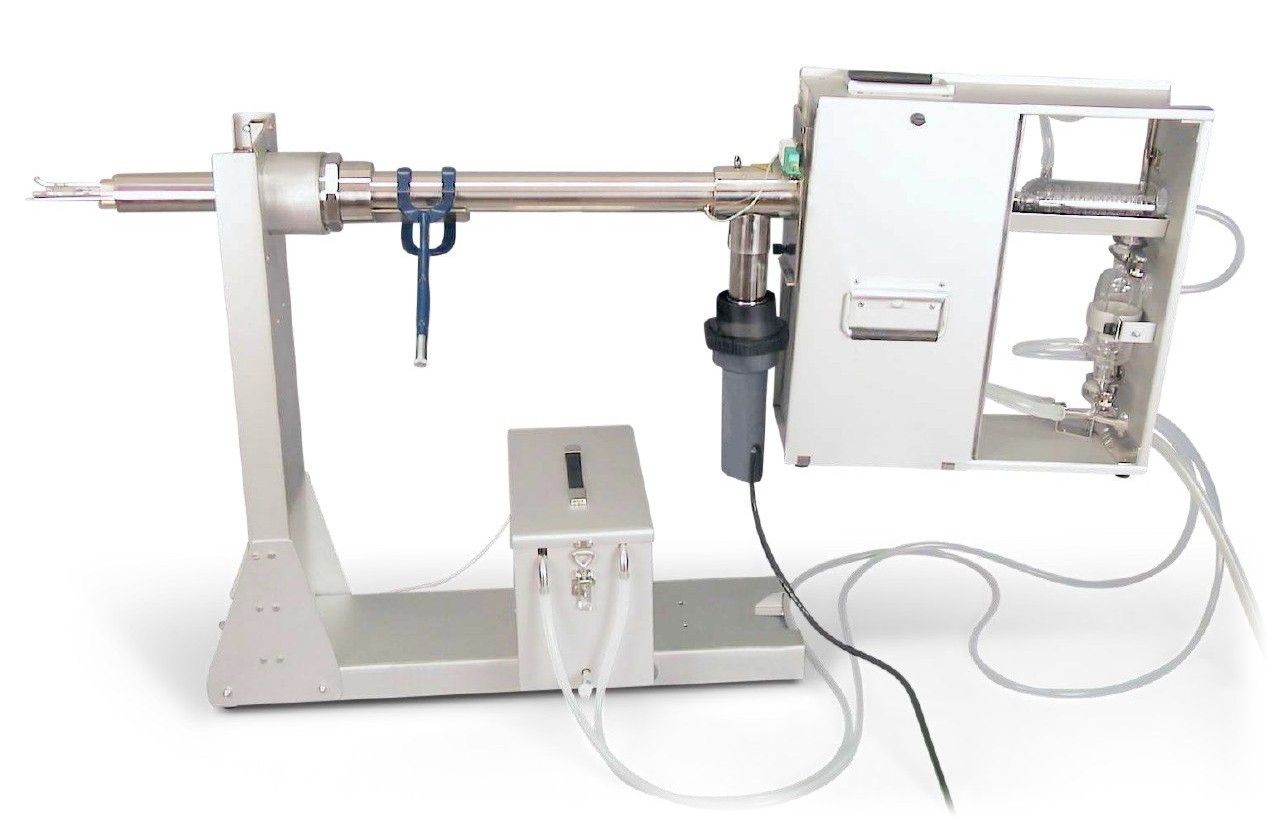 EVA Light
 dioxin sampler
Glass probe, heated filter box, glass cooler and XAD-2 cartridge for sampling according to EN 1948, up to 20 l/min.
-
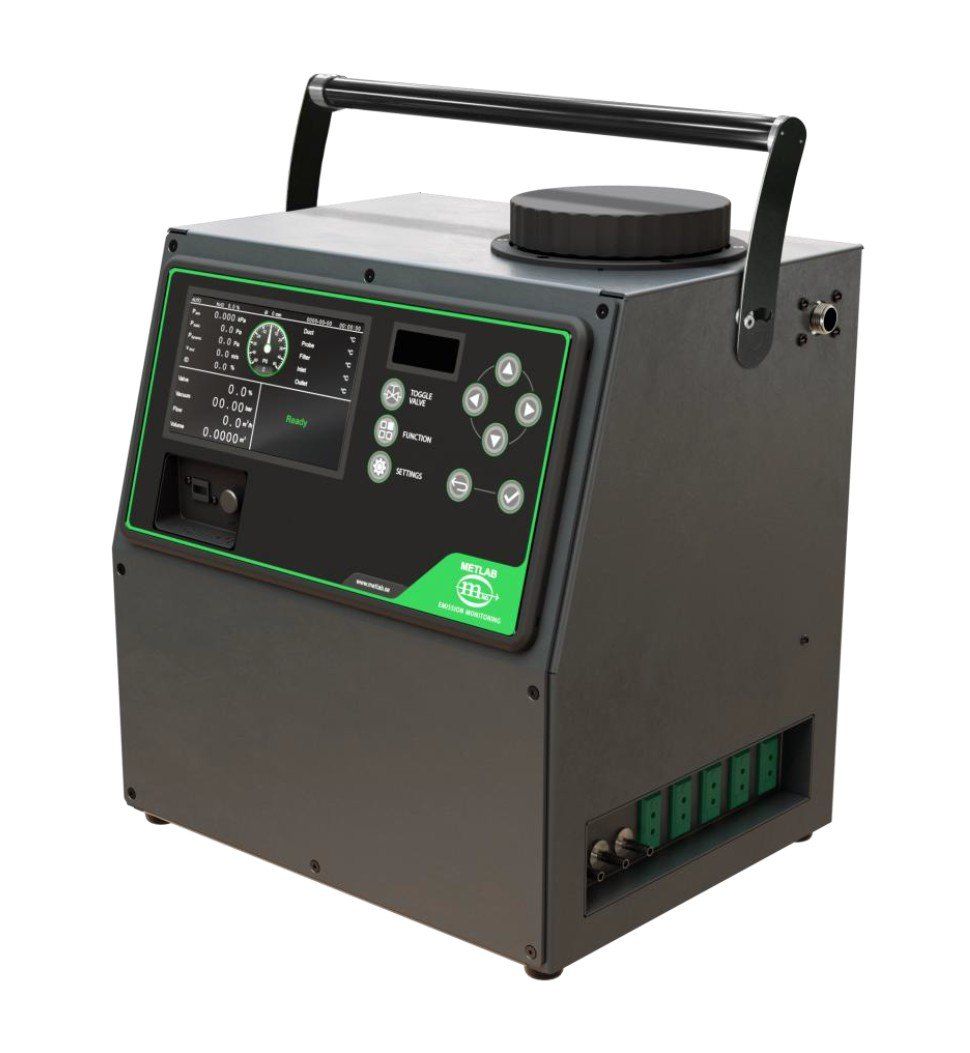 DX11-101
ADS-1-DX control unit
Automatic isokinetic control, logging of all parameters and a 7-inch display. Handles dust sampling too.
Frequently asked questions about dioxin measurement
Is the dioxin measurement accredited?
Yes, the sampling. METLAB's Swedac accreditation covers the sampling of dioxins and furans according to EN 1948-1, of PCB according to EN 1948-4 and of chlorobenzenes and chlorophenols according to a modified EN 1948-1. The analysis is done by an accredited laboratory.
How long does a dioxin measurement take?
Each sample takes 6–8 hours. With set-up, preliminary measurement, field blank and leak tests it is a long working day on site per sample, and then comes the analysis in the laboratory.
Can dioxins be measured at the same time as other parameters?
Yes. Dioxin-like PCB are determined in the same sample, and chlorobenzenes, chlorophenols and PAH can be sampled in the same sampling train. Metals and mercury, which under the Swedish Ordinance on Waste Incineration (SFS 2013:253) have the same measurement frequency as dioxins, are often measured during the same visit with sampling trains of their own.
What is required of the measurement site?
The same as for dust measurement: sampling ports on a straight run of duct, normally 3-inch threaded sockets, and a safe working platform with room for the probe and the glassware. Also electricity for the heating, the cooler and the pump, weather protection outdoors and stable operation for a whole working day.
What is long-term sampling of dioxins?
An automatic sampler draws flue gas isokinetically through a filter and an adsorbent for two to four weeks, and the sample is analysed in a laboratory (CEN/TS 1948-5). It gives a long-term average but no continuous measurement, and does not replace the short-term samples according to EN 1948-1.