
On this page
The carbon-14 method to EN ISO 13833
The carbon dioxide in the flue gas is absorbed in sodium hydroxide, normally over one month, in proportion to the flue gas flow. An accredited laboratory determines the sample's carbon-14 by accelerator mass spectrometry (AMS). Fossil carbon has no carbon-14 left, biogenic carbon has the same carbon-14 concentration as the air, so the share of carbon-14 gives the share of biogenic carbon dioxide. The share times the plant's total carbon dioxide emissions gives the tonnes of biogenic and fossil CO2 for the emissions report.
The EU Monitoring and Reporting Regulation (MRR), (EU) 2018/2066, requires a flue gas sample for every 50,000 tonnes of carbon dioxide, at least once a month, and a sampling plan that covers the whole reporting year. What emissions trading requires, and the EU timeline, are in the article Emissions trading and biogenic CO2; the method in detail and the requirements of the standard on the biogenic CO2 service page.
Every percentage point of biogenic share has a price
A waste-to-energy plant that emits 200,000 tonnes of carbon dioxide a year with a 50 % biogenic share needs allowances for 100,000 tonnes. Move the share by one percentage point and that is 2,000 tonnes, about €160,000 a year at €80 per allowance. Work it out for your plant:
What decides whether the value can be trusted is the sampling: the sample must follow the flue gas flow through the whole month, and no air may leak in. The carbon dioxide in air contains carbon-14 and counts as biogenic.
The C14G2 sampler in brief
- Liquid absorbent. 4 M sodium hydroxide in a standard absorption bottle, about 5 ml/min. The gas bubbles through the liquid, so there are no channels for the gas to slip through, as there can be in a solid absorbent, and the bubbling shows that sampling is running.
- Follows the flow. The sample flow is set by the flow signal from the plant's CEMS, so the sample reflects the emissions even when operation varies.
- Shows an air leak at once. The oxygen after the absorbent is compared with the oxygen in the stack. If it rises, the leak shows on the display and as a 4–20 mA signal, within hours instead of weeks later in the laboratory report.
- Ready for the control room. Remote start and stop, output signals for oxygen and sampling rate (4–20 mA). The sampler pauses and restarts with the plant.
- Easy to check. A 5.7-inch touchscreen, visible bubbling and one bottle swap a month with a two-minute leak test.
- Small and safe. 560 × 500 × 300 mm and 17 kg, on a wall, a bench or inside an existing analyser cabinet. The bottles sit in a locked stand.
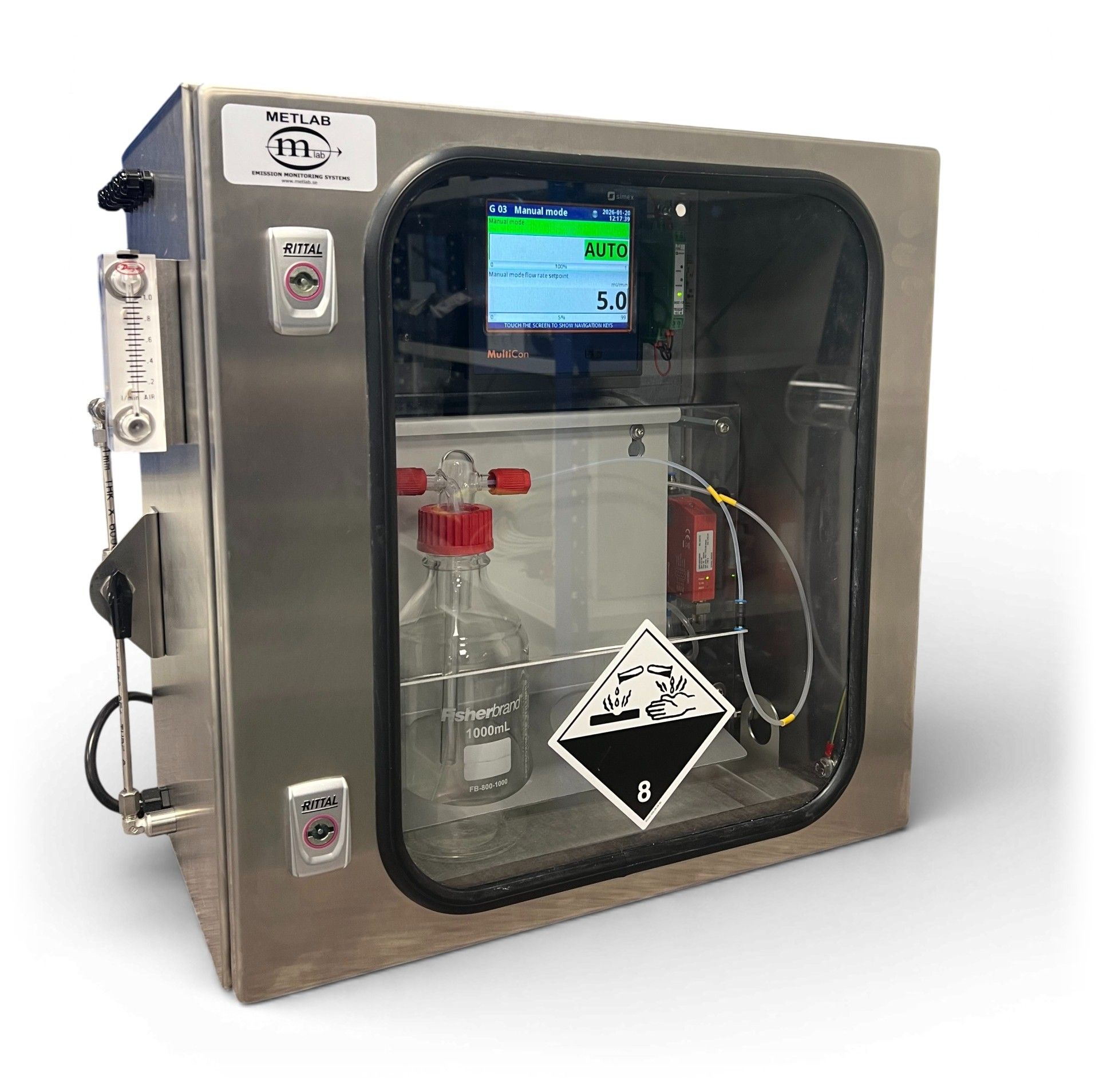
All technical data are on the C14G2 product page.
The C14G2 on site
-
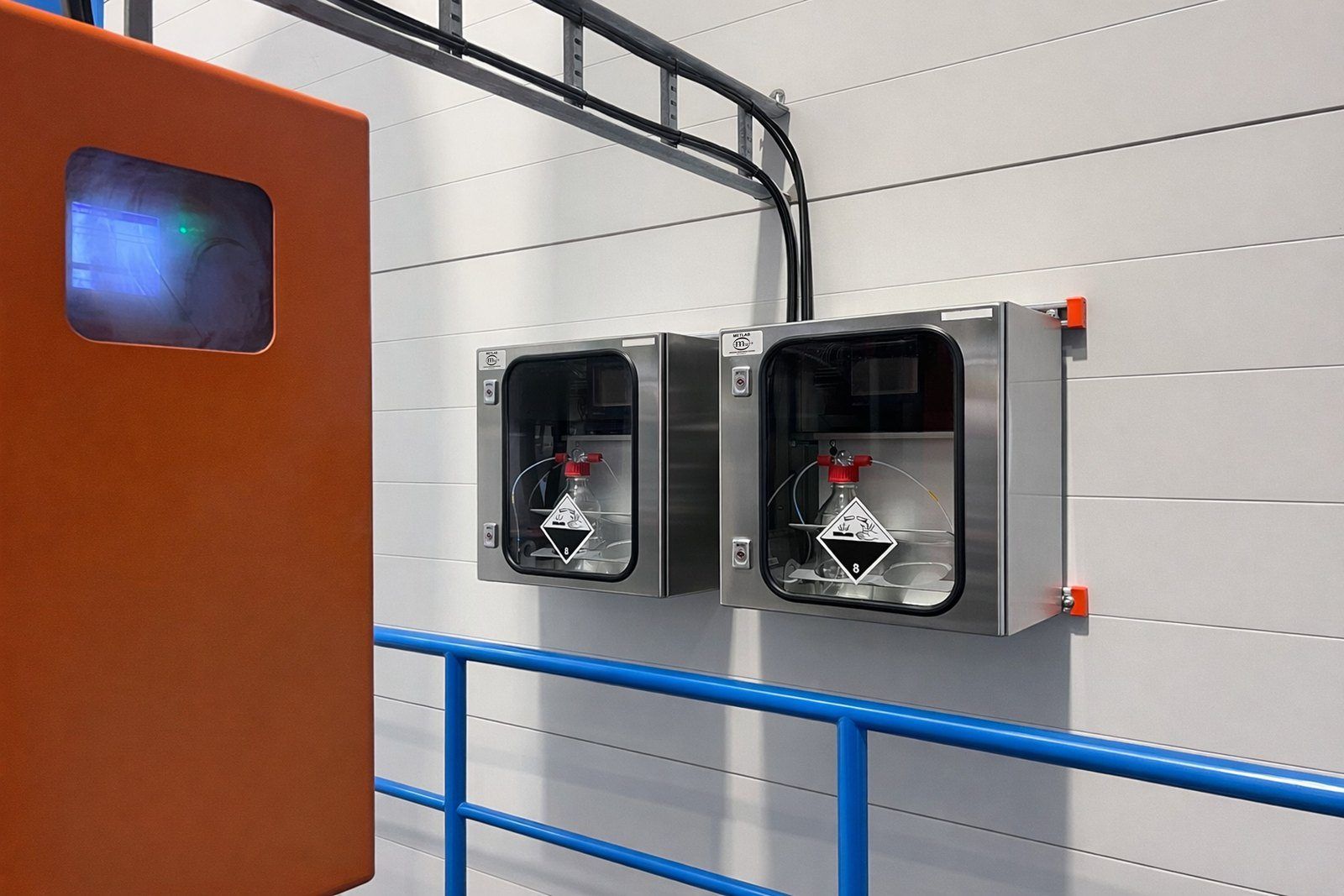
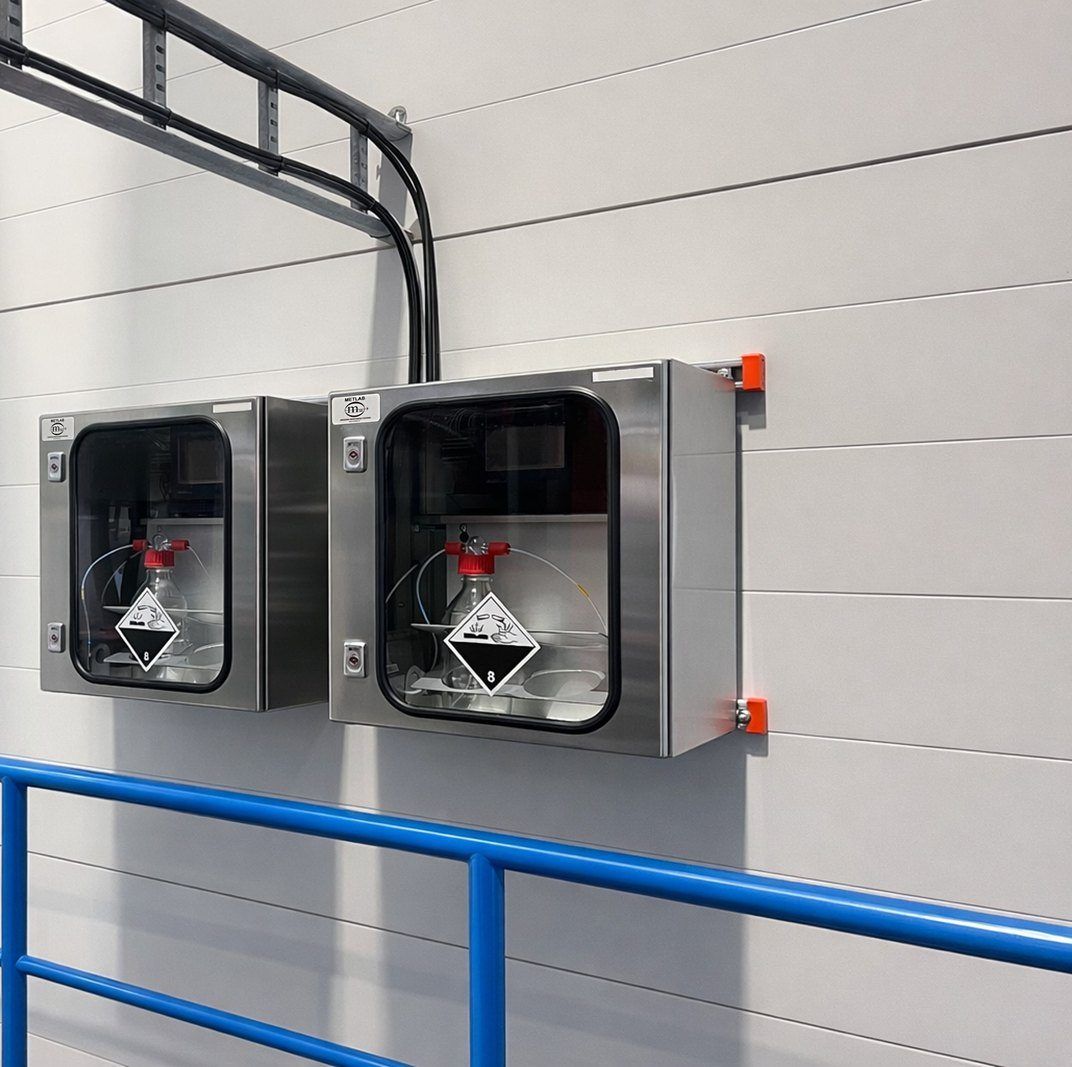
Two C14G2 samplers for two lines on one wall at a waste-to-energy plant. -
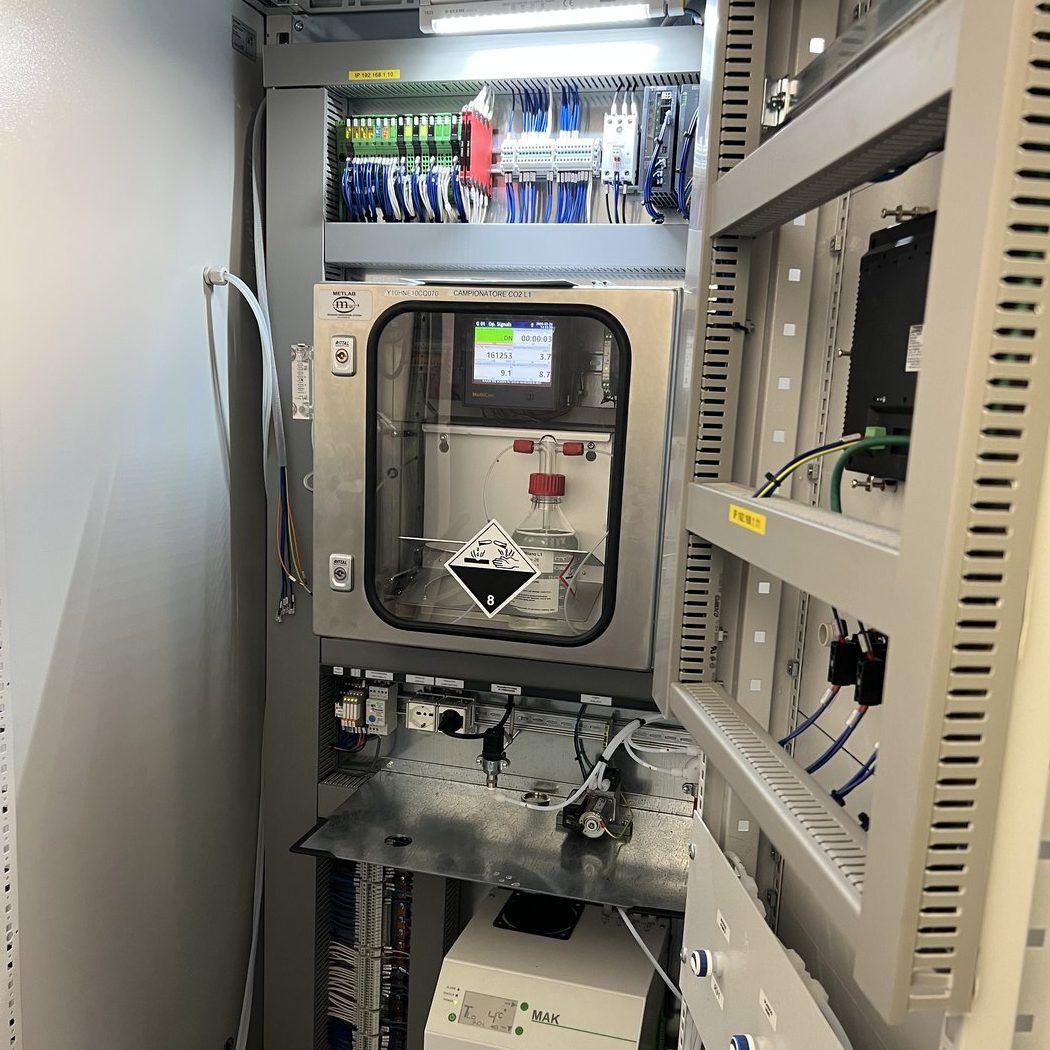
A C14G2 fitted inside an analyser cabinet.
Proportional sampling, proven in the field
We evaluate every sampling month from the logged data: the plant's flue gas flow and the sample flow measured by the C14G2, hour by hour. This is what 60 monthly samples from five lines look like, 37,200 operating hours.
- 0.7 %Hourly deviation from perfect proportionalityMedian over all operating hours (mean 1.1 %).
- 2.3 %Monthly 2σ, median monthThe figure in every monthly report (mean 3.3 %).
- > 98 %Of all hours within ±5 %The standard requires flow control within 5 % of reading.
Hourly values, plant operating hours only. Hourly ratio z = (sample flow ÷ its monthly mean) ÷ (flue gas flow ÷ its monthly mean); z = 1 is perfect proportionality. Hourly deviation = |z ÷ mean z − 1|, median (mean) over all operating hours. Monthly 2σ = 2 × the standard deviation of z ÷ mean z, per monthly sample, median (mean) over the 60 monthly samples. Within ±5 % = the share of operating hours with a deviation of 5 % or less.
One sampling month hour by hour
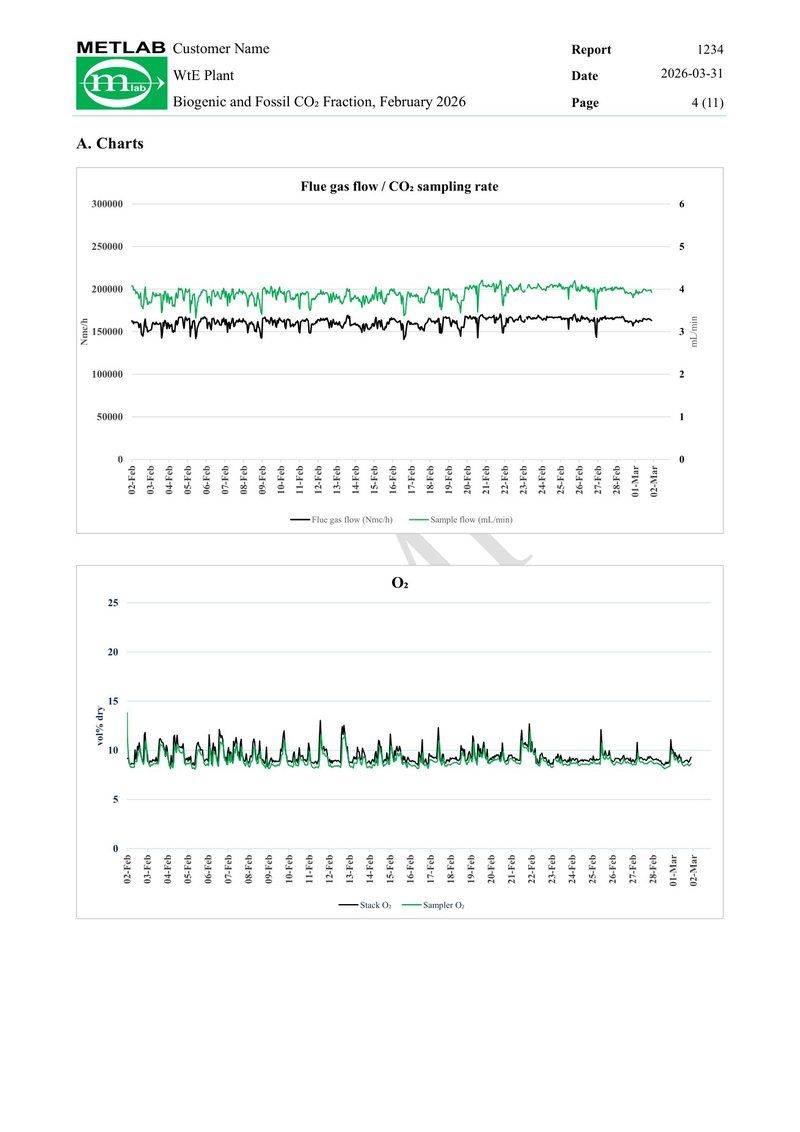
One of the lines over a month with large load changes: the flue gas flow moved between 114,000 and 193,000 Nm3/h, from 35 % below to 10 % above its monthly mean. The sample flow follows every rise and every dip.
Both signals are available continuously, on the display and as 4–20 mA. If something goes wrong, it shows at once, not when the analysis result arrives.
Absorbent prepared carbonate-free in our laboratory
Sodium hydroxide takes up carbon dioxide from the air too, and carbon dioxide carried over from the preparation counts as biogenic. So we prepare the 4 M sodium hydroxide carbonate-free in our own laboratory, in four steps, and analyse blank bottles regularly. After a normal sampling month the absorbent has more than 75 % of its capacity left; the standard requires more than 25 %. The sample is homogeneous, so we split it into representative sub-samples, one of which can be archived.
Boil
Deionised water is boiled to drive out the carbon dioxide.
Cool under nitrogen
The water is cooled under a nitrogen blanket, so that no carbon dioxide is taken up from the air.
Mix
Sodium hydroxide is dissolved to 4 mol/l.
Bottle under nitrogen
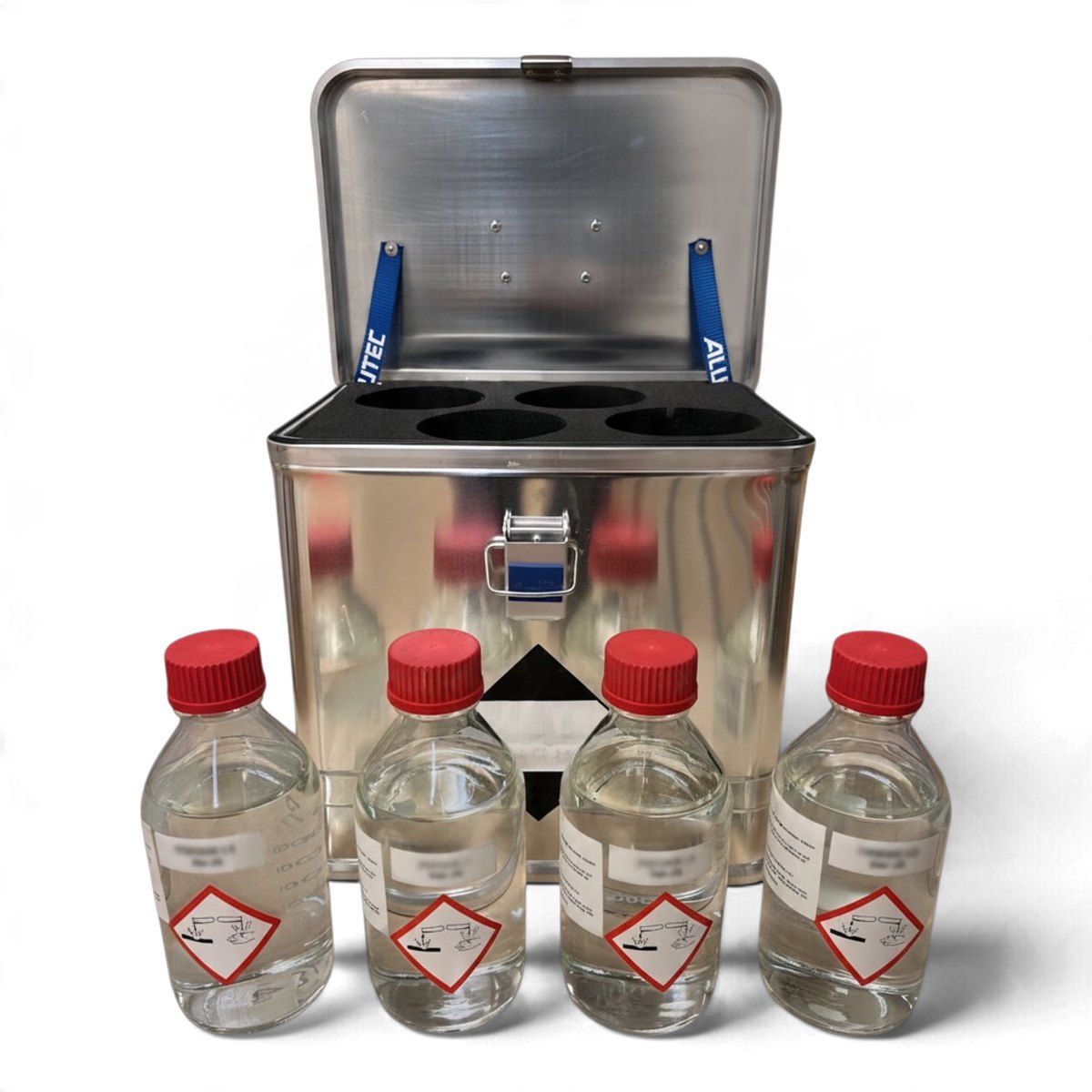
The bottles are filled and sealed under nitrogen, labelled with plant, line and month.
Two ways to connect to the stack
The flue gas is extracted, dried and led to the C14G2, which draws its sample stream in proportion to the plant's flow signal. That can be arranged in two ways, and we go through which one suits your plant before the quote.
A. A dedicated sample line
- 1. Probe with filter
- 2. Heated sample line
- 3. Gas cooler that removes the moisture
- 4. Pump that keeps a surplus flow
- 5. Bypass valve that lets the surplus flow out
- 6. The C14G2 sampler, which draws its sample stream, about 5 ml/min, from a T-piece
- 7. Signals to and from the plant's control system, 4–20 mA: in flue gas flow and stack O2, out O2 after the absorbent and sampling rate
The sampler gets its own probe, heated line, gas cooler and pump. The pump keeps a surplus flow that the bypass valve lets out, and the sampler draws its sample stream from a T-piece before the valve. The line is independent of the plant's CEMS, so sampling continues during CEMS maintenance, and the whole sample path is under control. Probe, line and cooler have to be installed.
B. Via the plant's existing CEMS
- 1. Existing probe with filter
- 2. Existing heated sample line
- 3. The plant's existing CEMS, whose dry outlet gas continues to the exhaust
- 4. Passive gas cooler on the sample stream, when the gas from the CEMS is hot and wet
- 5. The C14G2 sampler, which draws its sample stream, about 5 ml/min, from a T-piece on the outlet line
- 6. Signals to and from the plant's control system, 4–20 mA: in flue gas flow and stack O2, out O2 after the absorbent and sampling rate
The sampler draws a sample stream of a few millilitres per minute from the dry outlet gas of the existing CEMS, through a T-piece on the outlet line, and so reuses its probe, line and gas conditioning; the rest of the gas goes to the exhaust as before. If the gas from the CEMS is hot and wet, a passive gas cooler sits on the sample stream right before the sampler. Sampling pauses when the CEMS is under maintenance or has a fault, and the gas must be dry and unchanged in carbon dioxide content. In use downstream of a mercury analyser at a German waste-to-energy plant.
We commission the installation: leak test, oxygen check against the plant's CEMS and training of the staff on site.
From prepared bottle to report in five weeks
With the full service we handle everything except the bottle swap itself, which the plant's staff do once a month. The bottles arrive pre-labelled with plant, line and month and travel both ways in their own transport case.
Prepare
4 M sodium hydroxide is prepared carbonate-free in our laboratory.
Ship
Pre-labelled bottles are sent in the transport case.
Sample
The plant's staff swap the bottle once a month.
Return
The used bottle and the logged data go back to METLAB.
Analyse
Carbon-14 analysis by AMS at an accredited laboratory.
Report
Report with results and charts within five weeks of the end of the sampling month.
A report the verifier can follow, every sampling month
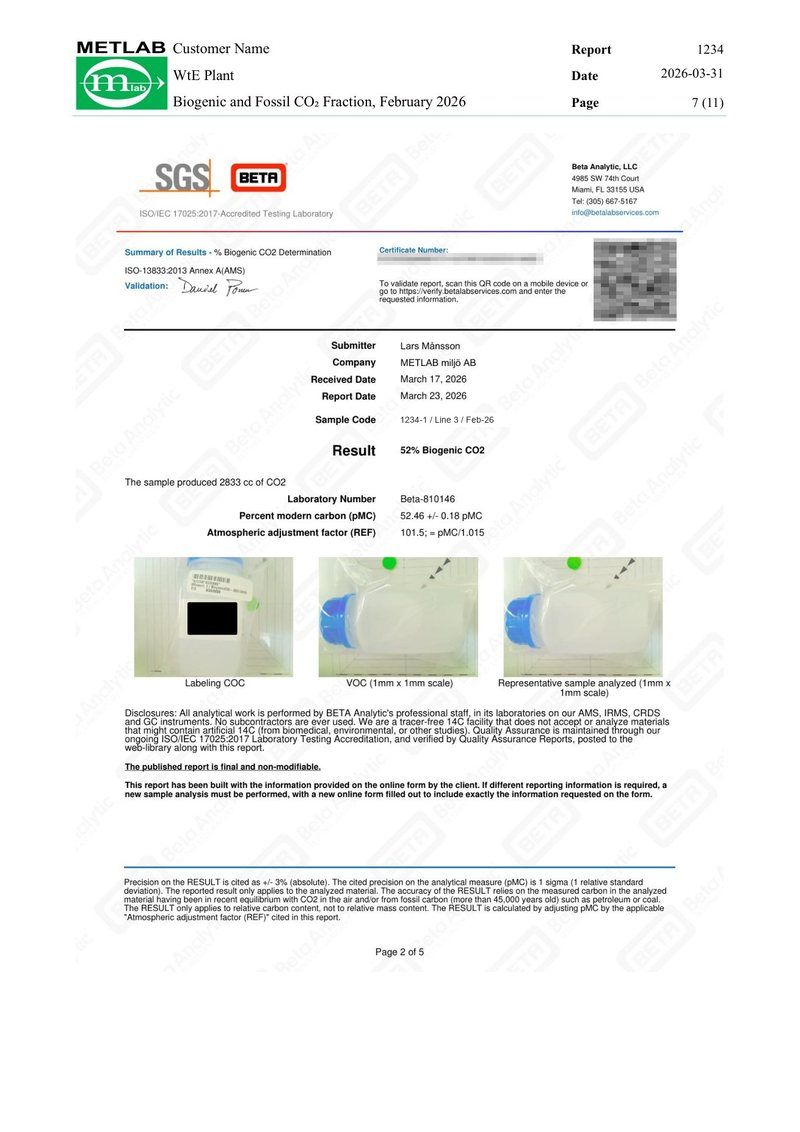
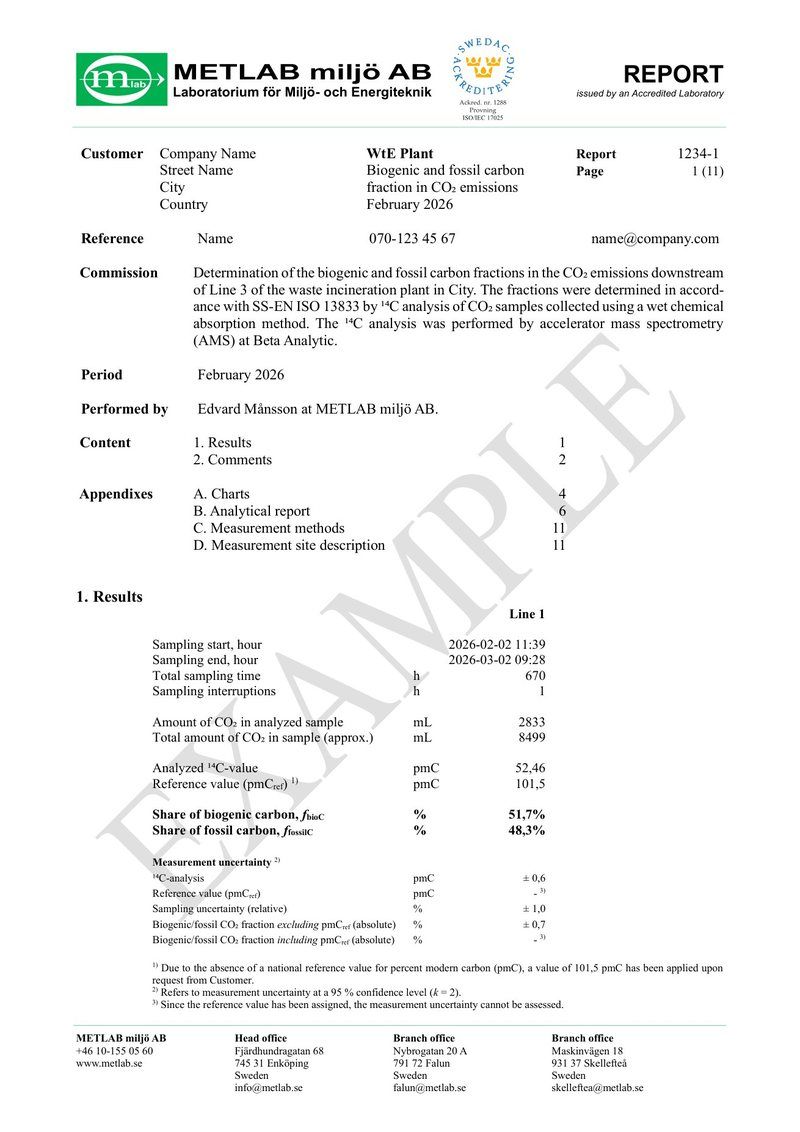
- Biogenic and fossil share with measurement uncertainty (k = 2).
- Operating conditions and every interruption, minute by minute.
- Charts: flue gas flow, sampling rate, oxygen in the stack against oxygen in the sampler, load.
- Sampling checks: the absorbent's remaining capacity and the oxygen leak check.
- The laboratory's original report from the carbon-14 analysis.
Buy the sampler – or let us handle everything
Both routes give the same sampling and the same kind of report. The price depends on the number of lines, sampling periods per year and how much your own staff handle. We answer a quote request within two working days.
- Option 1
Buy the C14G2 sampler
For plants and measurement laboratories that run their own sampling.
- The C14G2 sampler
- Sampling procedure, record sheets and instructions for preparing the absorbent
- Support with handling the data
- Installation support and a service agreement as options
- Most popular Option 2
Full service
We run the sampling programme for you, with a report every month.
- Absorbent prepared carbonate-free in our laboratory
- Installation and commissioning of the sampler
- Sample handling, carbon-14 analysis and evaluation
- Report within five weeks, every month
Customers and markets
Some of Europe's largest waste-to-energy plants determine their biogenic share with the C14G2. We are active in Sweden, Norway, Denmark, Germany and Italy and expanding across the EU. References are available on request.
Frequently asked questions
Buy the sampler or choose the full service?
If you have your own measurement staff and want to run the sampling yourself, you buy the C14G2 and get the sampling procedure, record sheets, instructions and support. If you want a finished result every month, with no work of your own beyond the bottle swap, you choose the full service. Many start with the sampler and add the service later, and both can be combined with a service agreement.
How soon can we start?
The sampler is built in our workshop in Enköping, Sweden. Tell us about the plant in the quote request, and you get the delivery time together with the price within two working days.
Does the C14G2 work with our CEMS?
Yes. The flow signal (4–20 mA) from the plant's CEMS sets the sample flow, and the oxygen after the absorbent is compared with the CEMS value for the stack. The sample gas can come through a dedicated line or from the dry outlet gas of the CEMS, see the two ways to connect.
What happens if air leaks in during a sampling month?
Air in the sample path raises the oxygen after the absorbent above the oxygen in the stack, and that shows on the display and as a 4–20 mA alarm. The fault can be put right at once, and the oxygen log shows the verifier that the sampling was leak-tight through the whole month.
Who does the carbon-14 analysis?
An accredited radiocarbon laboratory, by AMS. Our own accreditation covers the sampling, and the laboratory's original report comes with ours.
Can we get references?
Yes, on request. Say so in the quote request, and we get back to you with references.