
On this page
When do you need to measure oxygen and carbon dioxide?
- At every emission measurement. Oxygen is measured at the same time as dust, NOx, CO and other parameters, since their concentrations are to be converted to the reference oxygen content.
- The Swedish NOx charge. If you calculate the flue gas flow from the O2 or CO2 content, that monitor is part of the comparison measurement according to the Swedish EPA's regulations NFS 2016:13.
- Automated measuring systems. At waste incineration plants and in large combustion plants with continuous measurement, the oxygen content is also measured continuously. At QAL2 and AST we measure oxygen with the reference method, so that the oxygen monitor can be calibrated too.
- Gas flow and tuning: O2 and CO2 are needed for the gas density in flow measurement, and the oxygen content shows the excess air when the combustion is set up.
How the sampling train is built
Oxygen and carbon dioxide are measured in dry sample gas. A probe with a coarse filter draws a sample stream out of the duct, and the heated sample line keeps the gas above the dew point until the gas cooler, where the water vapour condenses out. Via a pump, a fine filter and a rotameter the dry gas reaches the analysers. The oxygen analyser uses the fact that oxygen molecules are drawn to a magnetic field: they are strongly paramagnetic, which hardly any other component of the flue gas is. The carbon dioxide analyser measures how much infrared light the sample gas absorbs. Zero and span gas are connected at the probe.
- 1. Probe with coarse filter
- 2. Heated sample line
- 3. Gas cooler that dries the sample gas
- 4. Condensate drain
- 5. Pump
- 6. Fine filter
- 7. Rotameter
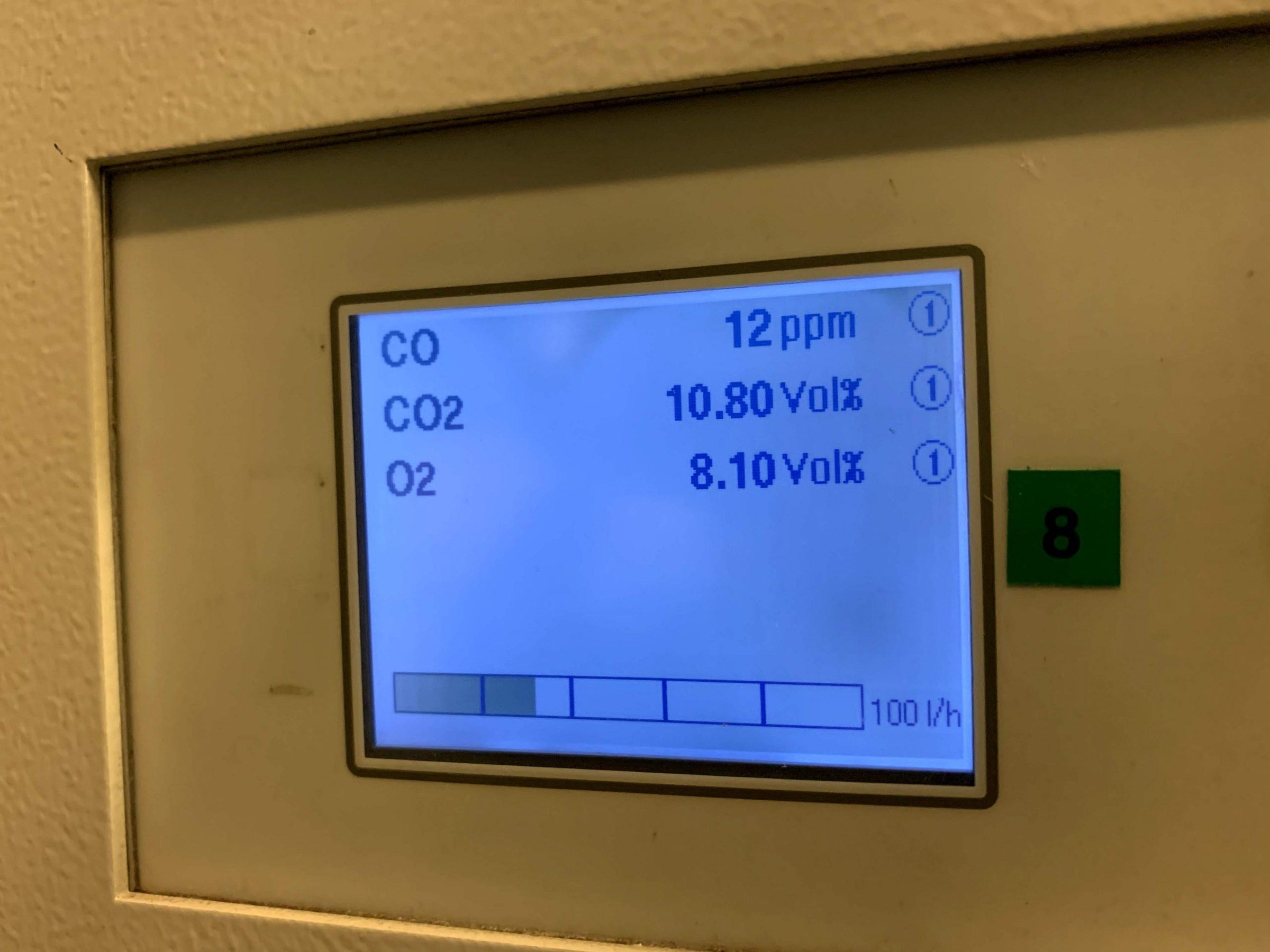
- 8. Analysers for oxygen and carbon dioxide
- 9. Data acquisition
- 10. Zero and span gas
A leak on the suction side draws in air with 20.9 % oxygen and raises the reading. That is why the system is leak tested before every measurement. Permanently installed oxygen monitors in the duct are usually zirconia cells, which measure in wet gas. The reference method measures in dry gas, so the two show different values for the same flue gas.
How is an oxygen measurement done?
Measurement point
Oxygen is measured in the same measurement plane as the parameters it is to convert: at one representative point if the flue gas is homogeneous over the cross-section, otherwise at several points according to EN 15259.
Calibration and leak test
The zero point is set with nitrogen and the span point with a gas of known concentration or with clean, dry air (in boiler houses taken from outdoors, where leaking flue gas does not affect it). The gases are fed first directly to the analyser and then in at the probe. The difference may be at most 2 % of the span gas value.
Measurement
O2 and CO2 are logged at least once a minute throughout the measurement. Each dust sample, wet chemical sample and gas average is then converted with the oxygen average for its own period.
Check after the measurement
The zero and span points are checked after the measurement period, at least once a day. For oxygen we correct the measured values when the drift is larger than 0.20 % by volume, and reject the measurement above 0.5 % by volume.
Report
The concentrations are reported in % by volume of dry gas with measurement uncertainty, together with the parameters they have been used for. The report is accredited and digitally signed.
The requirements in EN 14789
EN 14789 states the requirements in % by volume of oxygen. Leaks and drift are checked at every measurement, linearity and interference at least once a year.
| Requirement | Value |
|---|---|
| Validated range | 3–21 vol % O2, measurement periods of 30 minutes |
| Zero gas and span gas | Nitrogen with less than 0.05 % O2. Span gas with an uncertainty of at most 2 %, or dry ambient air: 20.9 % O2 with 0.5 % uncertainty |
| Leak test | At most 2 % deviation when the span gas is fed through the whole sampling system, or a leak rate of at most 2 % of the sample gas flow |
| Zero and span drift | Above 2 % of the span gas value the measured values are corrected, above 5 % the measurement is rejected. Our method description sets the limits at 0.20 and 0.5 vol % |
| Linearity | Deviation of at most 0.30 vol % |
| Interference | Other gases may together affect the reading by at most 0.40 vol % |
| Dew point after the gas cooler | At most 4 °C |
| Measurement uncertainty | Expanded uncertainty at most 6 % of the reading or 0.3 vol % |
For carbon dioxide, which is measured according to ISO 12039, we apply the drift limits of 2 and 5 % of the span gas value.
Reference oxygen content: why are concentrations converted?
The more air that comes with the flue gas, the lower the concentration of everything else, without the emission decreasing. Measured values are therefore converted to a fixed oxygen content, the reference oxygen content, before they are compared with the emission limit value: concentration at reference O2 = measured concentration × (21 − reference O2) / (21 − measured O2), with the oxygen contents in % by volume of dry gas. Example: 80 mg/Nm3 (dry gas at 0 °C and 101.3 kPa) measured at 11 % O2 becomes 80 × 15 / 10 = 120 mg/Nm3 at the reference 6 %. The reference is stated in the rule the emission limit value comes from:
| Plant or fuel | Reference oxygen content | Rule |
|---|---|---|
| Solid fuels | 6 % | SFS 2018:471, section 38 · SFS 2013:252, section 40 · the BAT conclusions for large combustion plants |
| Liquid and gaseous fuels, except in gas turbines and engines | 3 % | The same rules |
| Gas turbines and engines | 15 % | The same rules |
| Waste incineration | 11 % (3 % when incinerating waste oil) | SFS 2013:253, section 56 · the BAT conclusions for waste incineration |
| Co-incineration of waste in an energy plant | 6 % for solid and 3 % for liquid fuels. In the mixing rule the waste's limit values refer to 11 % | SFS 2013:253, sections 74 and 94 · the BAT conclusions for large combustion plants (6 %) |
| Cement kiln and lime kiln | 10 % for cement kilns, 11 % for lime kilns | SFS 2013:253, section 67 · the BAT conclusions for cement, lime and magnesium oxide |
| Recovery boiler and lime kiln in a pulp mill | 6 % | The BAT conclusions for pulp, paper and board |
The rule's own text applies, and the permit may state another reference. When incinerating hazardous waste with flue gas cleaning, the concentrations are converted only when the measured oxygen content is higher than the reference (SFS 2013:253, section 50). The formula applies to combustion with air, not oxygen-enriched combustion.
A high oxygen content makes the conversion uncertain
The conversion factor grows quickly when the measured oxygen content approaches the 21 % of air. To the reference 6 %, the factor is 1.5 from 11 % O2, 3 from 16 % and 7.5 from 19 %. At the same time the error in the oxygen measurement matters more and more: 0.3 % by volume (on a par with the measurement uncertainty EN 14789 allows) changes the converted value by about 2 % at 6 % O2, 3 % at 11 %, 10 % at 18 % and 15 % at 19 %. According to the Swedish Environmental Protection Agency (Naturvårdsverket), oxygen contents that high occur almost only in gas turbines and during start-up and shutdown, and permits may have their own rules. The agency's industry fact sheet for crematoria mentions a condition under which oxygen contents above 18 % are counted as 18 %.
What is the carbon dioxide value used for?
The CO2 content, like the oxygen content, is a measure of the excess air, and some permits state the emission limit value at a carbon dioxide content instead. Conditions for crematoria, for example, use 11 % O2 or 9 % CO2. The concentration is then converted with measured concentration × reference CO2 / measured CO2. For a given fuel O2 and CO2 are linked, so the two readings also check each other.
The CO2 content is also used in the calculation of the flue gas flow for the Swedish NOx charge, for the gas density in flow measurement and to correct the signal of the NOx analyser. In the EU Emissions Trading System (EU ETS) the emission can be determined by continuous measurement of the CO2 content and the flue gas flow. How much of the carbon dioxide is biogenic is determined with a method of its own, EN ISO 13833 (see biogenic CO2).
What does an oxygen measurement cost?
Oxygen and carbon dioxide are almost always measured as part of a larger emission measurement, with analysers in the same measuring system as NOx and CO. The price is then set by the whole campaign: the number of stacks or ducts and operating conditions, the length of the measurement, the conditions at the measurement site and the travel distance. There is no laboratory analysis. Request a quote – we reply within two working days. Approximate prices for the most common measurements are in the price guide.
How often must oxygen be measured?
As often as the parameters it belongs to: at every periodic measurement, that is at least every three years or every year for medium combustion plants, and otherwise as often as the permit says. At waste incineration plants the oxygen content is measured continuously. An oxygen or carbon dioxide monitor that is part of the flue gas flow calculation for the Swedish NOx charge is checked by a comparison measurement at least once per calendar year.
Frequently asked questions about oxygen and carbon dioxide
Why does our own oxygen monitor show a different value from your measurement?
Permanently installed oxygen monitors in the duct usually measure in wet gas, whereas the reference method measures in dried gas. Dry concentration = wet concentration × 100 / (100 − moisture content): 4.0 % O2 in flue gas with 20 % water vapour corresponds to 5.0 % in dry gas. The monitors may also sit at different places in the duct.
Is the measurement accredited?
Yes, both sampling and analysis: oxygen according to EN 14789 (paramagnetic analyser) and ISO 12039 (zirconia cell and electrochemical cell), carbon dioxide according to ISO 12039 (IR). Accredited measuring ranges: 0.05–30 % O2 by volume (paramagnetic) and 0.01–20 % CO2 by volume.
Does the emission in kilograms change when the concentration is converted to the reference oxygen content?
No. The conversion changes the concentration, not the quantity emitted. The emission in kilograms per hour is the concentration times the gas flow, and the two must be stated at the same oxygen content: either both as measured or both converted to the reference oxygen content.
What interferes with an oxygen measurement?
Paramagnetic analysers are selective: nitric oxide (NO) has a negligible effect, and carbon dioxide can affect the reading by about 1 %. Zirconia cells read low when the gas contains much CO or hydrocarbons, which are oxidised on the hot cell: 1 % CO gives a reading about 0.5 % by volume too low.
How long does the measurement take?
As long as the other parameters are measured or sampled. As a measurement in its own right, for example a comparison measurement of a permanently installed oxygen monitor, at least ten data pairs (a reference value and the monitor's value for the same period) are needed, according to NFS 2016:13 normally of 60 minutes each.
What is required of the measurement site?
The same as for other gas analysis according to EN 15259: a sampling port, a safe working platform and electricity. If sampling ports at different places in the duct are used, no air may leak in between them; otherwise the oxygen content does not match the samples it is to convert.