
On this page
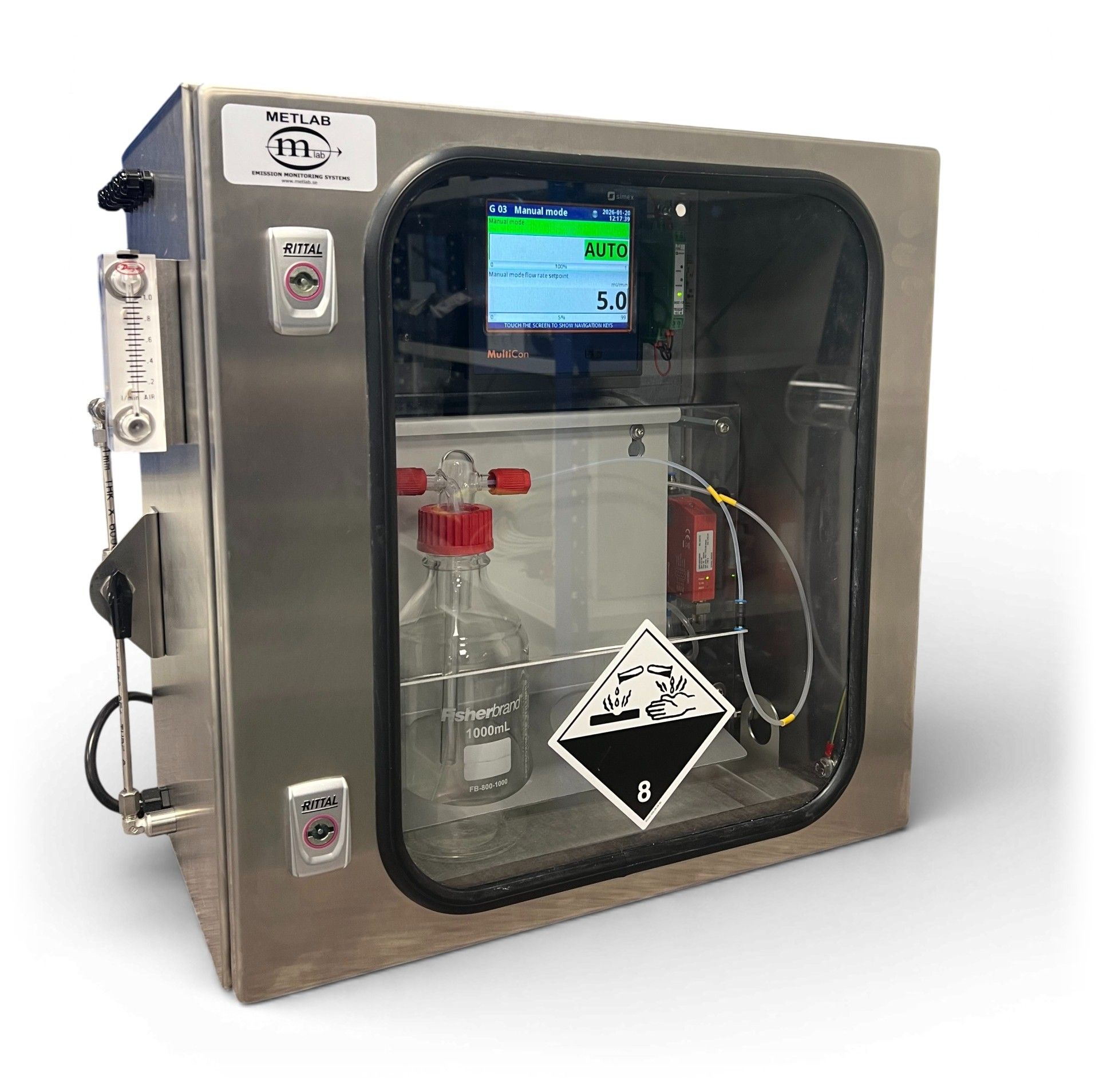
Why the C14G2
- Follows the flow. The sample flow is driven by the flow signal from the plant's CEMS, so the sample reflects the actual emissions even when operation varies. No separate pitot tube is needed, and there is no risk of clogging.
- Detects leaks straight away. A ZrO2 sensor measures O2 after the absorbent. If it deviates from the O2 in the stack, an air leak shows within hours, instead of weeks later when the laboratory report arrives.
- Liquid absorbent. Gives even contact between gas and liquid and avoids the channelling and uneven saturation that can occur in solid media.
- Remote control. Analogue input and output signals, remote start via a relay and all operating parameters available from the control room.
- Safe and simple. The bottles sit in locked holders in a stainless steel cabinet, changing the sample is simple and a 5.7-inch touchscreen keeps the training short.
How the sampling is done
Absorbent
4 M sodium hydroxide is prepared in a CO2-free laboratory environment and delivered in ready-filled bottles.
Installation
The bottle is fitted in the sampler. The flue gas is drawn through a heated probe and sample line to a gas conditioning unit that removes the moisture, and a pump with a bypass valve keeps a surplus flow of about 0.5 l/min.
Sampling
The C14G2 takes about 5 ml/min in proportion to the flue gas flow, normally over one month.
Collection
The used absorbent with the captured CO2 is collected and transported safely.
Analysis
The sample is split and analysed for carbon-14 by an accredited radiocarbon laboratory.
Report
The biogenic and fossil shares of the CO2 are calculated and reported together with an evaluation of the sampling.
Buy the sampler – or let us handle everything
Buy the C14G2 and run the sampling yourself. You get the equipment, instructions for preparing the absorbent, the sampling procedure with record sheets, and support with handling the data.
Full service: our technicians do the sampling for you. It covers absorbent prepared in a controlled laboratory environment, installation of the sampler on site, collection and handling of the samples, carbon-14 analysis by an accredited laboratory, evaluation of the sampling and a complete report. Read about the biogenic CO2 service.
Technical data
| C14G2 | Value |
|---|---|
| Dimensions (W × H × D) | 560 × 500 × 300 mm, without wall bracket |
| Weight | 17 kg |
| Operating temperature | 0 to +30 °C |
| Storage and transport | −20 to +50 °C |
| Relative humidity | 20–90 % |
| Altitude | −300 to 2,000 m |
| Power supply | 100–240 V, 50/60 Hz, 1 A. 2 m cable with earthed plug (CEE 7/4) |
| Gas connections | Swagelok 6 mm compression fittings |
| Input signals 4–20 mA | Stack O2 and flue gas flow |
| Output signals 4–20 mA | O2 for the leak check, and the sampling rate |
| Remote start | Relay |
| Mounting | Wall bracket, or rubber feet and carrying handle for portable use |
Frequently asked questions about the C14G2
What is biogenic CO2?
Carbon dioxide from biological material, for example wood, food waste and paper. The share is determined by measuring carbon-14: fossil carbon contains no carbon-14, biogenic carbon does.
How long is a sample period?
Normally one month. The sampler takes a continuous sample over the whole period, in proportion to the flue gas flow.
Can the sampler be connected to our CEMS?
Yes. The flow signal (4–20 mA) from the plant's CEMS drives the sampling. The sample gas can also be taken from the CEMS outlet if the gas is dry and unchanged, but then the sampling stops while the CEMS is being serviced or has a fault.
What is needed besides the sampler?
A heated probe and sample line, a gas conditioning unit that removes the moisture, and a pump with a bypass valve. The bypass valve is included.
Where can I read more about the C14G2?
At c14.metlab.se you will find installation diagrams, full specifications and customer references.