On this page
What the EU rules require
Delegated Regulation (EU) 2026/285 on the certification of permanent carbon removals has applied since 7 May 2026 and issues certificates only for the biogenic part of the carbon dioxide from co-firing, waste incineration and industries with partly biogenic fuels. The share is determined under Article 39 of the Monitoring and Reporting Regulation, (EU) 2018/2066, and uncertainty has a price: above ±2.5 per cent the certificates are reduced by as many per cent as the uncertainty, above ±20 per cent none are issued. Emissions trading counts from the other direction: a plant that sends carbon dioxide to storage may deduct only the fossil part (Article 49(6)), and a Commission proposal of July 2026 would bring waste incineration into the trading system from 2031.
The credit registries ask for the same measurement: Puro.earth requires carbon-14 to ISO 13833 or ASTM D6866 for carbon dioxide from waste with capture, Isometric requires continuous, flow-proportional sampling integrated over at most three months, and the large buyers' criteria require direct carbon-14 sampling at a sufficient frequency from several metering points.
- Method: carbon-14 in the flue gas to EN ISO 13833, or the balance method of ISO 18466 (Article 43(4)). The Commission's guidance calls carbon-14 the reference method.
- Frequency: one analysis for every 50,000 tonnes of carbon dioxide, and at least one a month (Annex VII). The removal certification uses the same frequency.
- Sampling point: a measurement section to EN 15259, before or after the capture according to Isometric. Plants outside emissions trading must admit the certification body for unannounced carbon-14 spot tests of the carbon dioxide leaving the plant.
- Uncertainty and verification: EN ISO 13833 states an expanded uncertainty of 5 per cent of the value for shares above 0.1. An accredited verifier or a recognised certification body goes through the monitoring plan, the sampling plan, the measurement section, the proportionality and the uncertainty budget.
At 400,000 tonnes of captured carbon dioxide a year, one percentage point of biogenic share is 4,000 tonnes of certified removals a year. A year of monthly laboratory analyses costs a few thousand euro.
Where to take the sample at a capture plant
No standard describes carbon-14 sampling of captured, compressed or liquefied carbon dioxide, and no published study has measured both sides of a capture plant. Amine absorption and desorption take carbon dioxide molecules regardless of carbon isotope, apart from small mass-dependent effects that the δ13C correction in the analysis removes, so at any instant the captured carbon dioxide has the same biogenic share as the flue gas it came from. Over a month the averages differ when the capture rate varies, because the captured share is the flue-gas share weighted by the captured flow.
So we sample the flue gas before the absorber, at a measurement section to EN 15259 where the carbon dioxide concentration is still 8–12 per cent, and control the sample in proportion to the flow of captured carbon dioxide from the plant's custody meter. After an absorber that takes 90 per cent, about 1 per cent carbon dioxide remains in the stack: enough for the laboratory, but ten times less sample.
The product stream itself, 95–99.9 per cent carbon dioxide, is the easiest spot sample there is, and the one the unannounced spot tests are aimed at. Sampling it continuously over a month is new ground: a tenth of the normal sample flow, low pressure after the stripper and saturation of the absorbent as the design limit. METLAB is validating such sampling; until it is documented we recommend the flue gas before the absorber, with spot samples of the product stream as the complement.
How often and how accurately
An integrated monthly sample in proportion to the flow meets the regulation's floor and Isometric's ceiling. Plants above about 600,000 tonnes of carbon dioxide a year need more than twelve analyses a year. Danish long-term measurements show why one integrates instead of taking grab samples: the monthly biogenic share at one plant moved between 58 and 77 per cent within a year.
The standard's 5 per cent of the value is ±2.5 percentage points at 50 per cent biogenic. Averaging twelve monthly samples shrinks the random part to about ±0.7 percentage points, but two terms do not shrink. The reference value for fully biogenic carbon falls by about 0.35 pMC a year and waste is a mixture of ages, so the choice of reference value should be documented. The flow is the other term: in the only published comparison of several plants, from 2026, carbon-14 and the balance method gave consistent shares, 53–64 per cent, while the fossil tonnes differed by several thousand tonnes a year because of the flow measurement. At a capture plant the custody meter takes over that role; in the stack, an accredited flow calibration is as much a part of the biogenic tonne as the isotope ratio.
How METLAB delivers the measurement
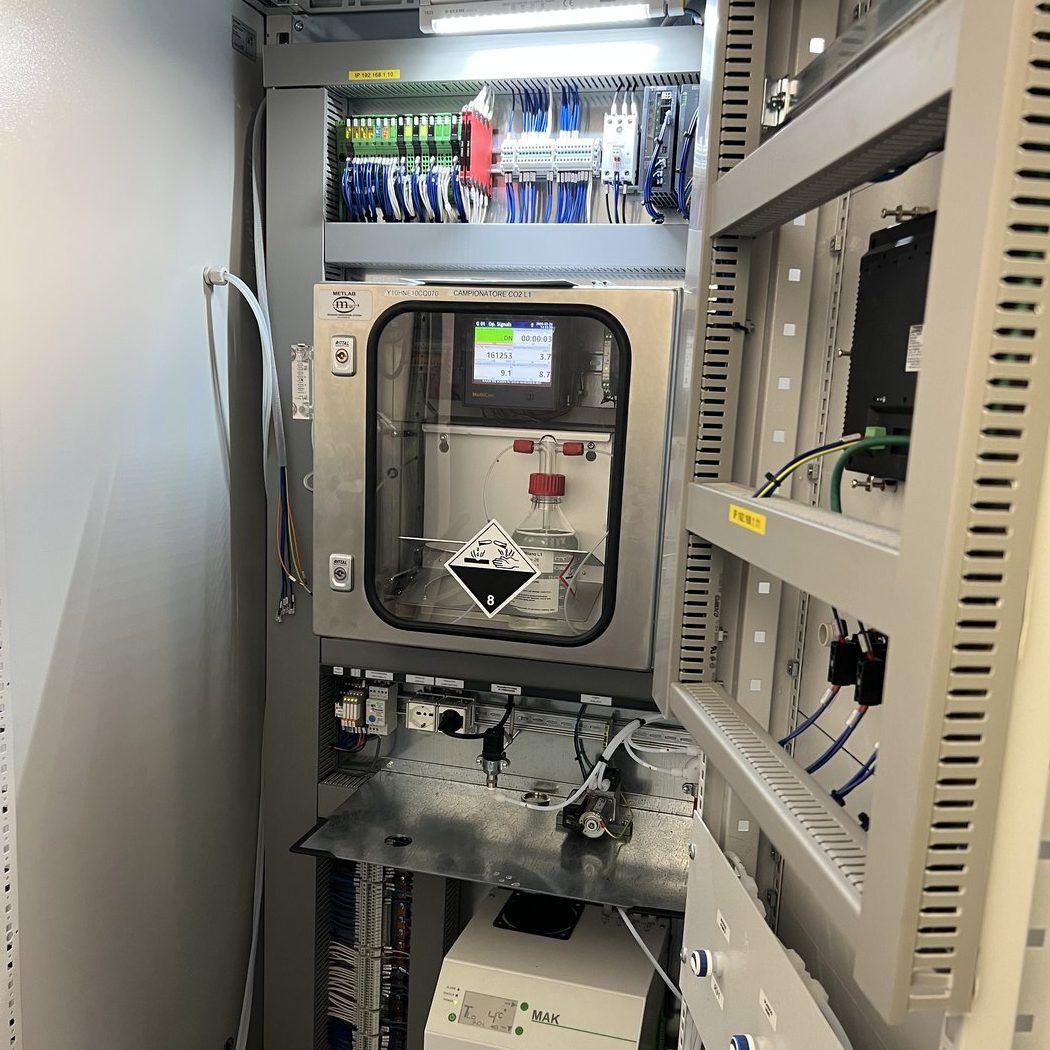
We have sampled biogenic carbon dioxide to EN ISO 13833 under accreditation since 2013 and build the C14G2 sampler ourselves. For a capture plant the work starts with the sampling plan for your verifier or certification body: the sampling point, the flow signal that controls the sample, the number of analyses a year and the uncertainty budget. The sampler then goes in, on a wall or inside an existing analyser cabinet, fed by a dedicated sample line or by the dry outlet gas of the plant's CEMS, and we commission it on site with a leak test, an oxygen check against the CEMS and training of your staff.
Plants with their own measurement staff buy the C14G2 and get the sampling procedure, record sheets and support. With the full service we handle everything except the bottle swap, a few minutes of your staff's time once a month: absorbent prepared carbonate-free in our laboratory, pre-labelled bottles in a transport case that travels both ways, carbon-14 analysis at an accredited laboratory and a report within five weeks of the end of the sampling month, with the shares and their uncertainty, the operating conditions and interruptions, the proportionality, the oxygen leak check and the laboratory's original report. Our sampling is accredited to ISO/IEC 17025 by Swedac, the Swedish accreditation body, and the sampler is in use at some of Europe's largest waste-to-energy plants.
Is the balance method enough?
The balance method of ISO 18466 allocates the boiler's total carbon dioxide from operating data, without sampling, but says nothing about the captured stream. The Commission's guidance treats it as an estimation method to be validated against carbon-14, which the 2026 comparison supports. At a capture plant it complements carbon-14.
The method and the sampler are on the biogenic CO2 overview, and the emissions-trading requirements in the article Emissions trading and biogenic CO2.