
On this page
Why the measurement site matters
- The result is representative. After a bend or a fan the gas swirls and stratifies. If we measure there, the sample shows something other than what leaves the stack. A straight run gives an even flow that can be measured.
- The measurement day goes faster. The right ports at the right height, room for the probe and power on the platform mean that we measure instead of improvising. That shows in the time on site and in the price.
- The result can be compared. EN 15259 is the standard every accredited laboratory measures to. A measurement site that meets it gives a result that is representative and can be compared with earlier years, with other plants and with the emission limit value.
Where on the duct?
The measurement plane must lie in a straight duct with the same cross-section all the way, as far as possible from anything that disturbs the flow. The standard's rule of thumb is five diameters upstream and two downstream.
| Question | What it should be | Clause in EN 15259 |
|---|---|---|
| Upstream of the measurement plane | At least 5 D of straight duct from the nearest bend, fan, damper or change of area | 6.2.1 b, note 4 |
| Downstream of the measurement plane | At least 2 D to the next disturbance, and at least 5 D to the top of the stack | 6.2.1 b, note 4 |
| Shape of the duct | Round or rectangular with the same cross-section through the whole measurement section. A vertical duct is preferable, especially for dust, metals and dioxins | 6.2.1 b and d |
| Flow in the plane | The gas may deviate at most 15° from the duct axis, no backflow, dynamic pressure above 5 Pa, and the fastest point at most three times the slowest | 6.2.1 c |
| Labelling | A sign at the measurement section with the source, position and direction of flow | 6.2.1 f |
D is the hydraulic diameter: four times the duct area divided by its perimeter, which for a round duct is the diameter. It is possible to measure with shorter straight runs too, and we check the flow on site; the risk is that the result may not be fully representative.
The sampling ports: three options
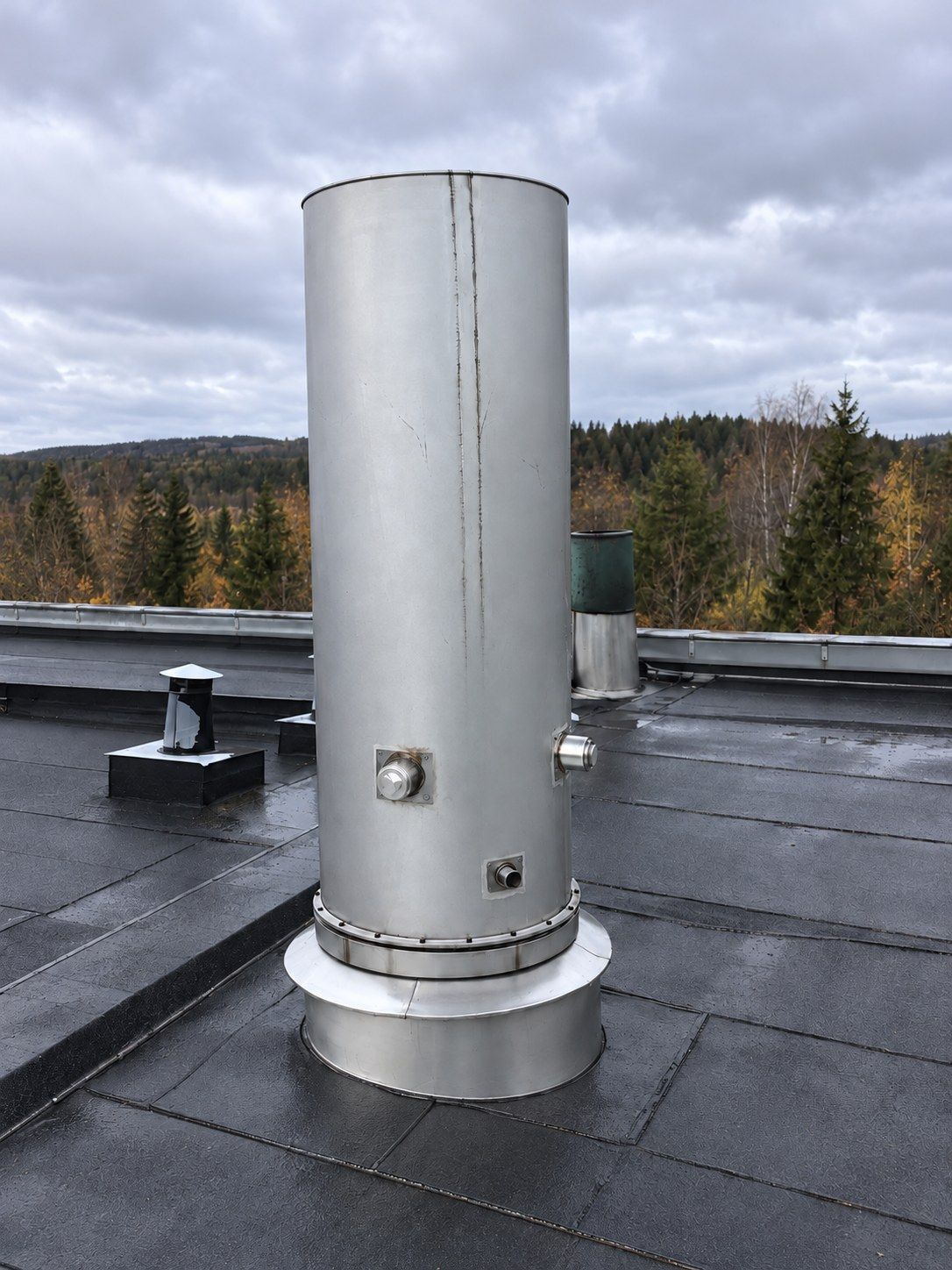
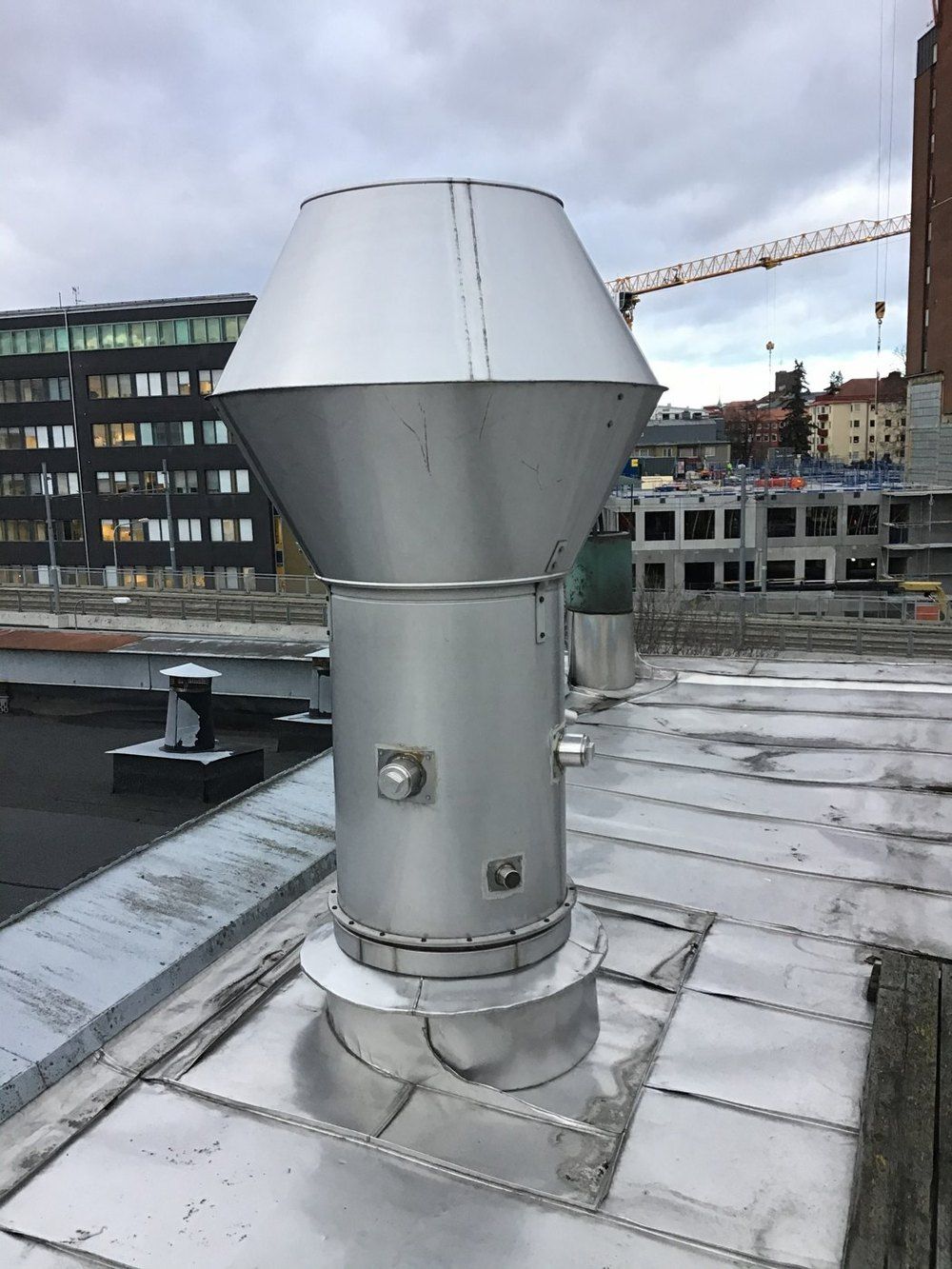
- 1 × 3". One port. The simplest and quickest to fit, and enough for gas analysis and for ducts under 0.35 m in diameter.
- 2 × 3" at 90°. Two ports at the same height, 90° apart. This is what the standards assume for particle sampling in round ducts from 0.35 m: two measurement lines across the duct.
- 2 × 3" + 1¼". As above, plus a 1¼" port for a permanently installed flow meter: 45° between the large ports and 1 D upstream, so that the flow meter does not disturb the sampling.
- Size of the socket. A 3" socket (75 mm) is the standard's own Figure A.4 and is enough for our probes. For ducts above 0.7 m the standard recommends 125 mm as an alternative; tell us if you are planning large measurement programmes.
How the port is fitted
3" socket with internal thread
A stainless steel socket welded on the outside of the duct, for example Ahlsell 1457500. On an insulated duct the socket must reach out through the insulation and the cladding.
A hole as large as the socket's opening
Nothing may protrude into the duct: neither the edge of the socket nor weld residue. The probe must go straight in and out.
3" plug with a greased thread
A brass plug, for example Ahlsell 8070097. Grease the thread so that it can be opened after a year. The plug is rated for 185 °C; on hot ducts a stainless steel plug is chosen.
Rectangular ducts and large ducts
On a rectangular duct the ports sit on the longer side. If it is more than two metres to the opposite wall, ports are fitted on both sides so that the probe reaches all the points.
How many measurement points?
Dust and other particle-bound parameters are sampled according to the standards in a grid of points over the duct's cross-section, and the gas velocity is measured at the same points. The number decides how many ports are needed and how long the measurement day will be.
| Round duct | Measurement lines | Measurement points |
|---|---|---|
| Under 0.35 m in diameter (under 0.1 m2) | – | 1 point, one port is enough |
| 0.35–1.1 m (0.1–1 m2) | 2 | 4 |
| 1.1–1.6 m (1–2 m2) | 2 | 8 |
| Over 1.6 m (over 2 m2) | 2 | At least 12 and 4 per m2; 20 is normally enough |
EN 15259 Table 2. Rectangular ducts are divided into squares instead: 4 points up to 1 m2, 9 up to 2 m2, then at least 12 and 4 per m2 (Table 3). Instrumental gas analysis needs no grid, only a representative point.
Platform, space and power
We come as two people with 50–300 kg of equipment, and the probes are as long as the duct is wide. The platform must carry that and leave room to pull the probe out straight.
| What | What it should be |
|---|---|
| Working height | 1.2–1.5 m from the platform floor up to the ports |
| Clear depth in front of the port | The duct's internal diameter plus the wall plus 1.5 m, with no railings or beams in the way. With ports on both sides, half is enough |
| Area | About 4 m2 for a simple measurement in a small duct. A full measurement programme, as at waste incineration, needs around 18 m2: 6 m2 at the ports and 12 m2 for instruments |
| Load capacity | Two to six people and up to 300 kg of equipment. A temporary platform must be anchored |
| Power | 230 V/16 A near the ports. For large measurement programmes a 16 A/400 V outlet, and cooling water for dioxin sampling |
| Access | Stairs or a lift to the platform, and a hoist for the equipment when that is not possible. Weather protection on outdoor platforms |
EN 15259 clauses 6.2.3 and 6.3 and the Swedish guidance SIL 2014:03. The standard does not cover the construction of the platform or personal safety; those are governed by the Swedish work environment (health and safety) regulations.
Before the measurement day
The standard leaves some preparations to the plant: run the load and the fuel that the measurement is to cover, open the plugs in advance so that they come off easily, remove deposits in and around the ports, and tell us about operating disturbances that could affect safety on the platform. Also tell us if anything has changed since the last measurement, for example a new damper or a moved fan.
Ask us before you build
It is cheaper to weld the sockets in the right place from the start than to move them. Send a sketch or a photo of the duct with dimensions, bends and fans, and we will reply with where the ports should go and how large the platform needs to be. The sheet with the three options is available as a PDF (in Swedish) to send to whoever is building. Write to us – we reply within two working days.
Frequently asked questions about measurement sites
Is one port enough?
Often, yes. For gas analysis one port is always enough, and for round ducts under 0.35 m in diameter also for particles. Put simply, the standards for particle sampling in larger round ducts assume two ports at 90°, so that the sample can be taken along two lines. It is fine to measure through one port anyway, with the risk that the result may not be fully representative. How representative it is depends above all on the straight runs upstream and downstream of the port.
We only have three diameters of straight duct. Can you measure?
Yes, it is possible to measure. Five and two diameters are the standard's recommendation; the requirement concerns the flow in the measurement plane, and we check that on site. With a shorter straight run there is a risk that the result may not be fully representative.
Can the ports be on a horizontal duct?
Yes, but a vertical duct is preferable for dust, metals and dioxins, since heavy particles can settle in a horizontal duct. On a horizontal duct the ports are placed on the side and on top, so that the lines are vertical and horizontal.
Do we have to build a permanent platform?
If the plant is measured every year, a permanent platform pays off. A boom lift or scaffolding also works, but the scaffolding must be anchored and the lift makes the measurement day longer. The measurement standard says nothing about the safety of the platform; that is governed by the health and safety regulations.
Where do we buy the socket and the plug?
A stainless steel 3" socket with internal thread (Ahlsell 1457500) and a 3" brass plug (Ahlsell 8070097) are stocked by wholesalers. The brass plug is rated for 185 °C; on hotter ducts a stainless steel plug is chosen. For the small flow port a 1¼" socket and plug are used.